• TalkBass has been independent since 1998. Add your voice.
    Create a free account to reply to discussions, view embedded media, and browse with fewer display ads.
    Join freeLog in
    Want zero display ads or expanded classifieds tools? Compare plans.

Double Bass Unusual scroll(s)

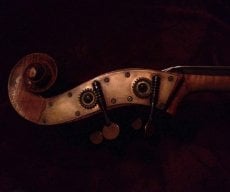
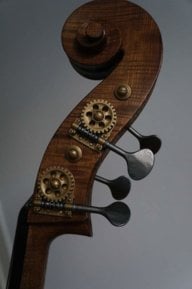
Here is the 2009, before and after color:
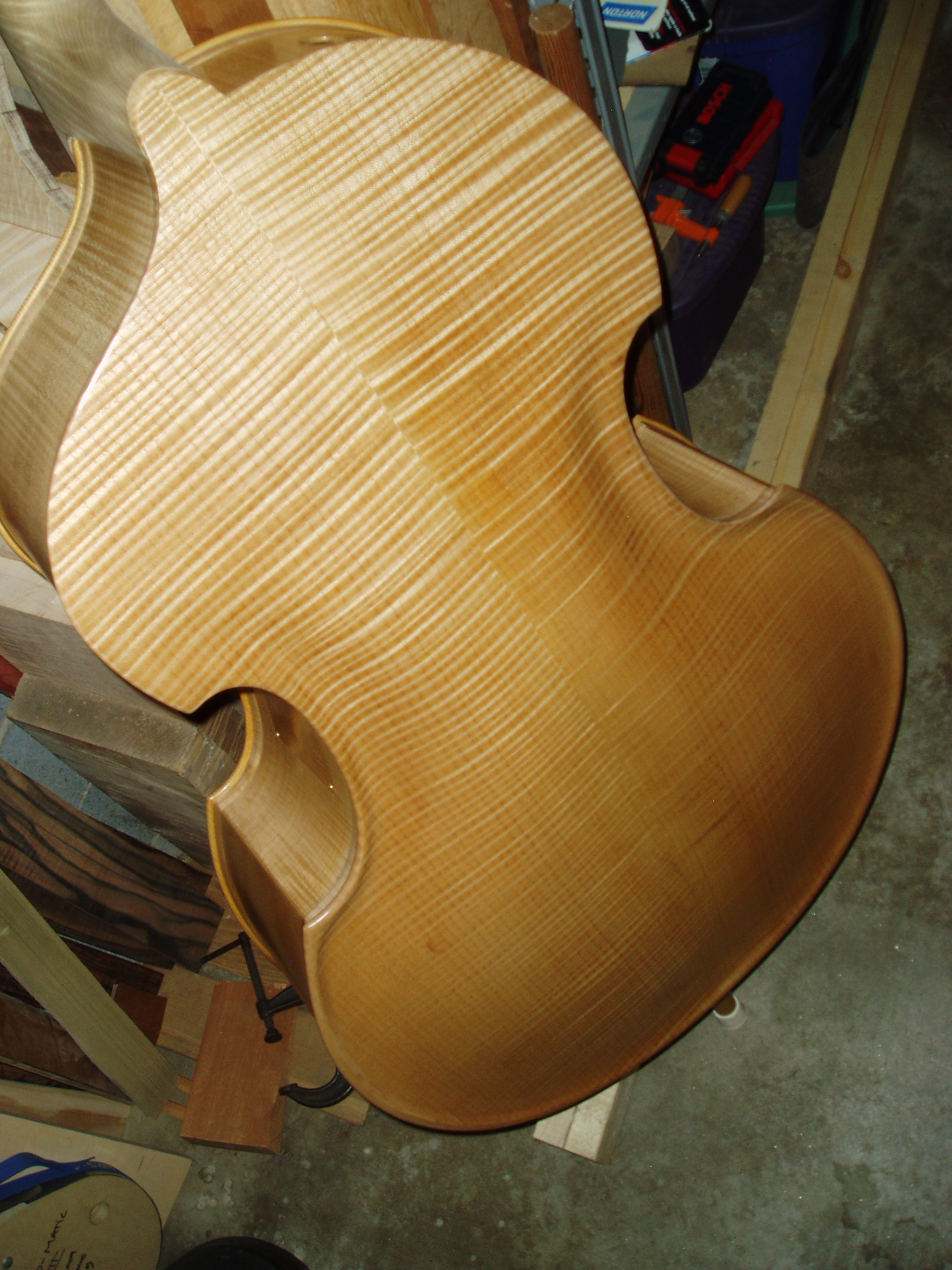
b15.JPG


condino bass 2009.jpg


bass 100 crop.jpg


It is currently available for trade. Everyone in the country is dirt broke, so trades are a lot more fun and open up the possibilities more.
 
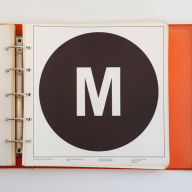
KUNGfuSHERIFF may have ID'd this "bullseye" scroll as belonging to a '37 Kay.

'37 K-Meyer is correct, and within the first couple weeks of production (numbers under 200). The factory only made maybe 35 of these before the bullseye scroll went away, and it looks like an attempt at cost-saving for the low-end marque. We know of six confirmed survivors with this feature, and a few of them seem to have been built with a joined pegbox, as you see in the photo. Kay was testing the bullseye as a logo for K-Meyer; it lasted longer as a little machined-in decoration on the scroll tail, but only by a couple of weeks. The marque was discontinued entirely in '40, in favor of Kraftsman.

Another distinctive feature of this group is that most have no serial numbers at all, and the exceptions have hand-lettered labels. The luthiers were clearly still working things out.
 
'37 K-Meyer is correct, and within the first couple weeks of production (numbers under 200). The factory only made maybe 35 of these before the bullseye scroll went away, and it looks like an attempt at cost-saving for the low-end marque. We know of six confirmed survivors with this feature, and a few of them seem to have been built with a joined pegbox, as you see in the photo. Kay was testing the bullseye as a logo for K-Meyer; it lasted longer as a little machined-in decoration on the scroll tail, but only by a couple of weeks. The marque was discontinued entirely in '40, in favor of Kraftsman.

Another distinctive feature of this group is that most have no serial numbers at all, and the exceptions have hand-lettered labels. The luthiers were clearly still working things out.

It’s a shame the bullseye didn’t survive — it’s quite handsome.
 
Quoted from Warwick's website:
The story of Warwick and Framus began on 1st January 1946 when the "Fränkische Musikinstrumentenerzeugung Fred Wilfer KG" was founded in Erlangen/Bavaria.

FRAMUS was one of the most important manufacturers of electric guitars in Europe between 1946 and the end of the 1970s. The company was created by Fred Wilfer, the father of Hans-Peter Wilfer, who would create Warwick some years later...

[snip]

After the company's bankruptcy at the end of the 1970s, Framus was vanished into thin air. But Hans-Peter Wilfer, who spent his childhood in the company of his father, soon founded his own company. When he was 24 years old he founded Warwick on 13th September 1982 in Pretzfeld/Bavaria.

The company has grown continuously and so they moved the production to Markneukirchen in Saxony - where they also revived FRAMUS.
 
  • Like
Reactions: james condino
I was speaking with a maker in Denver, and he said some of the best sounding basses he had ever heard were built by another Denver area builder, and they had very unconventional - essentially no - scrolls. He said the guy had no web presence or anything.

Wondering if any of you had encountered such basses and, if so, if you had pics to share. (Yeah, I probably should just contact the guy I talked to, but I'm hesitant to waste his time, especially since I'm not interested in trying/buying one.)

This is probably what you're referring to. Mark Dresser's Kent McLagan bass. Great sounding.
1-Trio-M.jpeg
 
Last edited:
Which one? If my post just previous to yours, it's an early 1930's Alcoa (aluminum) double bass.

I had OP's plank scroll in mind. Reminds me of Day of the Triffids somehow, don't know why. But yours aluminium bass is also a wonder of early science fiction to me. I would very much like to play such a bass, but haven't met any in Europe so far. Perhaps on Mars these are more common ;-)