• TalkBass has been independent since 1998. Add your voice.
    Create a free account to reply to discussions, view embedded media, and browse with fewer display ads.
    Join freeLog in
    Want zero display ads or expanded classifieds tools? Compare plans.

Update On the Trace Eliott ELF That I Blew Up.

Yep. Nobody with an amp needs an Elf unless they broke both legs and their picking arm is in plaster. But still, gas, laziness, convenience, curiosity makes them sell like hotcakes.
I think for some, the convenience factor is high. You could basically mount an elf as the last thing on a pedal board and essentially carry a bass, your board, and a cab for a rig you could move in one trip
 
New questions for the OP, based on this. ^

Did the fuse blow the first time he plugged to amp in to 220?
If yes, did he replace it with the same fuse or a larger one?

Just occurred to me... the amp should be fused differently for operation at 220 Volts than at 110.
Usually the fuse for 110 would have a higher rating, maybe double, right?
Then if he had an amp intended for operation at 110 and plugged it into 220, the fuse might not have blown because it was one that could handle twice the current. Does that make any sense?


I was wondering also if it had been fused, I never changed the fuse in mine though and luckily it popped, I assume I should put in a fuse with half the amperage when doubling the voltage which I actually never thought of?

@beans-on-toast
 
I was wondering also if it had been fused, I never changed the fuse in mine though and luckily it popped, I assume I should put in a fuse with half the amperage when doubling the voltage which I actually never thought of?

@beans-on-toast
Best thing is to see what the manual says for sizing fuses.
Otherwise contact the manufacturer.
I wouldn't want to guess. And you definitely don't want me guessing.
 
Fuse size is based on safety, has nothing to do with protecting the amp. See my previous posts,

A fuse won't likely protect against this kind of fault because the power supply topology doesn't lend itself to this. The line frequency bulk supply has a very low input impedance so the initial over voltage damage occurs very quickly.
 
Fuse size is based on safety, has nothing to do with protecting the amp. See my previous posts,

A fuse won't likely protect against this kind of fault because the power supply topology doesn't lend itself to this. The line frequency bulk supply has a very low input impedance so the initial over voltage damage occurs very quickly.

When voltage is doubled amperage is cut in half right? The question had to do with someone plugging his 110V amp into a 220V circuit and the amp blew up. I stupidly did this twice years ago and the only thing that happened was my fuse blew twice. My question is if I convert my 110V amp which has a 10 amp fuse to 220V (has a dual range transformer) should i put a 5 amp fuse in instead?
 
When voltage is doubled amperage is cut in half right? The question had to do with someone plugging his 110V amp into a 220V circuit and the amp blew up. I stupidly did this twice years ago and the only thing that happened was my fuse blew twice. My question is if I convert my 110V amp which has a 10 amp fuse to 220V (has a dual range transformer) should i put a 5 amp fuse in instead?
No! Do what the manufacturer says to do.
 
No! Do what the manufacturer says to do.

Cutting the fuse amperage in half will not hurt the amp if it's wrong, it will just blow the fuse when the standby switch is thrown from the initial surge, I did go to school for this many years ago and know that as AC voltage goes up the amperage goes proportionally down which is why high voltage lines exist, less of the current is wasted as heat. Less current, less heat.
 
Fuse size is based on safety, has nothing to do with protecting the amp. See my previous posts,

A fuse won't likely protect against this kind of fault because the power supply topology doesn't lend itself to this. The line frequency bulk supply has a very low input impedance so the initial over voltage damage occurs very quickly.
But fusing correctly is still a thing right?

My old school thinking is that if you blow a fuse and keep putting in larger fuses until they don't blow anymore, then the thing that caused the fuse to blow in the first place is gonna take it out on something else.

We hadn't really discussed if the OP had blown a fuse and replaced it, and what he replaced it with.
Did his amp blow on the first instance of plugging it in to 220, or did we miss a part of the story where he may have kept upping the fuse rating until eventually exceeding the smoke retention capacity of some component.
 
My old school thinking is that if you blow a fuse and keep putting in larger fuses until they don't blow anymore, then the thing that caused the fuse blew in the first place is gonna take it out on something else.
Precisely correct...eventually you get an expensive amp or amplifier component protecting a 15 cent fuse.
 
Cutting the fuse amperage in half will not hurt the amp if it's wrong, it will just blow the fuse when the standby switch is thrown from the initial surge, I did go to school for this many years ago and know that as AC voltage goes up the amperage goes proportionally down which is why high voltage lines exist, less of the current is wasted as heat. Less current, less heat.
I am not arguing the electronics of it. I am simply advising that the best course of action is to use the proper fusing for the voltage in question, as per the manufacturer.
 
  • Like
Reactions: Al Kraft
I am not arguing the electronics of it. I am simply advising that the best course of action is to use the proper fusing for the voltage in question, as per the manufacturer.

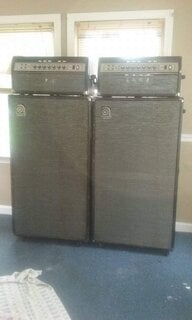
Well my amp here is a 1976 SVT and I long ago lost the original documentation. I have converted them before from 220 to 110 but never changed the fuse but you never know. I don't want to have an overrated fuse in it if something does short out. I would never do a drastic change without checking with someone first but halving the amperage of a fuse would only hurt the fuse not the amp. This kind of info is not readily available usually even in the documentation. I think it's electronics 101 but just in case, I want to check with someone who knows what they're doing.
 
I am not arguing the electronics of it. I am simply advising that the best course of action is to use the proper fusing for the voltage in question, as per the manufacturer.
I would assume that in most cases installing a weaker component in the sacrificial link position would be safer (to the unit) than installing a strong component, but OGB's advice to follow the recommendations of the designer/manufacturer is the the most prudent IME.

If I were on a gig, was sure why a fuse blew, and only had higher and lower rated fuses of the same type (e,g, fast blow, slow blow, etc.) to choose from, I would probably take a chance on the lower rated fuse to save the show. That would, however, not be my permanent fix.
 
I would assume that in most cases installing a weaker component in the sacrificial link position would be safer (to the unit) than installing a strong component, but OGB's advice to follow the recommendations of the designer/manufacturer is the the most prudent IME.

If I were on a gig, was sure why a fuse blew, and only had higher and lower rated fuses of the same type (e,g, fast blow, slow blow, etc.) to choose from, I would probably take a chance on the lower rated fuse to save the show. That would, however, not be my permanent fix.

Yeah, thanks, I'm not going to convert it now anyway.
 
  • Like
Reactions: Al Kraft
When voltage is doubled amperage is cut in half right? The question had to do with someone plugging his 110V amp into a 220V circuit and the amp blew up. I stupidly did this twice years ago and the only thing that happened was my fuse blew twice. My question is if I convert my 110V amp which has a 10 amp fuse to 220V (has a dual range transformer) should i put a 5 amp fuse in instead?

It depends very much on the type of power supply (the ELF has an SMPS type, capacitor input supply, yours has an EI line frequency transformer (inductor) input supply. The characteristics and impedances are very different, so while this rule of thumb generally works on line frequency supplies, it's not a universal truth and depends very much of how the supply is rated and treated by the safety agencies. Follow what the manufacturer specifies, which in this case MAY involve replacing 2 (or 4) fuses on some versions/models. Going from memory, some may have had a separate filament transformer that was fused differently, some may have had one time primary protection inside the filament transformer, and some models had external fuses with an internal back-up (of a higher value).

Cutting the fuse amperage in half will not hurt the amp if it's wrong, it will just blow the fuse when the standby switch is thrown from the initial surge, I did go to school for this many years ago and know that as AC voltage goes up the amperage goes proportionally down which is why high voltage lines exist, less of the current is wasted as heat. Less current, less heat.

Probably, but in the case of some supply types that use complex timing (mostly SMPS) for the starting and stopping of various housekeeping functions within the supply, this could jeopardize parts of the supply and/or the attached circuitry if the failure occurred at a bad time within the start-up process. Fuses in such applications are to protect against fire and life safety, and will not fail under any rated operating conditions. This is why they are set higher than the casual seat of the pants calculations might suggest. There is often additional back-up protection built into the transformer or other parts.

But fusing correctly is still a thing right?

My old school thinking is that if you blow a fuse and keep putting in larger fuses until they don't blow anymore, then the thing that caused the fuse to blow in the first place is gonna take it out on something else.

We hadn't really discussed if the OP had blown a fuse and replaced it, and what he replaced it with.
Did his amp blow on the first instance of plugging it in to 220, or did we miss a part of the story where he may have kept upping the fuse rating until eventually exceeding the smoke retention capacity of some component.

It doesn't matter in his case because the typical chain of events is that the over-voltage damages parts such as the ICL, bridge rectifier (could be simple diodes or it could be a synchronous rectifier), filter caps, SMPS bridge switches, stand-by or initialization "bump" supply, then as the damage progressed and the current increased more damage occurred until the current reached the fuse clearing point and the fuse opens. By this time, the damage is plenty messy.

Well my amp here is a 1976 SVT and I long ago lost the original documentation. I have converted them before from 220 to 110 but never changed the fuse but you never know. I don't want to have an overrated fuse in it if something does short out. I would never do a drastic change without checking with someone first but halving the amperage of a fuse would only hurt the fuse not the amp. This kind of info is not readily available usually even in the documentation. I think it's electronics 101 but just in case, I want to check with someone who knows what they're doing.

Call the manufacturer, though they may refer you to an authorized service center (that's what I would probably do) because there are many versions, some likely with internal primary thermal cutouts, some without. When a product has a long run, they typically evolve as the safety standards evolve.
 
Yep. Nobody with an amp needs an Elf unless they broke both legs and their picking arm is in plaster. But still, gas, laziness, convenience, curiosity makes them sell like hotcakes.
I thought about getting one just as a backup head, in case my B|Amp ever goes kaplooey during a gig. But that’s the only reason why I’d want one.
 
  • Like
Reactions: Artman
I think for some, the convenience factor is high. You could basically mount an elf as the last thing on a pedal board and essentially carry a bass, your board, and a cab for a rig you could move in one trip

This is a great idea.

What would be nice is an amp about the size of an Elf with the 4 band EQ of the Subway DI with knobs facing up and 500+ watts . A decent DI built in and just run a speakon to your favorite cab. Why your not seeing more of thisvthese days is baffling to me. The amps are small enough to live on a pedal boatd but the controls need to face up .
 
It depends very much on the type of power supply (the ELF has an SMPS type, capacitor input supply, yours has an EI line frequency transformer (inductor) input supply. The characteristics and impedances are very different, so while this rule of thumb generally works on line frequency supplies, it's not a universal truth and depends very much of how the supply is rated and treated by the safety agencies. Follow what the manufacturer specifies, which in this case MAY involve replacing 2 (or 4) fuses on some versions/models. Going from memory, some may have had a separate filament transformer that was fused differently, some may have had one time primary protection inside the filament transformer, and some models had external fuses with an internal back-up (of a higher value).


Probably, but in the case of some supply types that use complex timing (mostly SMPS) for the starting and stopping of various housekeeping functions within the supply, this could jeopardize parts of the supply and/or the attached circuitry if the failure occurred at a bad time within the start-up process. Fuses in such applications are to protect against fire and life safety, and will not fail under any rated operating conditions. This is why they are set higher than the casual seat of the pants calculations might suggest. There is often additional back-up protection built into the transformer or other parts.


It doesn't matter in his case because the typical chain of events is that the over-voltage damages parts such as the ICL, bridge rectifier (could be simple diodes or it could be a synchronous rectifier), filter caps, SMPS bridge switches, stand-by or initialization "bump" supply, then as the damage progressed and the current increased more damage occurred until the current reached the fuse clearing point and the fuse opens. By this time, the damage is plenty messy.


Call the manufacturer, though they may refer you to an authorized service center (that's what I would probably do) because there are many versions, some likely with internal primary thermal cutouts, some without. When a product has a long run, they typically evolve as the safety standards evolve.

Whoa! I guess we're not in Kansas anymore.