• TalkBass has been independent since 1998. Add your voice.
    Create a free account to reply to discussions, view embedded media, and browse with fewer display ads.
    Join freeLog in
    Want zero display ads or expanded classifieds tools? Compare plans.

Double Bass Upgrading Tuning Machines...

Status
Not open for further replies.
Just curious, how much would it cost for new tuning machines? I probably won't follow through on it... but my machines seem cheaply made at times and wiggle when i'm trying to tune them... i'm considering getting nicer metal machines or maybe the ebony hats by upton... but this is just a little fixation of mine that will probably pass by tonight.

--edit--
new rubner's are 110 ish on upton and the ebony hatpegs are 260... but how much is installation?


please keep in mind that this folly will pass soon once i finish my Science and Society homework that i'm procrastinating on
 
I've had the same kind of thoughts, but mine are more in terms of looks as the tuning machines work just fine. These thoughts always pass quickly, and I return to my thoughts of toasted whole wheat bagels with scallion cream cheese...

You could always have a luthier (I recommend Bill Merchant) take a look at them and see if there's anything that can be done to improve the way they're working (or not working). If nothing can be done to help them, then yes, switch them up. The luthier may even have an old set or two of tuning machines laying around that could be offered to you. Anyway, these are just my 2 cents.
 
i'm considering getting nicer metal machines or maybe the ebony hats by upton... but this is just a little fixation of mine that will probably pass by tonight.

--edit--
new rubner's are 110 ish on upton and the ebony hatpegs are 260... but how much is installation?

Ask Upton. I'm sure they'll tell you. ;)
 
Bill Merchant is my luthier of choice too ha. It is also for looks... but it comes and goes quickly. it's happened before. i'm obsessed with hatpegs... is all

Bill is the man. I tend to forget about what my tuning machines look like while I play because I'm usually not paying all that much attention to them. Maybe they feel neglected though, and will start detuning on their own in the middle of the next set I do.
 
Rubner and other hat peg gears do not fine tune. Between the large ebony/wood post and the smaller less fine worm/gear ratio they make it difficult to fine tune a Bass.

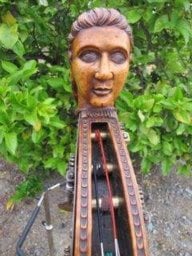
The only time I see them on pro Orchestra Basses is when they are very old and original. I have seen a 200 year old Ceruti with old Italian hatpegs and Hal Robinson has some old ones on his Gargoyle head Italian Bass which look old Tyrolean, as old as the replaced head is.

Other than those examples, pros that care about tuning usually get something higher grade when upgrading than commercial Rubners like Sloans or Krutz or Baker copies. These go for around $500. a set wholesate/retail (whatever) in the bag un-installed. There are other gears out there that cost less as well but performance is the goal here.

Rubners are what you see on new factory made basses from Romania, Germany and China. I once put a set of Rubner hatpegs on my Batchelder (1875 Yankee) only because the hatpegs on the Bass were failing. I was too lazy to plug and re-bush for higher grade Brass type tuners like the Krutz which I put on several of my Basses. My Martini (1919 Italian) came over from Italy with Rubner hatpegs and poorly bushed in the process. I re-did the entire job and put Krutz gears on it. Even though the Batchelder is an old handmade Bass the Martini is much more expensive and well worth the extra labor in my mind. If I had it over to do again, I would put something like the Krutz gears in the Batchelder.

Labor is labor so if you change tuners, get some that work well. Rubners are ok as I have them on some new Romanian Basses but for upgrading, they are not on my menu.

To save money on labor, get gears that fit in the existing holes no matter what the brand.
 
Rubner and other hat peg gears do not fine tune. Between the large ebony/wood post and the smaller less fine worm/gear ratio they make it difficult to fine tune a Bass.

The only time I see them on pro Orchestra Basses is when they are very old and original. I have seen a 200 year old Ceruti with old Italian hatpegs and Hal Robinson has some old ones on his Gargoyle head Italian Bass which look old Tyrolean, as old as the replaced head is.

Other than those examples, pros that care about tuning usually get something higher grade when upgrading than commercial Rubners like Sloans or Krutz or Baker copies. These go for around $500. a set wholesate/retail (whatever) in the bag un-installed. There are other gears out there that cost less as well but performance is the goal here.

Rubners are what you see on new factory made basses from Romania, Germany and China. I once put a set of Rubner hatpegs on my Batchelder (1875 Yankee) only because the hatpegs on the Bass were failing. I was too lazy to plug and re-bush for higher grade Brass type tuners like the Krutz which I put on several of my Basses. My Martini (1919 Italian) came over from Italy with Rubner hatpegs and poorly bushed in the process. I re-did the entire job and put Krutz gears on it. Even though the Batchelder is an old handmade Bass the Martini is much more expensive and well worth the extra labor in my mind. If I had it over to do again, I would put something like the Krutz gears in the Batchelder.

Labor is labor so if you change tuners, get some that work well. Rubners are ok as I have them on some new Romanian Basses but for upgrading, they are not on my menu.

To save money on labor, get gears that fit in the existing holes no matter what the brand.

Thanks Ken.

I don't have that nice of a bass. It's a Xuechang Sun 401 and it's only a couple years old, but I love it. I've gotten compliments on my sound from all my teachers including David Wong who has a really nice looking bass and Roger Shew who has a nice Pollman. I'm just kind of curious to see how it'd look with some hatpegs... but i'm just crazy.

I still have to get a working french bow... so i guess the tuners can wait.
 
Hey, you should have checked out my bass when you fell by Friday, the tuners on there are Gagnon's but Jeff tweaked'em. They're not as high a ratio as his own tuners, but pretty smooth.
 
I just got a bass from Upton (three days ago) with the "full plate" Rubner hat pegs. It was a bass ordered by someone else, it sounded okay, so I took it as is. This is my first experience with the ebony pegs. I do not recommend them, based on three days' experience (sic).

So far, I agree with Ken Smith's post. The wood pegs don't move, and then, suddenly, they do, with a bit less control than the metal tuners I've used before. I will try some powdered graphite in the holes next time I change strings, to reduce the wood-to-wood friction.

Its not that I can't tune the bass, but it definitely feels less accurate, fine, and controlled than with good metal machines. They also creak a bit, which could stink in an orchestral or studio setting if you were tuning on the fly.

When I bought the bass at Upton, they told me that the tuner choice was purely aesthetic - that they didn't affect function. My experience to date has been different. Tuning with the wood pegs is definitely less controlled. They look groovy, but add a variable that I would rather do without.

Oh well...
 
The tuners on my two Xuechang Sun basses are similar or identical to the standard halfplate tuners that Eastman uses. They are alright on basses in this price range. Rubner tuners of any type would be a step up from these Chinese halfplate tuners and remain price appropriate for a bass of this kind. The Rubner tuners represent a consistently good quality standard compared to the range of other Chinese tuners that I've had experience with. I certainly prefer all of the Rubner models as compared with the tuners that Kolstein likes to put on their basses (Gagnon?). Barry Kolstein couldn't believe that I preferred Rubner hatpegs instead of his huge brass tuners that tended to be a little eccentric in their gear cut and sometimes a little rough. I regularly have to quickly tune up 8-10 basses at a time in my shop just before a customer arrives to look at instruments in a certain price or functional range. I've never experienced any difference in tuning performance of the hatpeg Rubner tuners compared to their brass shaft sisters when the tuners are properly installed on the bass and the strings are properly installed on the tuners.

Ken, you have a collection of really fine top quality basses worth in the tens to over one hundred thousand dollars apiece. It is price appropriate to do full-bore restorations and repairs to these great old instruments and to require for yourself an extra bit of performance for tuning machines when playing in high level professional orchestras. The inherent danger in this perspective, though, is that you tend to dismiss out of hand almost anything that is not in the highest ranges of performance and cost. I maintain that for a $3-4,000.00 student bass, the Rubner tuners will give Kevin significantly better performance over the comparatively rougher gear cutting found on his stock tuners found on his high quality student Chinese bass.
 
Status
Not open for further replies.