• TalkBass has been independent since 1998. Add your voice.
    Create a free account to reply to discussions, view embedded media, and browse with fewer display ads.
    Join freeLog in
    Want zero display ads or expanded classifieds tools? Compare plans.

Double Bass Upright Bass Stand for Stage

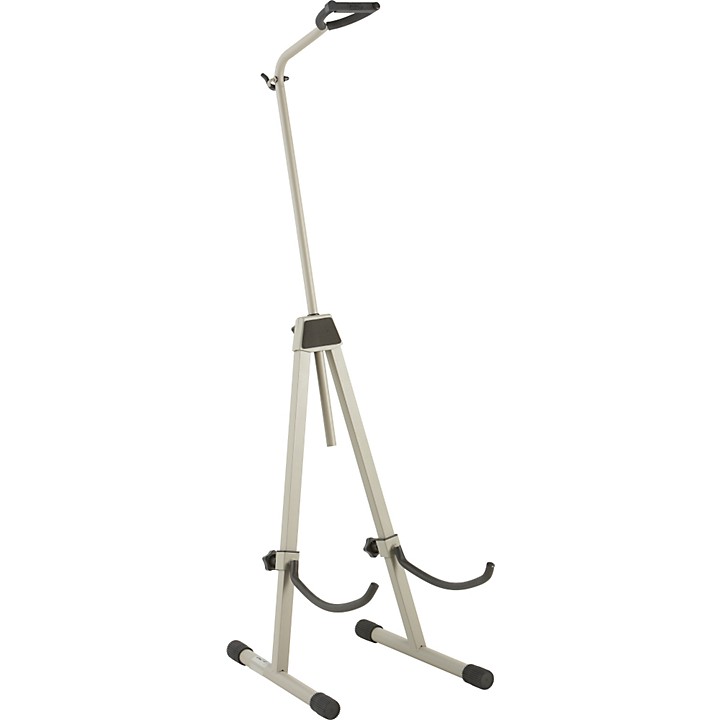
I use this Hercules stand at home
Double Bass
but I can see how the bass bar would be better on stage. If my end pin was any further out I’d have to put it in to use the Hercules.
I use the Hercules as well, and it's as stable as I'd ever want it to be. If someone on stage was able to knock over a DB in that stand, you have a whole host of other problems. (Like drunk hooligans or just plain stupid bandmates)

You raise a good point though, and it is the only drawback I can see to this stand: It doesn't allow the end pin to be all the way out. I'm not so tall, so I can get away with it. But anyone that really jacks up the pin might need to readjust it every time they take the bass out of the stand, which I imagine can become a PITA fast.
 
  • Like
Reactions: reeljerc
I once ordered the old and current K & M DB stands and the Hercules and tried to give the bass an impact like a careless person passing by.
The Hercules wins, but needs a lot of space additionally. I kept it and sent the K & M stands back.
The Ingles was out of question, I didn‘t trust the lower arms, the feet area seems to be too small
Later I got the old K & M with the cup used and kept it when there is not enough room for the Hercules or unpleasant to transport (bus, tram, train). Does not work with the rubber disk for the endpin, but I only use that on a lawn.
The newer K & M with the triangle works with the rubber disc, but is hard to get it in with a large bass and medium short endpin.
Anyway, without the rubber disk, I prefer the older stand with the bowl.

For a shorter endpin I would always take a Hercules, for a longer one a K & M.
Those stands where the bass lies diagonally, it takes up more space and the risk that someone catches the bass so it might fall is larger. For the stand and seat models it might depend on the floor feet area and how well the stand keeps the bass in place.
 
Last edited:
I don't let people hold open doors for me when I'm carrying my bass, and I don't trust stands to hold it.
Maybe the problem is me, but, I just get the willies everytime I see a bass on one of those stands
You are right, but a bass on the floor might be dangerous as well. It doesn’t fall as low as one on a stand, but if you can put the stand in a corner that you cannot lean the bass into (if you can this is better than a stand), out of the way of the people it might be better than on the floor where people don’t see it and run into.
It might be better to have the stand as an option that you sometimes choose not to use than not having the option.
 
Jason, I'd suggest you consider getting hold of a stand that holds from the lower bouts (not requiring you to aim and hit a little cup for the endpin in the darkness and shadow of a stage), and THEN get a welder to make you up a heavy duty copy of the same from heavy gauge steel. I think you want a lot of heft and reliability, more than compactness or light weight.
 
  • Like
Reactions: Jason Sypher
If you do opt for an Ingles-style solution, Gollihur sells a black version that would look much classier on stage.

upload_2023-8-23_16-56-54.png
 
  • Like
Reactions: Jason Sypher
Meisel. I don't know if they are still available. I often play with a keyboard player with a good left hand. I shift between tenor sax and upright, so ... the meisel has never failed me in quick bass placement. No "cup", so huge target area for the bass bottom.
 
It’s called the McNutt Bass Cradle. I think Gollihur sells it. I have one, works with my Laborie endpin! Link Removed
I had McNutt craddle, I loved it, it was easy to use and looked nice... until the day it almost lead to a catastrophe.

One day, as I had placed my bass on the craddle, someone pointed out to me that the craddle was very slowly slipping away on the floor (made of very smooth hard tiles) due to the side push of the bass. This would have lead ultimately to my bass crashing on the floor. This was so slow that I had not noticed. My previous experience with the craddle was completely ok, because it was on a rougher, less slippery, floor, so I was not aware of the the danger.

I am not saying the craddle cannot work because the problem I had depends sighficantly of the endpin extension: mine is amost entirely in, and this leads to a push of the bass on the craddle that is quite sideways. With a longer endpin, the push would be more vertical and the craddle would be less prone to slip away.

Anyhow, I have since stopped using the craddle and bought an Hercules stand of which I am completely satisfied (also it takes less space on stage than the craddle, due to the vertical position of the bass).
 
Last edited:
So sorry you had this experience. The user instructions posted on the website prevent this: "SPECIAL CAUTION! When using the Cradle on a hard floor you must be absolutely certain to hook the C-bout properly over the lower supporting arm. If you fail to do this the Cradle may slip out from under the instrument, dropping it to the floor.” I also strongly recommend making a habit of doing the "Bass Cradle Waggle" that takes about 2 seconds: Link Removed. Instructions at: Link Removed
 
  • Like
Reactions: Chris Fitzgerald
So sorry you had this experience. The user instructions posted on the website prevent this: "SPECIAL CAUTION! When using the Cradle on a hard floor you must be absolutely certain to hook the C-bout properly over the lower supporting arm. If you fail to do this the Cradle may slip out from under the instrument, dropping it to the floor.” I also strongly recommend making a habit of doing the "Bass Cradle Waggle" that takes about 2 seconds: Link Removed. Instructions at: Link Removed
Thank you for taking the time to respond to my post.

I wish to stress that the issue I pointed out did take place with the C-bout properly hooked on the craddle.

Please re-read carefully my post where I explain that the issue arises as a result of the lateral push, if the endpin is short. My bass is a 3/4 bass, and my endpin is about 10 cm long.

I am sorry to say that, but in my view, a bass stand that does not work properly if the floor is hard is not a satisfactory product (you usually cannot chose the nature of the floor on your next gig...).

I do believe it can presumably be improved to address this problem, though.
 
Thanks for replying. I read it carefully. My bass endpin is out much less than yours, usually only about 2”. A 10” endpin helps the C-bout hook even more securely over the supporting arm because the bass lays more prone. I have used the Cradle almost daily for quite a few years on slippery surfaces. If the C-bout is properly hooked over the supporting arm the Cradle is mechanically locked to the bass, whatever the endpin height. A properly hooked C-bout prevents any “lateral push”. Check out the endorsing artists using the Gigger’s Model. Particularly note the very expensive basses owned by the principal bassists of the Pacific Symphony and the Los Angeles Opera. Their short endpins on smooth floors present no problem for them. Link Removed.
 
Thanks for replying. I read it carefully. My bass endpin is out much less than yours, usually only about 2”. A 10” endpin helps the C-bout hook even more securely over the supporting arm because the bass lays more prone. I have used the Cradle almost daily for quite a few years on slippery surfaces. If the C-bout is properly hooked over the supporting arm the Cradle is mechanically locked to the bass, whatever the endpin height. A properly hooked C-bout prevents any “lateral push”. Check out the endorsing artists using the Gigger’s Model. Particularly note the very expensive basses owned by the principal bassists of the Pacific Symphony and the Los Angeles Opera. Their short endpins on smooth floors present no problem for them. Link Removed.
Again, thank you for responding. I appreciate.

I shall not argue with the argument that professional players successfully use the cradle with their highly valuable instruments, because what really matters to me is whether my bass is safe (or not...) on the cradle.

There are points in your response that I do not buy however, because they are simply true. You state in your post that, if the C-bout is properly hooked on the C-bout rest of the cradle, there is no lateral push. This not correct, and I shall explain this below.

Let me first indicate that I am a professional physicist and that I know what I am talking about when it comes to mechanical forces and static equilibrium of a system.

The C-bout rest is at an angle of 25 to 30 degrees with respect to horizontal. Because of this, the back plane of the bass is not vertical, but is at an angle (the same of 25 - 30 degrees) with respect to the vertical. This generates a strong lateral push of back of the bass towards the back rest of the cradle.

IMG_20240205_224507.jpg


The above pic is photo of my bass resting on the cradle. You can see that the C-bout is properly hooked on the cradle. Yet, the bass a very pronounced inclination towards the right, that generates a very sizable lateral push (to the right) of the arm of the cradle on which the back of the bass rests.

In this present case, the cradle is on a carpet and cannot slip on the floor. And as had indicated I had not noticed any problem until using the cradle on very smooth hard floor.

What happened in this case is not intuitive at all, due to the somehow complex geometry of the cradle (everything is oblique in all 3 directions of space).

I shall try to explain it with the help of the photo below.

IMG_20240205_225119.jpg


"C" indicates the arm that supports the C-bout. "B" indicates the arm on which rests the backbof the bass. Foot 1 is the one closet to the endpin of the bass. Foot 2 is the prolongation of the arm supporting the back. Foot 3 is the prolongation of the arm supporting the C-bout.

When the floor is very smooth, the plastic feet of the cradle provide less friction and may slip on the floor if subject to a lateral push. Because of the strongly oblique tilt of the back of bass on the cradle, foot 1 is subject to a lateral force that may cause it to slip (towards the left on the above photo). What happen then is that foot 1 and foot 2 start to rotate clockwise around foot 3, progressively bringing the bass out of equilibrium.

I admit it does not happen in most situations, but it did happen once to my bass (fortunately without damage), enough for me to stop using it. Like you, I observed that apparently a long endpin makes the cradle more stable, however mine is short, less than 10 cm (around 3 inches, not 10 inches).

There is another thing that bugs me on the cradle: the arms that bind the legs together are just hooked and cannot be securely locked with a screw. That generates the risk that one might accidentally unhook one of them, for example when displacing the cradle. That would be too bad...
 
Last edited:
My apologies for mis-understanding your first post.

I thought you were saying that the lateral push was in the long direction of the neck. Your recent post makes clear you are concerned with lateral push in the direction of the back, causing Foot 1 in your illustration to slip counterclockwise.

Thanks kindly for sharing how this can happen on a slippery surface. Thanks also for suggesting that a fix is possible.

1st, a reminder again: Any insecurity of the bass on the Cradle will be immediately revealed by taking 2 seconds to do the Bass Waggle. (Link below) This readily becomes an unconscious habit.

2nd, an easy solution: Lateral pressure will be greatly reduced or even eliminated by reducing the recline angle of the bass back relative to the floor. This can be done by slightly modifying the tip of the leg that supports the back—Leg B in your illustration. Remove the end cap and use a hacksaw to cut 2” off the tip and replace the end cap.

The photo below shows the removed piece.

Then do the empirical test—Waggle it!

Thanks again.

The Waggle:


The Bass Waggle:
 
Thanks again for your very constructive response, and for your efforts to address to your customers' concerns.

Your recent post makes clear you are concerned with lateral push in the direction of the back, causing Foot 1 in your illustration to slip counterclockwise.
To clarify: what I observe is a tendency of foot 1 to slip clockwise (away from the back of the bass), not counterclockwise.

I do believe that the fix you suggested (to cut off 2 inches from foot 2) would indeed mitigate significantly the problem I pointed out. I think I may try it (if I do, I shall report about it here).

The fix you suggested reminds me that, while investigating the problem, I observed that I could not see any benefit in having the arm C inclined at some angle with respect to the horizontal, so that the bass is partly resting on its back (except possibly to go around patents protecting some other types of stands...). In particular, the inclined arm does not offer any increase of stability. Because the ribs of double basses are usually quite wide, a bass resting on the C-bout on an horizontal arm is already very stable.
Also, the inclined arm contributes to increase the overall footprint of the bass on its stand. Conversely, I find that an horizontal arm makes it easier for the player to detect and avoid any erroneous placement of the bass on the stand (when the bass rests with its back inclined on the stand, it is easier to overlook an erroneous positioning). So, I came to the conclusion that the McNutt cradle would actually be best if arm C would be horizontal, but then, it would no longer be a cradle, it would be a kind of bass bar...
 
Last edited: