• TalkBass has been independent since 1998. Add your voice.
    Create a free account to reply to discussions, view embedded media, and browse with fewer display ads.
    Join freeLog in
    Want zero display ads or expanded classifieds tools? Compare plans.

Upright sound on electric

Tapewound (Nylon)
Flat wound strings

Piece of foam under the strings right at the bridge

Pluck over the end of the fretboad or close to it

That's as close as you'll get.
strings with a high action played over the neck favoring the neck pickup is your best bet.

Now, you will never really emulate the sound of the doghouse with an electric bass, fretless bass, EUB. Never.
 
  • Like
Reactions: Teijo K.
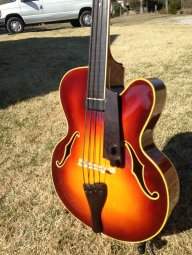
This is a test rig for designing the top of the bass I'm building. I can only get a few notes on the A and D string along with open E and G, on the plywood neck/fingerboard. I'm doing a build thread here: Archtop Acoustic Hybrid

As someone said earlier in the thread, a good double bass isn't muffled, those high mids and high are important. This is what it sounds like: [Invalid or Expired Link Removed]

DSC03729.JPG
 
Lots of different idea on what a double bass should sound like. Welcome to asking for advice! Here's more!

An upright sounds uprighty for a number of reasons, but two important ones are because you're playing a fretless so the notes all have a swell to them and because the fingering is necessarily different.

You already have flats, but can you borrow an electric fretless? That would get you closer. Or a Zoom b2, those have a fretless emulation that only sucks a little. A foam mute to LIGHTLY mute the strings (don't overdo it) and fingers at an angle so they roll over the strings rather than hitting them at a right angle. and playing over the fretboard rather than over the pups. And roll off the highs a bit. Then think like an upright player. Think quarters and halves, ones and fives and passing notes, hold each note longer. Listen to similar music actually being played on an upright and you'll hear less notes than on an electric.
 
Rotosound RS 88 Tru Bass strings. Black Nylon Tape wound, and have been manufactured for several decades (first designed in 1962).

In fact, I use them exclusively on my frettless basses.

And if you want pull the fretts out of the electric, fill the grooves, smooth the frett board, and readjust the bridge. Presto - Electric Frettless Bass (AKA Jaco)
2013-10-26_09-47-27_902.jpg
 
People have different definitions of "The Upright Sound" so you might need to be a little more specific - maybe post a sound clip of what you are after.

If you have a look over on the DB side of the forum you'll see people spending hundreds to capture a specific upright tone.
 
I agree it's all about the decay of the notes (not that all uprights don't sustain, but in trying to emulate one a shorter note decay helps), and as Jimmy says thinking like an upright player. Pretend you're really working for those notes--an upright is physically harder to get around on. So, use a foam mute(or thumb pluck w/palm mute), flats, roll off your bridge pickup, easy on the high EQ, and emulate the physical "struggle" of playing a doghouse.
 
'The right hand has been mentioned, but don't forget the left hand. My jazz foundation is with the Simandl / Ray Brown 1-2-4 method and I can pull off an upright-ish sound/approach on just about any electric bass using those techniques.'

This is correct. I've even forgot about it but the very few lessons I had long time ago was with an upright teacher. I started with these same books - all these years later I only play 1, 2, 4 left hand even though I rarely play upright anymore.
 
I'd like to offer another solution that doesn't seem to have been mentioned:

First of all, there are a lot of good suggestions on how to attempt to cop the sound. If you want to go for that sound, create a list of the suggestions and try them all out, with your teacher's help.

But most middle/high school band directors don't understand that bass guitar and upright bass are different instruments and have different sounds. If your teacher is pushing for the more upright sound, they need to understand that it won't come as close as they're hoping. As a school clinician, I witness this all the time.

If you are interested in learning upright, time to acquire one (with the help of a local bassist to assist you in not getting screwed) and learn it.

But, also mention to your band director that their song selection can favor electric bass over upright, and the electric bass even has its own place in the big band sound.
 
  • Like
Reactions: 12BitSlab
This is a test rig for designing the top of the bass I'm building. I can only get a few notes on the A and D string along with open E and G, on the plywood neck/fingerboard. I'm doing a build thread here: Archtop Acoustic Hybrid

As someone said earlier in the thread, a good double bass isn't muffled, those high mids and high are important. This is what it sounds like: [Invalid or Expired Link Removed]

View attachment 1047517
Wow. This is by a large margin definitely the BEST emulation of upright I have heard so far.
 
  • Like
Reactions: smithcreek
This is one I make take some flack for, but I think it is a legitimate part of the upright sound: Tune your bass ever-so-slightly out of tune (and I mean like a couple of cents) The slight imperfections in intonation in even the best players are part of what give the upright it's character. I absolutely believe that is part of the reason James Jamerson kept the funk machines so poorly set up-the intonation issues that caused made the bass sound more like an upright.
 
to sound more like an upright for jazz band
hi Rick
plug it in
bridge pup = 0
front full up to begin with
tone full up (I am shagin' serious about that detail!!!!)(just for the record)!!!!
(than imagine yourself being Paul Chambers);)
put your thumb against the neck(as a thumb-rest)
it won't sound like it should by then (you are not Paul Chambers and of course I am not either):D
hold your bass as if it was a DB then touch it like a virgin (still doesn' t work?)

so get the volume pot (front!!!!) to 1/2 big surprise!!! this will change the sound!!!( still don't touch the tone pot: a DB without treble is a bad recorded one)

you should be near to what you are looking for (even without changing strings (strings that your school bought last century)) will not work with rounds you bought last week ;) see: I am f... serious...about..

now play with the thing they gave you to make it loud (schoolstuff amp for those who understand)

keep it flat (as allways because it's a piece of...)

if you got too much fretsound in it: try to play neat:thumbsup: and walk. and walk and walk and walk:cool:

good luck man

may the bass be with you

Wise(b)ass
 
  • Like
Reactions: Rickstery
Flat wound strings

Piece of foam under the strings right at the bridge

Pluck over the end of the fretboad or close to it

That's as close as you'll get.

Almost there. On my Carvin AC50 I use nylon wrapped string that work quite well. The foam under the strings at the bridge is tapered into a sort of triangle shape because the low strings (5er) take more damping than high ones.

And lastly because "it's all in the fingers", It helps a lot if you get your mind right and instead of plucking bass guitar style with the tips of your first two fingers alternately, put them together and pluck upright-style with the side of that two finger pair. Doing that also helps you to think in uprightish fashion as well...at least it does to me. I started bass playing a real upright.
 
This is a subject that is near and dear to my heart. First of all, let me say right off the bat, the only way you are ever going to really get an upright double bass sound is to play an upright double bass. This is a topic that periodically comes up on Talk Bass. I've been a member here for over 14 years.

This is my primary instrument, a 2000 Ernie Ball Music Man StingRay unlined fretless with 3-band EQ and piezo bridge. I first bought a StingRay precisely because a StingRay with flats is the closest thing to an upright bass tone I've ever heard out of a conventional electric bass guitar, and when I made that discovery, it was with magnetic pickups only. Mine with piezo is even better. Meet 玉子 (Tamako), so named because it means "little jewel" or "jewel child" in Japanese, and also "egg" (though that is more commonly written as 卵 (tamago) ); she is Transparent Gold, the colour of a egg yolk; and my name, "Gemma", means "gem" or "jewel" in Italian:

File Jan 10, 18 30 03.jpeg


The first thing to understand is that there are as many "upright" tones as these are "electric" tones, so you have to consider what type of upright tone you are looking for.

I play Rotosound RS77LD strings, they are fantastic, my favourites, no need for you to change. However, should you desire to change, I would also recommend D'Addario Chromes flats or Thomastik-Infeld Jazz Bass flats.

In addition, do not overlook the D'Addario Orchestral strings like their NS Bass strings that fit electric bass guitars, or their Prelude 1/8 scale strings, which are designed for a playing length of 31 3/4", but because of the way a double bass is constructed, these should be long enough for a 34" scale bass guitar. They may actually be a little *too* long, I'm not sure, but I use 27" scale cello strings on my 30" scale Warwick. The ball end silks extend above the bridge, but this only helps improve the tone. The orchestral strings all have stranded cores, unlike the electric strings which have solid cores.

I have never actually tried nylon tapewound strings, because they are not as versatile. I may try them when I decide my current set of Rotosounds are worn out. In several years or more.

String mutes. These are a very big help, but not essential. I personally like them. If you put them all the way up against the bridge, they do not kill your sustain, and they add to the woody, thumpy character.

Piezo pickups. For this type of sound, piezo pickups are far better than magnetic. There's really no comparison. That being said...flatwound strings sound *much* better on a Precision Bass or StingRay than they do on a Jazz Bass, because of the pickup placement. Conversely, to my ears, a Jazz Bass sounds a hell of a lot better with roundwound strings than a Precision or StingRay. You can get pleasing tones from magnetic pickups. Also, if I am not mistaken, Niels-Henning Ørsted Pedersen used magnetic pickups on his upright, but that's an upright.

An "acoustic pedal". The Boss AC-2 and AC-3 Acoustic Simulator pedals were designed to help an electric guitar sound sorta kinda like an acoustic/electric, and they are terrible at that, but they are great for making piezo pickups sound better, and they do a really great job helping a piezo fretless bass with flats and mutes cop an uprighty tone. I am currently experimenting with a tc electronic BodyRez to see if that works better, but my initial impression is that it does not. It's still a nice tone, but not what I can get with my AC-2. The AC-2, however, is fairly noisy/hissy. Next I'm going to try the AC-3 and new AD-2 Acoustic Preamp pedal.

Don't listen to people who tell you to turn down the treble. Upright basses have a substantial amount of treble, and treble is essential to getting that woody/airy tone and the transients of strings knocking on ebony and finger noises. Look instead to cut upper mids, with a parametric EQ.

Play like an upright player. Use the side of your fingers, rather than the tips. Hell, if you can, put an endpin on your bass or hold it vertically and play it like an upright. You'll be surprised how it changes your mindset. Upright tone doesn't just come from the physical construction of the instrument, it comes from the way your physical technique necessarily changes due to the vertical orientation of the instrument.

Your amplifier. Use an amp that is more like what an amplified upright player would use. I use a Mesa/Boogie Walkabout Scout 12 combo, but I would also recommend one of the Phil Jones Bass amps, which I tested pretty extensively before settling on my Walkabout. You might also investigate the Acoustic Image amplifiers, which are popular with upright players.

Well, I think I've about exhausted the advice I can give for now. Good luck, and enjoy the adventure!
 
Last edited:
This is a subject that is near and dear to my heart. First of all, let me say right off the bat, the only way you are ever going to really get an upright double bass sound is to play an upright double bass. This is a topic that periodically comes up on Talk Bass. I've been a member here for over 14 years.

This is my primary instrument, a 2000 Ernie Ball Music Man StingRay unlined fretless with 3-band EQ and piezo bridge. I first bought a StingRay precisely because a StingRay with flats is the closest thing to an upright bass tone I've ever heard out of a conventional electric bass guitar, and when I made that discovery, it was with magnetic pickups only. Mine with piezo is even better. Meet 玉子 (Tamako), so named because it means "little jewel" or "jewel child" in Japanese, and also "egg" (though that is more commonly written as 卵 (tamago) ); she is Transparent Gold, the colour of a egg yolk; and my name, "Gemma", means "gem" or "jewel" in Italian:

View attachment 1048801

The first thing to understand is that there are as many "upright" tones as these are "electric" tones, so you have to consider what type of upright tone you are looking for.

I play Rotosound RS77LD strings, they are fantastic, my favourites, no need for you to change. However, should you desire to change, I would also recommend D'Addario Chromes flats or Thomastik-Infeld Jazz Bass flats.

In addition, do not overlook the D'Addario Orchestral strings like their NS Bass strings that fit electric bass guitars, or their Prelude 1/8 scale strings, which are designed for a playing length of 31 3/4", but because of the way a double bass is constructed, these should be long enough for a 34" scale bass guitar. They may actually be a little *too* long, I'm not sure, but I use 27" scale cello strings on my 30" scale Warwick. The ball end silks extend above the bridge, but this only helps improve the tone. The orchestral strings all have stranded cores, unlike the electric strings which have solid cores.

I have never actually tried nylon tapewound strings, because they are not as versatile. I may try them when I decide my current set of Rotosounds are worn out. In several years or more.

String mutes. These are a very big help, but not essential. I personally like them. If you put them all the way up against the bridge, they do not kill your sustain, and they add to the woody, thumpy character.

Piezo pickups. For this type of sound, piezo pickups are far better than magnetic. There's really no comparison. That being said...flatwound strings sound *much* better on a Precision Bass or StingRay than they do on a Jazz Bass, because of the pickup placement. Conversely, to my ears, a Jazz Bass sounds a hell of a lot better with roundwound strings than a Precision or StingRay. You can get pleasing tones from magnetic pickups. Also, if I am not mistaken, Niels-Henning Ørsted Pedersen used magnetic pickups on his upright, but that's an upright.

An "acoustic pedal". The Boss AC-2 and AC-3 Acoustic Simulator pedals were designed to help an electric guitar sound sorta kinda like an acoustic/electric, and they are terrible at that, but they are great for making piezo pickups sound better, and they do a really great job helping a piezo fretless bass with flats and mutes cop an uprighty tone. I am currently experimenting with a tc electronic BodyRez to see if that works better, but my initial impression is that it does not. It's still a nice tone, but not what I can get with my AC-2. The AC-2, however, is fairly noisy/hissy. Next I'm going to try the AC-3 and new AD-2 Acoustic Preamp pedal.

Don't listen to people who tell you to turn down the treble. Upright basses have a substantial amount of treble, and treble is essential to getting that woody/airy tone and the transients of strings knocking on ebony and finger noises. Look instead to cut upper mids, with a parametric EQ.

Play like an upright player. Use the side of your fingers, rather than the tips. Hell, if you can, put an endpin on your bass or hold it vertically and play it like an upright. You'll be surprised how it changes your mindset. Upright tone doesn't just come from the physical construction of the instrument, it comes from the way your physical technique necessarily changes due to the vertical orientation of the instrument.

Your amplifier. Use an amp that is more like what an amplified upright player would use. I use a Mesa/Boogie Walkabout Scout 12 combo, but I would also recommend one of the Phil Jones Bass amps, which I tested pretty extensively before settling on my Walkabout. You might also investigate the Acoustic Image amplifiers, which are popular with upright players.

Well, I think I've about exhausted the advice I can give for now. Good luck, and enjoy the adventure!

This is pretty much perfect.
 
  • Like
Reactions: amper