• TalkBass has been independent since 1998. Add your voice.
    Create a free account to reply to discussions, view embedded media, and browse with fewer display ads.
    Join freeLog in
    Want zero display ads or expanded classifieds tools? Compare plans.

Using a B string “correctly”

*background info here to start, you can skip* I’ve had a bit of change of heart lately. I recently moved to a new church where I am probably the most knowledgeable bassist. As such I don’t have anyone telling me how to play (as happened in my last church). In my last church I was told to use my B string heavily. I was asked to use low C, D, and E, etc. as the root of many songs and to use the B strings notes as much as possible. Since that is how I learned to play, I thought that was just the way it should be. However, the sound was usually very muddy in the PA, and we always thought it must be a high pass filter/crossover/low frequency problem. I’m now suspecting it was the heavy B string use. I was told to use it often so that the low end would be very present in the church and because playing higher would make me lost in the mix.

*The question: was I using the B string the “wrong” way? I’m starting to think that it should only be used for accents and not as a starting point for songs (at least not a starting point for anything below E). If I play in regular 4 string territory, will the overall low end of the band be lost? I’m the sound tech at my church as well so any mixing advice is appreciated as well (I’m still learning). Thanks for any help in advance!
 
I understand there isn’t a correct way persay and that’s why I put it in quotation marks in my OP. What I mean is, is it really essential to the overall sound of the band to play so low or am I just adding to the muddiness? Do any of you all play on the B string as much as the E string for example?
 
I think that you should use it where it sounds good to you. Personally, I feel the song should drive those decisions. I often will play up at least one octave, or maybe more, during the first part of the song, but drop down as we progress. This decision is driven by dynamics of the entire group.

I guess all that is to say, there isn't a 1 rule to ring them all, but it's an artistic choice based on the way you want folks to feel.
 
The proper way to use a B string is as a thumb rest :D
i use B strings to pull cars out of ditches after some snow and ice: works! :D

KickingBass : i'm sorry that you "were told" what you were told at the last church gig. maybe that's the church where music was invented. although i don't have much experience with low B strings: IMO, charlie monroe 's advice/experience sounds useful and thoughtful.

edit: as does BassJuju 's advice.
 
I'm going to guess that in your context it's not essential. And, as you've already noticed, it can get muddy. EQing the bass ought to help reduce the muddiness of the 5, or bring out fuller lows, if needed, on a 4 string. I play 4s and 5s. I use my B string sparingly, and hardly ever play below a low D. It just sounds muddy. I need to play with a really soft touch if I go below the low D. Probably other 5-strings sound tighter...

Experiment, and see what works for you.
 
IDo any of you all play on the B string as much as the E string for example?
I try to set things up so that if I want to play a G or F# on the B string, it doesn't boom or otherwise not match, tone- or volume-wise. When playing my 5-string, I don't set boundaries on B-string use. I just play across to it as I normally would play across a 4-string. I don't just use it for low notes.

Kinda annoyed at the idea of those people telling you how to play your instrument. Raises my hackles and I don't even know what those are.
 
I try to set things up so that if I want to play a G or F# on the B string, it doesn't boom or otherwise not match, tone- or volume-wise. When playing my 5-string, I don't set boundaries on B-string use. I just play across to it as I normally would play across a 4-string. I don't just use it for low notes.

Kinda annoyed at the idea of those people telling you how to play your instrument. Raises my hackles and I don't even know what those are.
That’s how I would normally play as well especially in the past. How would you set it up to match tonally when using G and F# on the B string? Depending on the song I like to use those notes as well.
 
I understand there isn’t a correct way persay and that’s why I put it in quotation marks in my OP. What I mean is, is it really essential to the overall sound of the band to play so low or am I just adding to the muddiness? Do any of you all play on the B string as much as the E string for example?
The B-string is more about hand positioning than five lower notes. Like every other note, use those five notes wisely. One need not camp out there or anywhere else on the fretboard.
 
I think that you should use it where it sounds good to you. Personally, I feel the song should drive those decisions. I often will play up at least one octave, or maybe more, during the first part of the song, but drop down as we progress. This decision is driven by dynamics of the entire group.

I guess all that is to say, there isn't a 1 rule to ring them all, but it's an artistic choice based on the way you want folks to feel.
Definitely food for thought, I never really thought of using it as a layer of dynamics especially in scheme of the entire band.
 
The B-string is more about hand positioning than five lower notes. Like every other note, use those five notes wisely. One need not camp out there or anywhere else on the fretboard.
Being able to play in more places on the fretboard is one of my favorite parts of using a 5 string. I think maybe this is why people search for a 5 string that has a very even sounding low B string that blends well with the other strings.
 
That’s how I would normally play as well especially in the past. How would you set it up to match tonally when using G and F# on the B string? Depending on the song I like to use those notes as well.
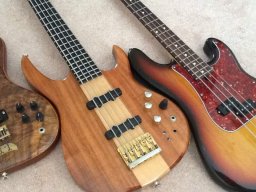
String guage and pickup height adjustment, mostly. I run Medium Lights on it and tilt the bass side away from the strings. I also don't play it as hard. I also don't jack my amp around to accommodate the 5. I use the same settings as with my P-Bass. Here's a picture of my 5-string (most people, myself included, on forums love pictures).

A6E87525-A971-4240-95C4-C19A4AAA3160.jpeg
 
FWIW - I play 5 in my church and agree with all you are saying. I used to be the sound man and so have similar input autonomy.
When I play below low E, it can get muddy. I think I stumbled upon something that helps. I use a Keeley bassist compressor. It’s capable of applying some clean boost with a minimal amount of compression and setting a pretty high threshold. So what I get is clean boost and not much comp the only kicks in if I really dig in. So that helps. Also I play direct, and suspect you do too. My DI is a sansamp para. It has the ability apply a rumble as well as an air filter. I use the rumble filter and that seems to make my lows way less boomy. I think it kinda acts as a high pass filter of sorts. The para also has a blendable drive knob. I add a 50/50 blend of the drive knob at around 10 o’clock. Which also helps I think.

100% of the time I don’t start Uber-low on the b string. It’s a cool component to add to your playing, but I just don’t bring it in right off the bat. It’s more of an emphasis thing once the tune gets rolling. I rarely go below the low E. In my opinion, the tone just disappears into the kick drum freq range. I might rarely use it as a passing note, but going below e like that is more of an effects trick for me than an actual note ina song played with intent or anything


Hope this helps!!
 
  • Like
Reactions: molecule