• TalkBass has been independent since 1998. Add your voice.
    Create a free account to reply to discussions, view embedded media, and browse with fewer display ads.
    Join freeLog in
    Want zero display ads or expanded classifieds tools? Compare plans.

Using a B string “correctly”

I use my B more for Low accents and to get more variety when playing songs in the flat keys ( as you know... Many CCM songs tend to be in Dd Eb etc).

Rarely do I start on the B string (although I have depending on how I want to color a song).

I often end the song on a low E or low D.

Rarely do I used the C... Although it has been done...

BTW...the Low D does produce a great low rumble and grindy sound!
 
Two things that would determine my usage of the B are: quality and setup of FOH, and abilities of sound man.

I can control my playing style and hand position to affect the dynamics I want to create in worship, but if I’m not sure of FOH sound then I’m living in a fantasy land where what I hear to crowd doesn’t. So heavy B string usage may be muddy, overbearing, or just right to the congregation....

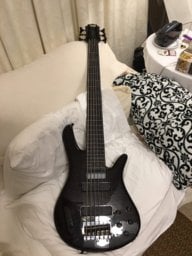
Seems like a lot of worship and gospel music is created with 5 and 6 string bass lines (from what I’ve found), so using a 5er is just easier sometimes (even though I generally use a 4). The B string is also extremely helpful with a worship leader who changes up the keys of songs frequently (and last minute or on the fly) to keep your low end in tact (sorry if that doesn’t make sense).
 
  • Like
Reactions: basspraiser
I try to set things up so that if I want to play a G or F# on the B string, it doesn't boom or otherwise not match, tone- or volume-wise. When playing my 5-string, I don't set boundaries on B-string use. I just play across to it as I normally would play across a 4-string. I don't just use it for low notes.
I’ve played 5 strings in all sorts of band environments for a couple decades. Most important part about playing that low with clarity is to eq AND equip* for clarity in that specific range throughout the signal chain. With this approach you could certainly play those notes as usefully as any others. Now it becomes a matter of the mood you’d like to create/support.

*This can go from string choices all the way to stage amp or FOH main speaker can choices at the extremes.
 
*background info here to start, you can skip* I’ve had a bit of change of heart lately. I recently moved to a new church where I am probably the most knowledgeable bassist. As such I don’t have anyone telling me how to play (as happened in my last church). In my last church I was told to use my B string heavily. I was asked to use low C, D, and E, etc. as the root of many songs and to use the B strings notes as much as possible. Since that is how I learned to play, I thought that was just the way it should be. However, the sound was usually very muddy in the PA, and we always thought it must be a high pass filter/crossover/low frequency problem. I’m now suspecting it was the heavy B string use. I was told to use it often so that the low end would be very present in the church and because playing higher would make me lost in the mix.

*The question: was I using the B string the “wrong” way? I’m starting to think that it should only be used for accents and not as a starting point for songs (at least not a starting point for anything below E). If I play in regular 4 string territory, will the overall low end of the band be lost? I’m the sound tech at my church as well so any mixing advice is appreciated as well (I’m still learning). Thanks for any help in advance!
The timber of a note on the B is obviously deep, and perhaps your musical director likes the way it sounds. Sometimes it is hard to hear what other people are hearing, or know what it does for them when they hear it.
You are in a particular situation where you have someone that is more or less the authority over what you are doing. When you play in a band that has a director of some kind, you have to go along with their vision. That's a particular case.
Outside of that particular situation, there isn't really a "right" or "wrong" way to use a low B; just what works for the song. Then you get to be your own director. For me personally, I only use a 5 string when I want a lot of low notes and I know I'm going to use that B a lot. However, I play music where low notes are used to make the sound thicker, and that isn't common to a lot of the rest of the world. Some guys like having a low passing not available to them, as you have suggested. It is a matter of preference.
 
  • Like
Reactions: KickingBass
I started on a 4-string back in 1985; in my early formative years most commercially-available (read: cheap enough I could afford them) 5-string basses s-u-c-k-e-d hard. It didn't help that most bass amps and speakers had trouble handling those lower notes without distortion. The first couple of fivers I owned I didn't keep long.

Ultimately I did the whole B-E-A-D tuning on one of my fours, and the pickup system on that bass handled it way better than any of the cheaper fives through my rig.

Years later I finally decided to try "the mighty six" and never looked back. I have owned a couple of fives since, but usually only for a couple of weeks - I don't even look at them these days when I am bass shopping. It's not snobbery - if I don't have the high C, I kinda tend to miss it with the stuff I play.

From the perspective of an older guy (almost 50), I use the low B for a few things: first, as pointed out, it makes a dandy thumbrest, which is how I use it a lot of the time; I will use it as an accent for particular 'hits' in a song for additional punch; I'll use it in the bass line as played if the line calls for it; and finally, I'll use it to extend walking lines/patterns in a song where changing octaves or direction else would sound 'off'.

I won't say there is a "wrong" way to use the low B. I will, however, say that it was always a running joke among myself and my friends that you could usually tell the guy who just got his first five-string, in that he wears out the B string and forgets the others exist for a while.

Maybe the best advice I can give is to just go play music and have a great time, rather than worrying about which string you're playing the music on. As someone pointed out previously, if it sounds good to you you're gonna be just fine. :)
 
  • Like
Reactions: KickingBass
*background info here to start, you can skip* I’ve had a bit of change of heart lately. I recently moved to a new church where I am probably the most knowledgeable bassist. As such I don’t have anyone telling me how to play (as happened in my last church). In my last church I was told to use my B string heavily. I was asked to use low C, D, and E, etc. as the root of many songs and to use the B strings notes as much as possible. Since that is how I learned to play, I thought that was just the way it should be. However, the sound was usually very muddy in the PA, and we always thought it must be a high pass filter/crossover/low frequency problem. I’m now suspecting it was the heavy B string use. I was told to use it often so that the low end would be very present in the church and because playing higher would make me lost in the mix.

*The question: was I using the B string the “wrong” way? I’m starting to think that it should only be used for accents and not as a starting point for songs (at least not a starting point for anything below E). If I play in regular 4 string territory, will the overall low end of the band be lost? I’m the sound tech at my church as well so any mixing advice is appreciated as well (I’m still learning). Thanks for any help in advance!
Tell them to donate a few grand to you for their cause and you’ll buy MOOG Taurus bass pedals

They must not have a good keyboard available?
 
That’s pretty much exactly what I do. I love how easy it is to transpose on a 5er at the drop of a hat to follow the leader and the low register is great too. When a low note fits I use it to great effect (IMO anyway!) and when it doesn’t fit I stay out of the basement.
I like that!
I’ve been exclusively playing a 4-string fretless forever, and have recently thought of getting a fretted bass as well. Perhaps I ought to try out a fiver! Make my second bass as different from my fretless to play as my guitar is.
I’m not a very good guitarist, but a part of what keeps me going is that the b string on that instrument and the sonic difference keeps my brain more actively engaged. I think a five string might do the same thing for me. I’m sure that muting that low b is a bit of an adjustment as well.
 
I understand there isn’t a correct way persay and that’s why I put it in quotation marks in my OP. What I mean is, is it really essential to the overall sound of the band to play so low or am I just adding to the muddiness? Do any of you all play on the B string as much as the E string for example?

You'll get a whole lot of "You're the bass player. Do what you want and screw everybody else" type responses. They are simply incorrect.

In Praise and Worship you want to build the first couple of songs. In other words, they start off kind of in tue middle volume wise and how "big" the band sounds.

The closer you get to the end, the wider you want your frequency range. The female lead vocals will go up. One guitar or keyboad will go high. And the bass goes low.

Does that mean you can never hit a low B string note until the end? No. Of course you can. But don't "live" there until the big build up at the end.

Any many churches the last song is a call to worship and is more laid back. I have used B string notes plenty in that situation, but usually play very lightly when doing so.

Hope that helps.
 
*background info here to start, you can skip* I’ve had a bit of change of heart lately. I recently moved to a new church where I am probably the most knowledgeable bassist. As such I don’t have anyone telling me how to play (as happened in my last church). In my last church I was told to use my B string heavily. I was asked to use low C, D, and E, etc. as the root of many songs and to use the B strings notes as much as possible. Since that is how I learned to play, I thought that was just the way it should be. However, the sound was usually very muddy in the PA, and we always thought it must be a high pass filter/crossover/low frequency problem. I’m now suspecting it was the heavy B string use. I was told to use it often so that the low end would be very present in the church and because playing higher would make me lost in the mix.

*The question: was I using the B string the “wrong” way? I’m starting to think that it should only be used for accents and not as a starting point for songs (at least not a starting point for anything below E). If I play in regular 4 string territory, will the overall low end of the band be lost? I’m the sound tech at my church as well so any mixing advice is appreciated as well (I’m still learning). Thanks for any help in advance!

It's an EQ issue; you should be able to play only on the B the entire song if that's what's called for, with any muddiness.

Try using a variable HPF on the bass and sweeping from 35Hz up as far as 80Hz until you find the sweet spot where the bottom end is tight but still full.

You may also need to notch a narrow Q somewhere between 80Hz and 250Hz, depending on the source and the room.
 
I like my “B” notes to stand out as an accent, an extra flavor in the sauce. Dropping to low notes on a second verse helps it stand out, low note finales are nice. But if I use it too much, then it doesn’t have the “look at me” impact. Again, that’s just me. :)
 
  • Like
Reactions: BritFunk
To me, it really comes down to where the other people are in the frequency mix and what your sound system is capable of supporting. If you have a sound mixer who can achieve good separation between the instruments and you're not being played over/out by the guitars and keys when you're in their frequency range, then there's really no reason to go down too low. Similarly, if your amp or PA system is limited and cannot support the lower notes of the B string, then there's also no point in getting too far down there.

Really, the B string is mostly for a few things. One would be the ability to cover a wider range of notes without shifting your left hand position (basically playing in the 4 string range but incorporating all 5 strings). The other is to avoid having to down tune or drop tune your bass for songs that require Eb, D or Db. There are a few songs where the original requires a low C or B, but those aren't too common. That said, I wouldn't go down to the lower notes just because I could.

Personally, I've always been fortunate have both an amp as well as PA support that cover my B string range. I do have to tweak the EQ depending on the space and how the other instruments are mixed. My struggle is more getting drowned out by the other instruments in the mix, so I tend to stay in the bass-only ranges most of the time.
 
Nothing inherently muddy about a B. First thing to sort out is EQ. Second, it could be the string itself. Maybe it's too loose, and you could use a heavier gauge. Maybe your technique favours plucking around the neck with a fingerstyle with flatwound strings. No idea. Could be many things, but certainly not to do with it being a B.
 

Latest posts