
• TalkBass has been independent since 1998. Add your voice.
    Create a free account to reply to discussions, view embedded media, and browse with fewer display ads.
    Join freeLog in
    Want zero display ads or expanded classifieds tools? Compare plans.

Using a multimeter to test battery drain of active EMG circuit. Help!

I've searched for hours but every result I find just says "use a multimeter, good luck" but no actual details on how to use it. I will describe what I did, though.

I just installed an active EMG set wired 18v. I wanted to test whether the battery is draining even when the bass is unplugged. Just to have closure as the final step of the installation process.

Here is the way my electronics are installed:
3bsRpJo.png


Here is the way my batteries are installed:
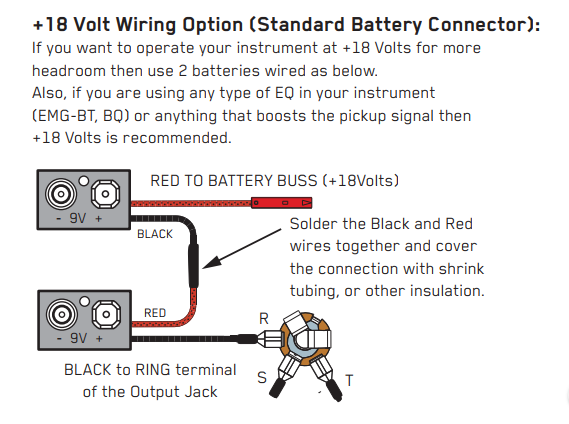
qxiL6Cl.png


Using the 20 DC Volt setting, these are the readings I get when I attach the prongs of my multimeter to various terminals of the output jack [UNPLUGGED]:
  • S and R: 18.92
  • T and R: 18.92
  • T and S: 0
  • T and negative prong of 2nd battery: 18.92
  • S and negative prong of 2nd battery: 18.92
  • R and negative prong of 2nd battery: 0
When I plug a cable into the output jack, all of these readings become 0. The bass plays fine when plugged in. The first battery behaves differently and shows 9.45 or -9.45 depending on whether the bass is plugged in or not. I don't understand how that part works but it is about half of the usual reading.

Is everything normal here? I don't know if active EMG wiring is odd compared to the way other pickups are wired.
 
Not sure about your tip/ring/sleeve readings (except that 18.92 corresponds to two 9V batteries and 9.45 to one). But one way to check for battery drain when unplugged is to check for current draw (amperes, probably will need to use the milliampere setting on your multimeter) at the battery connector. Unsnap one half of one battery connector and insert your multimeter here. If you see amperage on the meter, then there is a drain somewhere.

If wired properly, the battery ground is only attached to the ring terminal of the jack. So another way to check for drain would be to use the resistance (ohms) or continuity setting of the meter, and see if that ring terminal is connected to ground anywhere without a cable plugged into the jack.
 
  • Like
Reactions: Killed_by_Death
To measure for battery drain, your meter should be set for current, not voltage. As mentioned, disconnect one side of the battery snap, and put the leads there. With the bass unplugged, you should have 0 Amps of current. With the bass plugged in, you should have something in the hundreds of microAmps range, up to one or two milliAmps. Any more than this is a concern.
 
Your voltage readings sound correct for a properly operating curcuit. So the battery switching function at the jack is working correctly.

Be careful with the ammeter measurements. You do not want to probe directly across a pair of battery terminals, or any part of a circuit that can deliver more current than the meter can handle.

The ammeter always wants to be in series with the part of the circuit being measured, in this case the battery supply. That is why you first open the circuit at the battery clip, and then use the ammeter leads to complete the circuit again. The ammeter is now in series with the supply, and not in parallel with it as it might be when making voltage measurements.

-
 
  • Like
Reactions: el_Bajo_Verde
One test lead goes on the positive battery terminal & the other test lead goes on the loose half of the battery connector, set the multi-meter to measure milliAmps.

To measure for battery drain, your meter should be set for current, not voltage. As mentioned, disconnect one side of the battery snap, and put the leads there. With the bass unplugged, you should have 0 Amps of current. With the bass plugged in, you should have something in the hundreds of microAmps range, up to one or two milliAmps. Any more than this is a concern.

Your voltage readings sound correct for a properly operating curcuit. So the battery switching function at the jack is working correctly.

Be careful with the ammeter measurements. You do not want to probe directly across a pair of battery terminals, or any part of a circuit that can deliver more current than the meter can handle.

The ammeter always wants to be in series with the part of the circuit being measured, in this case the battery supply. That is why you first open the circuit at the battery clip, and then use the ammeter leads to complete the circuit again. The ammeter is now in series with the supply, and not in parallel with it as it might be when making voltage measurements.

-

Thanks, guys! Using this test I get 0 with no cable, and I get about 0.94 mA when a cable is plugged in. Now I can rest easy!

I had an Ibanez Talman with a battery drain problem so now I check all my active bass purchases for the same!
 
Last edited:
I guess the question is , are you experiencing battery drain?
If so, check that the connector on the bottom of the P'up is not touching the shielding, or anything else when dropped in to the bass body.

I had this happen to my EMG eqipped bass when I adjusted the p'up height to the strings. I lowered it a bit much, and the prongs on the back of the EMG contacted the cavity shielding and grounded out, killing my betteries overnight.
I merely insulated the bottom of the cavity and no issues since.
 
  • Like
Reactions: el_Bajo_Verde
An easy way to test battery drain (current flow) without messing with the batteries (if you have a stereo TRS cable): plug cable into bass and measure mA (current) between ring and sleeve at exposed end of cable. The meter completes the circuit that is still open when the TRS end is inserted into the bass. You get the same reading as you would when unclipping one lead from the battery and measuring between the exposed battery terminal and the corresponding terminal of the battery clip.