• TalkBass has been independent since 1998. Add your voice.
    Create a free account to reply to discussions, view embedded media, and browse with fewer display ads.
    Join freeLog in
    Want zero display ads or expanded classifieds tools? Compare plans.

Using Two Combo Amps

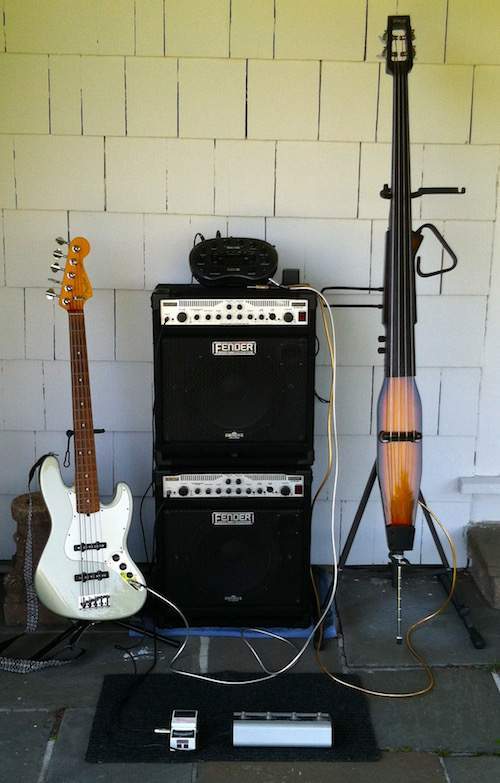
For some gigs, I've been using a pair of Fender Bassman 150 combos, fed by a Line 6 Bass PODxt. I like the redundancy factor.

twocombos.jpg


Yes, garp! I have a Bassman 150, also. And, MAN!, that's a LOT of thump out of one 12" speaker!!!

I used to chain it, Send to Return, to a matching Bassman 250. And the Master Volume of the slave still controlls that amp (Rumbles don't do that)! So I put the 150 on the opposite side of the stage from me and the 250, where the keys could control the bass volume they got.

Master-slave (1).jpg

.
 
  • Like
Reactions: MadJack and garp
I just got a response from Gianfranco at GR Bass and he said to use a XLR to 1/4" cable to go from the DI of the master to the input of the slave. But the Y cable method sounds just as simple. Does it matter that the jack going into the master effects send is TRS? I much prefer the cable methods to the ABY pedal method dude to simplicity and less stuff to carry around and set up. Thanks!
It's been awhile, but if I recall correctly a simple TS from the effects send does the job. You want the exact same signal going to both effects-return jacks, so splitting the one signal should do it. That Y cord is not in my gig bag anymore because it's been so long since I've used it. I haven't needed it since 2010. TS male from first amp effects-send to two TS female connectors coming out of the Y should do it. That way you can use normal patch cords or instrument cords for the rest of the connections.
 
That sounds odd to me. Wouldn't both conditions produce the +3 dB increase? It amounts to two ways to double power.. When adding an identical thing gets a 6 dB rise, it's usually like adding a tape track or mixing two signals, on the basis that it's doubling the voltage. A second (and equal) combo wouldn't be doing this.

Anything more than 3dB extra from ganging driver arrays might be more to do with increased directionality from a wavefront that is wider at source, assuming they're closely set together and not cancelling at frequencies various due to mismatched distances.

Since you are using two amps, you get 6dB. The combined efficiency of two cabs is 3dB higher than one cab. You are also doubling to power which also gets you +3dB.

If you use only one amp to drive both cabs, it depends on how much power the amp produces at each impedance.

With a tube amp the power stays the same as long as the amp sees the expected load. So if the amp has a 4 ohm and 8 ohm tap it will make exactly the same power at either 4 or 8 ohms. Let's assume 100W and 8 ohm cabs with a 96dB 1W/1m sensitivity rating.

The decibel change from 1-100W is log(100) x 10 = 20dB. So one cab receiving 100W will make 96 + 20 = 116dB.

When you add the second cab, the total power remains at 100W, but it is divided equally between identical cabs. So each cab receives 50W. Since the power is cut in half, we know the SPL of one cab will drop by 3dB.
So each cab will make 113dB. Then you get +6dB from mutual summing and the total SPL is 113 + 6= 119dB.

Here is the math that shows each cab makes 96dB with 50W. Log(50) X 10 = ~ 17dB. This figure was rounded from 16.9897. The SPL of one cab receiving 50W is 96 + 17 = 113dB

We could look at it a different way:
Remember I said the combined sensitivity of two cabs is 3dB higher than one. This means as a system, the two cabs have a combined sensitivity of 96 + 3 = 99dB 1W/1m. 1-100W produces a 20dB change, so 99 + 20 = 119dB

Know we will show what happens with two 100W amps and two cabs. We already showed 1-100W produces a 20dB change and one cab will make 116dB with 100W. Since we have two amps, both cabs will receive 100W and make 116dB. So the total SPL will be 116 + 6 = 122dB.

Let's calculate this with 200W and the combined 99dB 1W/1m sensitivity rating. Log(200) x 10 + 99 = 122dB

Summary:
1 cab receiving 100W = 116dB
2 cabs receiving 100W total = 119dB
2 cabs receive 200W total = 122dB

I don't know the formulas for the mutual summing, but you can punch the figures into this online calculator: Total dB level adding of coherent correlated sound sources

What's going on when you double the number of drivers. My understanding is increasing the effective radiation area of the speakers increase how effectively they couple with the air. In other words, efficiency goes up. You get near perfect summing for frequencies where driver spacing is less than 1/4 wavelength. Near perfect summing results in +6dB.

I believe this article probably gives a good foundational explanation: Invalid Link Removed

 
Last edited:
We could look at it a different way:
Remember I said the combined sensitivity of two cabs is 3dB higher than one. This means as a system, the two cabs have a combined sensitivity of 96 + 3 = 99dB 1W/1m. 1-100W produces a 20dB change, so 99 + 20 = 119dB

Know we will show what happens with two 100W amps and two cabs. We already showed 1-100W produces a 20dB change and one cab will make 116dB with 100W. Since we have two amps, both cabs will receive 100W and make 116dB. So the total SPL will be 116 + 6 = 122dB.

That's the bit that works best for me. Thanks. I'm going to stay at that point (because better to digest in chunks of a size I'm likely to retain). @agedhorse mentioned 3dB for power doubling plus a ~3dB extra for the doubled surface and driving torque (not his word but I think it may be close enough). I questioned whether that approximation might mean 3.162277, square root of 10, but I can see from your answer that it's not. I guess he just means that when it comes to mechanics of drivers and cabs, the precision is never made exact as easily as it is in electronics. Anyway, you got your six. :)
 
Last edited:
OK! I think I will go with this method for sure. What about the TRS vs TS of the effects send jack?? Does it make a difference??? Thanks!
I suggest TS connections, no way of knowing how the ring is terminated.
 
Using my PodGO multiple outputs (generally in mono) into different combos/head+cab has yielded great results.
Currently enjoying a 15” + 2x8” setup and a very happy with tone.
Being able to position cabs (lean back and raised) makes a big local difference.
 
Yes, garp! I have a Bassman 150, also. And, MAN!, that's a LOT of thump out of one 12" speaker!!!
The Eminence 12” is certainly nice.

I got my first 150 to use as a practice amp, but sorta wished it had the capability to add an extension cab for gigs. Then I happened to find another 150, and using them in tandem turned out to be great. One amp gets the POD’s model/effect output, the other gets the POD’s DI signal.
 
  • Like
Reactions: G-Dog
Great Idea.
Just use a spliter cable or pedal with 2 outputs in each.
Turning multi linked amps down a level from where you'd be playing one, gives you a much bigger, clearer sound and accentuates your tone settings.
 
IME, the effects send split into 2 effects returns is a better way because that guaranteed correct level and polarity.

Today I received my Y cable with all TS ends and I looped the master GR Bass combo to itself and sent the other end to the slave combo and it works great. Yay! Tomorrow I will switch directions and on Thursday I will go from the tuner out of the Mesa into both combos and see how that sounds. Just gotta make sure I keep the volume in check.
 
I've been able to try a few different setups with the Y cable and had interesting results.

Slaving the two combos using the effects send & returns was successful. The level meter LEDs on both combos operated and put on quite a light show. The slave tone controls deactivate and all tone is controlled by the master combo.

I took the tuner out of the Mesa TT-800 into the effects returns of the combos and sound came out of the combos and Mesa stack. Again, tone control and was done with the Mesa/master amp but there was no light show with the combos.

I then connected the Mesa effects send to the effects returns of the combos and same result but this time the LEDs worked. Interesting.

My last test was the Mesa tuner out into the instrument inputs on the front of the combos. This setup allowed me to have individual tone control of each amplifier.

I want to borrow some type of modulation effect and go stereo with the combos and leave the Mesa dry and see how it sounds. Hopefully it won't be so good that I will feel compelled to buy a pedal because I hate pedals.
 
  • Like
Reactions: Riff Ranger
I want to borrow some type of modulation effect and go stereo with the combos and leave the Mesa dry and see how it sounds. Hopefully it won't be so good that I will feel compelled to buy a pedal because I hate pedals.
Basically my rick o sound setup. Rick - rick box - 1 signal to pedal chain, ends in Lester G that splits it to L/R and into to identical amps. Signal no 2 just has some slight fuzz and goes into a middle amp. Sounds really spaced out when using the pedal, as it pans back and forth.
You should buy one from a local shop, and if u dont like it, return it. (lester g by EHX)
 
I've been able to try a few different setups with the Y cable and had interesting results.

Slaving the two combos using the effects send & returns was successful. The level meter LEDs on both combos operated and put on quite a light show. The slave tone controls deactivate and all tone is controlled by the master combo.

I took the tuner out of the Mesa TT-800 into the effects returns of the combos and sound came out of the combos and Mesa stack. Again, tone control and was done with the Mesa/master amp but there was no light show with the combos.

I then connected the Mesa effects send to the effects returns of the combos and same result but this time the LEDs worked. Interesting.

My last test was the Mesa tuner out into the instrument inputs on the front of the combos. This setup allowed me to have individual tone control of each amplifier.

I want to borrow some type of modulation effect and go stereo with the combos and leave the Mesa dry and see how it sounds. Hopefully it won't be so good that I will feel compelled to buy a pedal because I hate pedals.
The tuner out is instrument level and the effects send is line level. The difference is roughly 20dB.
 
Long ago when I first started switching off lead guitar for a few songs, I posted that our bassist often ran a pair of PV Bassic 60s on either side of the drum riser when we could only mic the vocals.

Some newbie admonished me and regurgitated some math he didn't understand to scold me that it wouldn't work. I never told the bass player, cuz it worked perfectly for years when he didn't wanna lug his big rig. Sometimes the amps didn't read the math and didn't know they shouldn't be working.

Lotsa stuff worked that wasn't supposed to back in the dark ages when we were electronically illiterate while playing out for decent money 3 to 4 times a week. :laugh:
 
Last edited:
Long ago when I first started switching off lead guitar for a few songs, I posted that our bassist often ran a pair of PV Bassic 60s on either side of the drum riser when we could only mic the vocals.

Some newbie admonished me and regurgitated some math he didn't understand to scold me that it wouldn't work. I never told the bass player, cuz it worked perfectly for years when he didn't wanna lug his big rig. Sometimes the amps didn't read the math and didn't know they shouldn't be working.

Lotsa stuff worked that wasn't supposed to back in the dark ages when we were electronically illiterate while playing out for decent money 3 to 4 times a week. :laugh:
Sometimes things worked but didn’t work well… bus since a lot of things didn’t work too well back then nobody really noticed.

An amp on either side of the drum riser can work fine, it can solve one problem but it can also create other problems. It’s all about managing tradeoffs.
 
  • Like
Reactions: Phlipper and G-Dog
I sometimes wonder how we didn't blow everything up or electrocute ourselves back in the day. I've heard God looks after drunks and fools. I had both of those covered in the 80s. o_O
 
Hmm. Idk how to phrase this, so bare with me;

Would it be possible to chain/link like, 10 combo amps, place them in a circle, and use some kind of sweeping effect to get a note to travel smoothly around from amp to amp? Like building a "3d" or surround system with combos and direct input:D

I'm guessing it would require making a custom unit with X amount of outputs, but could technically be based on existing rotary pedals..

Could be fun to just try without that effect too. Like, have a circle of amps.. You'd face them inwards for when you practice, and outwards for gigs, and stand in the middle like in a bassnado™.
 
  • Like
Reactions: Riff Ranger
Hmm. Idk how to phrase this, so bare with me;

Would it be possible to chain/link like, 10 combo amps, place them in a circle, and use some kind of sweeping effect to get a note to travel smoothly around from amp to amp? Like building a "3d" or surround system with combos and direct input:D

I'm guessing it would require making a custom unit with X amount of outputs, but could technically be based on existing rotary pedals..

Could be fun to just try without that effect too. Like, have a circle of amps.. You'd face them inwards for when you practice, and outwards for gigs, and stand in the middle like in a bassnado™.
I suppose you could as an experiment. Seems these days, there might be better ways to achieve such an effect. :rolleyes:

As a part of my mis-spent youth, I was working at an automobile stereo shop doing installations. Had a guy bring in a quad (4 ch) 8 track format deck and four speakers to install.

The deck included a demo tape. Some of the tracks just put audio to the speakers going from one to the next much like you described. Kind of like how when stereo records first came out, they would do a lot of hard pan either left or right for the final mix just to emphasize the stereo-ish-ness. It sounded unnatural though.

I remember the stereo version of the same album in mono costs $1 more.

As this 4ch thing was new and a bit a novel, everyone in the shop came by to listen. No one was really impressed.
We then wondered where he might actually find any quad content tapes to buy. Oh well, his money, eh?
 
  • Like
Reactions: Riff Ranger and H K