Kay used Nitrocellulose Lacquer with (lacquer soluble) Aniline dyes for color.I have no idea what type of finish Kay used on these instruments.

Enjoy the benefits of a premium membership!
Upgrade Account
-
TalkBass has been independent since 1998. Add your voice.
Create a free account to reply to discussions, view embedded media, and browse with fewer display ads.
Join free Log in
Want zero display ads or expanded classifieds tools? Compare plans.
You are using an out of date browser. It may not display this or other websites correctly.
You should upgrade or use an alternative browser.
You should upgrade or use an alternative browser.
Double Bass VARNISH MATTERS
- Thread starter Martin Sheridan
- Start date
More options
Who Replied?Kay used Nitrocellulose Lacquer with (lacquer soluble) Aniline dyes for color
Thanks! As I understand it that's not as easy to handle as shellac. Do you think that lightly sanding the original finish and then applying orange shellac would be a reasoanble next step?
Thanks! As I understand it that's not as easy to handle as shellac. Do you think that lightly sanding the original finish and then applying orange shellac would be a reasoanble next step?
I recently replaced a back to a flat back bass from LInz Austria.
The back Is 2007 the rest Is 1883.
I melted shellac flacks In IsoprophIl alcohol and added transtInt dyes for the colors. I applied that for the shading. When that was dry I then covered the shellac wIth clear varnish and then rubbed It out.
I dId my best to make the new back blend wIth the older parts of the bass.
The back Is 2007 the rest Is 1883.
I melted shellac flacks In IsoprophIl alcohol and added transtInt dyes for the colors. I applied that for the shading. When that was dry I then covered the shellac wIth clear varnish and then rubbed It out.
I dId my best to make the new back blend wIth the older parts of the bass.

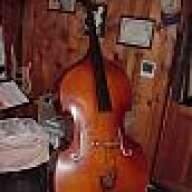
OK, I just got a new bass last week. I decided to cram it into my car to take it to a rehearsal. I ended up leaving it in the car for a while out in the sun, and the scroll was under the back window. Anyway, the some of the nylon apparently melted onto the finish on the scroll. How would I fix this!!??
Could some one elaborate on the process of treating the varnish after it has dried?
What kind of leveling techniques are used and what kind of rubbing compounds are used? Rotton Stone, MIcro mesh?
How can one achieve different levels of shine?
Any info would be great Thanks
What kind of leveling techniques are used and what kind of rubbing compounds are used? Rotton Stone, MIcro mesh?
How can one achieve different levels of shine?
Any info would be great Thanks
Could some one elaborate on the process of treating the varnish after it has dried?
What kind of leveling techniques are used and what kind of rubbing compounds are used? Rotton Stone, MIcro mesh?
How can one achieve different levels of shine?
Any info would be great Thanks
Mike, why the isopropyl rather than denatured alcohol?
As far as rubout, spirit varnish is a piece of cake compared to oil. I would level by wet-sanding with 800 and then 1200 grit, then shine it up with traditional French polish or padding lacquer. If it's too shiny for your taste, you can dull it a bit with 0000 steel wool. Press gently with the steel wool. When done, buff with a cotton cloth.
Hope it looks good...
Mike, why the isopropyl rather than denatured alcohol?
I talked to Lou about that. He said that Isopropyl alcohol dries slower than denatured making application a little easier.
But be careful. I bought 70% isopropyl from the drug store. The other 30% active ingredient was water. It turned my shellac flakes to jelly. Gross!
Then I tried the 90% Isopropyl and it worked well.
I used all the rubbing techniques you mentioned. It came out just fine.
Kay used Nitrocellulose Lacquer with (lacquer soluble) Aniline dyes for color.
Bob,
The early Kays look like they have some kind of cheap shellac; something out of the can. No?
I suppose that anything is possible on the early ones because of shortages during the WWII era, but all of the ones I've seen look like lacquer to me. I was also told by a person who had worked for Kay for several years that the finishing material used by Kay was nitrocellulose lacquer.Bob,
The early Kays look like they have some kind of cheap shellac; something out of the can. No?
This thread has been very insightful for me. Thanks to everyone who contributed. I'm getting close to varnishing the bass I'm building and have been testing different varnish techniques and colors. Here's what seems to be working for me:
One or two coats of amber shellac for a ground coat. Pad on a thin coat Behlen's Rock Hard (oil varnish) to seal the previous varnish, wet sand with 600 grit wet or dry, color coat with clear shellac tinted with Transtint dark walnut / reddish brown mixed, pad on another coat of Behlen's, wet sand, another coat of color, and so on until I get the desired depth of color. Then finish with several more coats of the Behlen's. It seems that the biggest challenge to brushing on a spirit varnish is that each coat can melt and screw up the last. One goof, and you're stripping the whole thing and starting over. The Behlen's in between makes brushing the shellac SO much less stressful. You're kind of locking in your progress as you go.
One or two coats of amber shellac for a ground coat. Pad on a thin coat Behlen's Rock Hard (oil varnish) to seal the previous varnish, wet sand with 600 grit wet or dry, color coat with clear shellac tinted with Transtint dark walnut / reddish brown mixed, pad on another coat of Behlen's, wet sand, another coat of color, and so on until I get the desired depth of color. Then finish with several more coats of the Behlen's. It seems that the biggest challenge to brushing on a spirit varnish is that each coat can melt and screw up the last. One goof, and you're stripping the whole thing and starting over. The Behlen's in between makes brushing the shellac SO much less stressful. You're kind of locking in your progress as you go.
This thread has been very insightful for me. Thanks to everyone who contributed. I'm getting close to varnishing the bass I'm building and have been testing different varnish techniques and colors. Here's what seems to be working for me:
One or two coats of amber shellac for a ground coat. Pad on a thin coat Behlen's Rock Hard (oil varnish) to seal the previous varnish, wet sand with 600 grit wet or dry, color coat with clear shellac tinted with Transtint dark walnut / reddish brown mixed, pad on another coat of Behlen's, wet sand, another coat of color, and so on until I get the desired depth of color. Then finish with several more coats of the Behlen's. It seems that the biggest challenge to brushing on a spirit varnish is that each coat can melt and screw up the last. One goof, and you're stripping the whole thing and starting over. The Behlen's in between makes brushing the shellac SO much less stressful. You're kind of locking in your progress as you go.
That's a good recipe for a crackled finish. If you are going to use spirit (shellac) for color, I'd go all the way with it. Or else consider using all oil varnish.

Matthew Tucker
Commercial User
- Aug 21, 2002
- 2,686
- 387
- Disclosures
- Owner: Bresque Basses, Sydney Basses and Cellos
with spirit varnish you need to work quickly. I find a cotton pad is sometimes easier to use than a brush for building up the body. The dilution of your spirit finish makes a huge difference, as does the temperature of your shop. Oil varnish is easier I think, you can tint with good artists oil colours.
<<That's a good recipe for a crackled finish>>
Thanks for the advice. When I discussed this with my "teacher", he said that there is a well known violin maker who does just that... spririt-oil-spirit-oil... I wonder how soon I would see a problem if I was going to have a problem. I'm hesitant to give up on it yet, since I'm really pleased with the results. I'm drying the coats out in the sun and so far it's as smooth as glass and very even looking.
Thanks for the advice. When I discussed this with my "teacher", he said that there is a well known violin maker who does just that... spririt-oil-spirit-oil... I wonder how soon I would see a problem if I was going to have a problem. I'm hesitant to give up on it yet, since I'm really pleased with the results. I'm drying the coats out in the sun and so far it's as smooth as glass and very even looking.
Matthew Tucker
Commercial User
- Aug 21, 2002
- 2,686
- 387
- Disclosures
- Owner: Bresque Basses, Sydney Basses and Cellos
and some people LOVE a crackled finish, so its whatever cooks yer goose. I wouldn't mind the crackle, but I think I'd worry about adhesion between the layers. that may be unfounded.
I also think this is good advice. I've seen crackling occur a year or more after an instrument was varnished. Even though Behlen's Rock Hard Varnish dries to the touch very quickly for an oil varnish, it still takes a considerable amount of time for the varnish to totally cure. You would likely be safe alternating spirit/shellac with the oil varnish if you don't mind waiting plenty of time between coats, but you could use the oil varnish with pigments and have the bass finish completed faster since you can put the next coat on after a day or two.That's a good recipe for a crackled finish. If you are going to use spirit (shellac) for color, I'd go all the way with it. Or else consider using all oil varnish.
My late mentor was very good at applying seedlac (spirit) varnish with a brush, but he used it water thin and typically put on 25 or more coats before he would rub it down. I've never been that good with a brush, so I prefer to spray it.
I'm also a bit skeptical about using the Transtint for color. As I read their website, it says it is fade resistant, but not color fast especially when using it as a varnish toner rather than a wood stain.
Thanks for the kind advice. I'm bummed because the test strips look way better than I expected for the first go round, plus I kind of like doing something not quite normal. The light fast thing did seem a little ambiguous on the website.
The light fast thing did seem a little ambiguous on the website.Latest posts
-

-

-

-
-
What I am finding out with regards to playing as I grow older
- Latest: Admiral Akbar
