
For me, it's about the neck. Nothing compares to an old, broken in Fender neck. I went to a local music store yesterday and played 4 or 5 custom shop, relic'd Fenders and the necks don't even come close to the real thing.

Enjoy the benefits of a premium membership!
Upgrade Account
-
TalkBass has been independent since 1998. Add your voice.
Create a free account to reply to discussions, view embedded media, and browse with fewer display ads.
Join free Log in
Want zero display ads or expanded classifieds tools? Compare plans.
You are using an out of date browser. It may not display this or other websites correctly.
You should upgrade or use an alternative browser.
You should upgrade or use an alternative browser.
Vintage Fenders. Why??
- Thread starter tb-player
- Start date
More options
Who Replied?

The only old Bass I want would be one of Larry Graham's white jazz basses or Bootsy's star bass.
If I got a good deal sure I might consider it but once I get near the 5k ranged Fodera, F Bass, Mayones, and slew of others would get my money 1st without hesitation.
If I got a good deal sure I might consider it but once I get near the 5k ranged Fodera, F Bass, Mayones, and slew of others would get my money 1st without hesitation.

Why a '69 Camaro? It's not nearly as advanced as a 2023. Why a '57 Corvette? It can't keep up with a C8.
Why an old Harley? Why your grandfather's old pocket knife? Why the same car you drove when you were 18? Why Pre-Fire Heaven Hill bourbon? Why a tube amp? Why vinyl on a turntable? Why CDs instead of MP3? Why an old Rolex?
Why are we entertaining a silly question?
Why an old Harley? Why your grandfather's old pocket knife? Why the same car you drove when you were 18? Why Pre-Fire Heaven Hill bourbon? Why a tube amp? Why vinyl on a turntable? Why CDs instead of MP3? Why an old Rolex?
Why are we entertaining a silly question?
Th answer the question directly, "Vintage Fenders, why?" - 'Cause I have a couple instruments I bought back then, and I haven't sold them. 
Some of the old stuff really plays and sounds great, reason enough to want those.
Some of the old stuff really plays and sounds great, reason enough to want those.


Here is a $2000 Peez dispenser. I can only assume it dispenses Peez candy far better than it's modern equivilents.

It seems like a lot of people that swear old Fenders are better than new basses are strictly comparing them to new Fenders. There's a whole world of brands out there nowadays, folks.
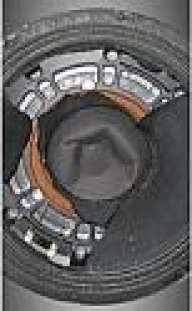
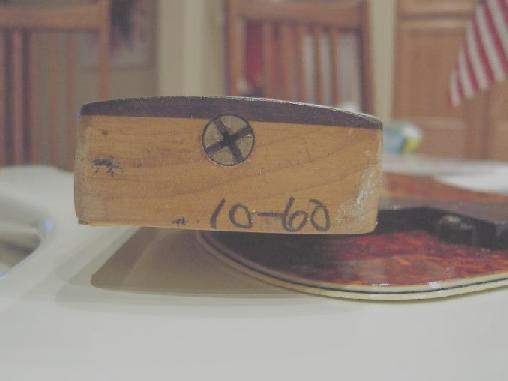
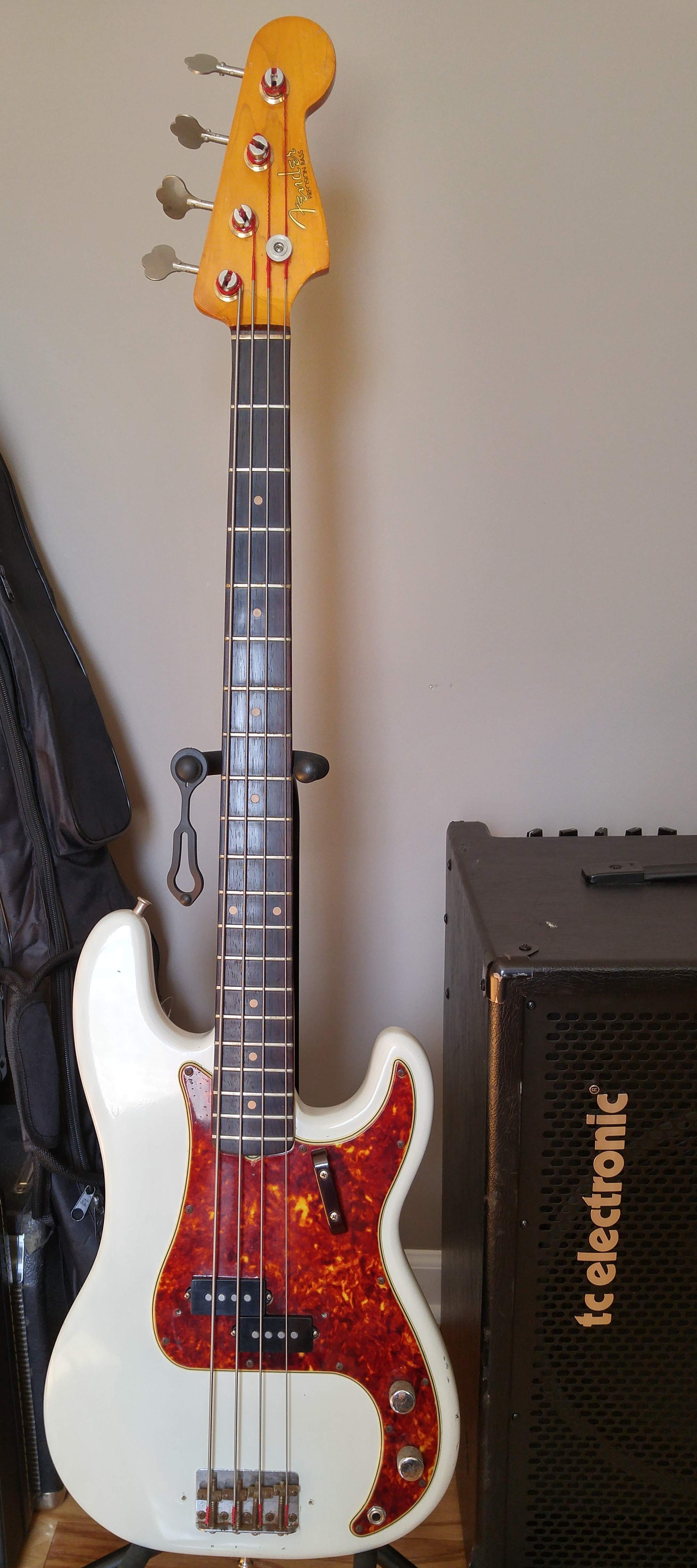
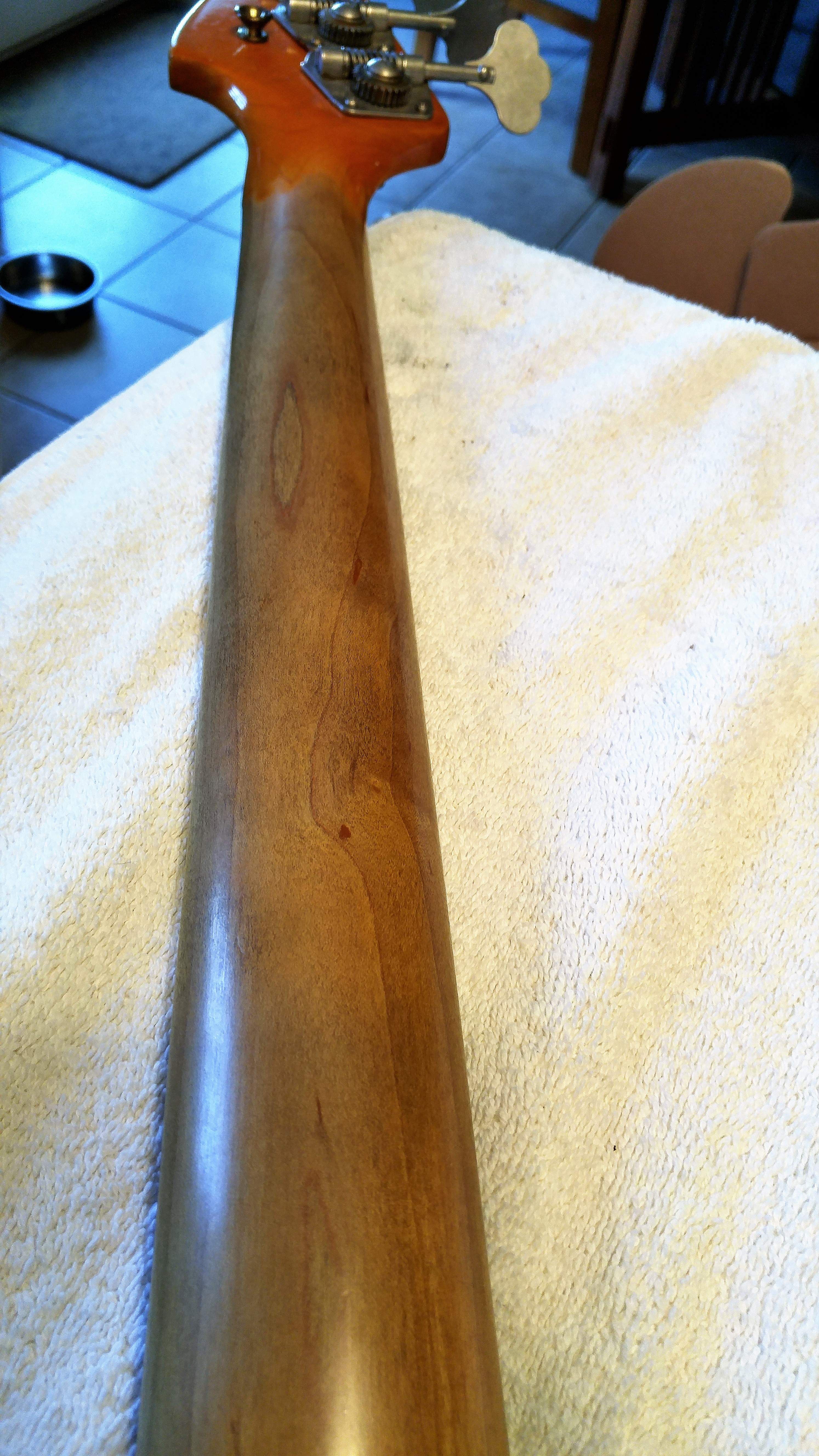
This is my 60 P bass which bought used in probably 72 or 73. I've owned it since then and for at least three decades was my ONLY bass. It's been in every state west of the Mississippi and 4 western Canadian Provinces. Temps from 115 + in AZ to -54 in Canada. I've only had to adjust the neck 5 times since I bought it. The truss rod nut isn't even sunken into the neck at all (see pic). That thick slab of Brazilian Rosewood keeps the neck ultra stable. The width is wider but the profine is thinner than a modern day P bass. None of my newer basses have been as stable as this one is. Chalk it up to better quality wood and better curing time back then. I had the body refinished in Oly White in 1985. No clear was shot on it so it hasn't yellowed very much. The pictures make it appear whiter than it is in person. The neck was refinished and refretted before I bought it and up until a quick re-crown a couple of years ago hadn't been touched since I bought it. Someone was smart and used huge jumbo frets so there's still plenty of fret left. Even after decades of using RotoSound RS66's. The wear you see in the pic is the real deal and I've yet to see any "relic" that truly approaches the visual and smoothness of wear on this neck. BTW I paid $270.00 for it from a local music store in AZ. It's worth to me now? PRICELESS. In collectors terms it is what's called "players grade" due to parts being replaced over the years. Hey, tuners, pots, screws wear out from use. Like I said the was my only bass for decades of road work.
I was a Fender dealer through the 70's and toured the factory in Fullerton during the 70's. Got to see the wood storage and temp controlled areas. Also we got a presentation on how the wood was chosen and how they picked the best and most stable wood. The man who was giving us the demonstration was an older gentleman who knew just about everything you could know about wood. There's a huge chance that nobody at Fender nowadays has the skill that old man did. Also the true craftsman such as Tadeo Gomez, whose neck carves were the best of the best are long gone. In fact, his ability to hand carve and shape a neck is probably better than anybody working in the custom shop nowadays.
One thing I learned from my friends who opened their own vintage shops is this, if you want a guitar that you are going to buy for a collection instrument. Look for one that looks almost new still. That said. if you want to buy one to play. Look for one with lots of mojo. He said the reason for that was, if an old guitar still looks new, it's because it probably wasn't that good to begin with, so it never got played. Then just as now, it's all up the skill of the craftsman building the instrument. A human still has to use the machine.
As to the never ending question of "are they better, and are they really worth that much"? Who knows? I've seen and played plenty of vintage instruments that were not that good. They either just played bad, or they didn't sound good. And as to the question of how much are they worth? Well, the old answer to that question tells you everything you need to know. How much is it worth? It's worth however much someone will pay for it.
I was a Fender dealer through the 70's and toured the factory in Fullerton during the 70's. Got to see the wood storage and temp controlled areas. Also we got a presentation on how the wood was chosen and how they picked the best and most stable wood. The man who was giving us the demonstration was an older gentleman who knew just about everything you could know about wood. There's a huge chance that nobody at Fender nowadays has the skill that old man did. Also the true craftsman such as Tadeo Gomez, whose neck carves were the best of the best are long gone. In fact, his ability to hand carve and shape a neck is probably better than anybody working in the custom shop nowadays.
One thing I learned from my friends who opened their own vintage shops is this, if you want a guitar that you are going to buy for a collection instrument. Look for one that looks almost new still. That said. if you want to buy one to play. Look for one with lots of mojo. He said the reason for that was, if an old guitar still looks new, it's because it probably wasn't that good to begin with, so it never got played. Then just as now, it's all up the skill of the craftsman building the instrument. A human still has to use the machine.
As to the never ending question of "are they better, and are they really worth that much"? Who knows? I've seen and played plenty of vintage instruments that were not that good. They either just played bad, or they didn't sound good. And as to the question of how much are they worth? Well, the old answer to that question tells you everything you need to know. How much is it worth? It's worth however much someone will pay for it.

utilitarian, reliable and sturdy workhorse basses. they used em back then, people like the sound from back them, people still use em.
Some people like old cars. If you could get your hands on a '65 GTO would you not go for it?
View attachment 5025859
I would not. It's just not me. I'd rather have an old VW Van or a Citroen 2CV.
The good ones tend to be very good. A buddy has a 59 P bass that is simply a great instrument. It plays easy and sounds phenomenal. It is the best P bass I have ever had a chance to play, and one of the best basses I've had a Chance to play, period.
All that said, it is not worth what it would cost to replace - even if you could find another one that plays that easily and sounds as good.
All that said, it is not worth what it would cost to replace - even if you could find another one that plays that easily and sounds as good.

I enjoy posts like this from owner/players as opposed to the many opinions from people who are giving strong opinions about something they have no experience with. Cool story and beautiful bass.This is my 60 P bass which bought used in probably 72 or 73. I've owned it since then and for at least three decades was my ONLY bass. It's been in every state west of the Mississippi and 4 western Canadian Provinces. Temps from 115 + in AZ to -54 in Canada. I've only had to adjust the neck 5 times since I bought it. The truss rod nut isn't even sunken into the neck at all (see pic). That thick slab of Brazilian Rosewood keeps the neck ultra stable. The width is wider but the profine is thinner than a modern day P bass. None of my newer basses have been as stable as this one is. Chalk it up to better quality wood and better curing time back then. I had the body refinished in Oly White in 1985. No clear was shot on it so it hasn't yellowed very much. The pictures make it appear whiter than it is in person. The neck was refinished and refretted before I bought it and up until a quick re-crown a couple of years ago hadn't been touched since I bought it. Someone was smart and used huge jumbo frets so there's still plenty of fret left. Even after decades of using RotoSound RS66's. The wear you see in the pic is the real deal and I've yet to see any "relic" that truly approaches the visual and smoothness of wear on this neck. BTW I paid $270.00 for it from a local music store in AZ. It's worth to me now? PRICELESS. In collectors terms it is what's called "players grade" due to parts being replaced over the years. Hey, tuners, pots, screws wear out from use. Like I said the was my only bass for decades of road work.
I was a Fender dealer through the 70's and toured the factory in Fullerton during the 70's. Got to see the wood storage and temp controlled areas. Also we got a presentation on how the wood was chosen and how they picked the best and most stable wood. The man who was giving us the demonstration was an older gentleman who knew just about everything you could know about wood. There's a huge chance that nobody at Fender nowadays has the skill that old man did. Also the true craftsman such as Tadeo Gomez, whose neck carves were the best of the best are long gone. In fact, his ability to hand carve and shape a neck is probably better than anybody working in the custom shop nowadays.
One thing I learned from my friends who opened their own vintage shops is this, if you want a guitar that you are going to buy for a collection instrument. Look for one that looks almost new still. That said. if you want to buy one to play. Look for one with lots of mojo. He said the reason for that was, if an old guitar still looks new, it's because it probably wasn't that good to begin with, so it never got played. Then just as now, it's all up the skill of the craftsman building the instrument. A human still has to use the machine.
As to the never ending question of "are they better, and are they really worth that much"? Who knows? I've seen and played plenty of vintage instruments that were not that good. They either just played bad, or they didn't sound good. And as to the question of how much are they worth? Well, the old answer to that question tells you everything you need to know. How much is it worth? It's worth however much someone will pay for it.
View attachment 5026117
View attachment 5026118
View attachment 5026119
Play one, play many and find out. Then your observations and experience will be yours. You don't know most of us so really all we offer are our experiences and or opinions.
I'd give credence to my opinion as I was playing them when they were just used basses between one and ten years old.
But don't really.
Play them yourself.
Judge each one on its own merits.
I have a killer '80/90s MIJ '51 P ri. Not vintage but it will be by the end of this thread.
I'd give credence to my opinion as I was playing them when they were just used basses between one and ten years old.
But don't really.
Play them yourself.
Judge each one on its own merits.
I have a killer '80/90s MIJ '51 P ri. Not vintage but it will be by the end of this thread.

This is also how I feel: I came of age and started playing in the mid-late 80's. I feel like my Guild Pilot is the best bass ever made and swoon over nice examples of Yamahas, Peaveys, and Steinbergers (knockoffs, mostly) of that era on Reverb.I get it if they grew up in the 60s or 70s. I had to have an 80s Steinberger in my hands, if only for a while, for the same reason: to recreate the sound in my head from when I first emerged into musical consciousness. The appeal proved short-lived.
Will Gen-X cause a bubble for these sorts of instruments the way Boomers did for old Fenders? Maybe, Matsumoku basses and their ilk are probably selling for more than they should (Hondos are expensive for Christ's sake), but I don't think you'll see the same sort of ridiculous prices that you see for old Fenders: it's a smaller generation, typically less sentimental, and generally without quite the disposable income.
I think why cars are an especially bad analogy is that we're seemingly only comparing old Fenders to split window Stingrays and late '60's GTOs, when these cars were exceptional even new. It's not like there's a tremendous market for late 60's regular LeMans or Plymouth Belvederes. Hell, probably hardly any still exist. Any value is in their novelty. Similarly, "vintage" Vegas, Dusters, or Mustang IIs have practically zero redeeming qualities over basically any modern car, which, in turn, will compare unfavorably in another 50 years. And yet even examples from the nadir of Fender quality are fetching big bucks.
Yeah when I compare my pre-CBS Fenders to what is being made today it's only modern Fenders I'm discussing. Otherwise it's not an apples to apples comparison.It seems like a lot of people that swear old Fenders are better than new basses are strictly comparing them to new Fenders. There's a whole world of brands out there nowadays, folks.

This is my 60 P bass which bought used in probably 72 or 73. I've owned it since then and for at least three decades was my ONLY bass. It's been in every state west of the Mississippi and 4 western Canadian Provinces. Temps from 115 + in AZ to -54 in Canada. I've only had to adjust the neck 5 times since I bought it. The truss rod nut isn't even sunken into the neck at all (see pic). That thick slab of Brazilian Rosewood keeps the neck ultra stable. The width is wider but the profine is thinner than a modern day P bass. None of my newer basses have been as stable as this one is. Chalk it up to better quality wood and better curing time back then. I had the body refinished in Oly White in 1985. No clear was shot on it so it hasn't yellowed very much. The pictures make it appear whiter than it is in person. The neck was refinished and refretted before I bought it and up until a quick re-crown a couple of years ago hadn't been touched since I bought it. Someone was smart and used huge jumbo frets so there's still plenty of fret left. Even after decades of using RotoSound RS66's. The wear you see in the pic is the real deal and I've yet to see any "relic" that truly approaches the visual and smoothness of wear on this neck. BTW I paid $270.00 for it from a local music store in AZ. It's worth to me now? PRICELESS. In collectors terms it is what's called "players grade" due to parts being replaced over the years. Hey, tuners, pots, screws wear out from use. Like I said the was my only bass for decades of road work.
I was a Fender dealer through the 70's and toured the factory in Fullerton during the 70's. Got to see the wood storage and temp controlled areas. Also we got a presentation on how the wood was chosen and how they picked the best and most stable wood. The man who was giving us the demonstration was an older gentleman who knew just about everything you could know about wood. There's a huge chance that nobody at Fender nowadays has the skill that old man did. Also the true craftsman such as Tadeo Gomez, whose neck carves were the best of the best are long gone. In fact, his ability to hand carve and shape a neck is probably better than anybody working in the custom shop nowadays.
One thing I learned from my friends who opened their own vintage shops is this, if you want a guitar that you are going to buy for a collection instrument. Look for one that looks almost new still. That said. if you want to buy one to play. Look for one with lots of mojo. He said the reason for that was, if an old guitar still looks new, it's because it probably wasn't that good to begin with, so it never got played. Then just as now, it's all up the skill of the craftsman building the instrument. A human still has to use the machine.
As to the never ending question of "are they better, and are they really worth that much"? Who knows? I've seen and played plenty of vintage instruments that were not that good. They either just played bad, or they didn't sound good. And as to the question of how much are they worth? Well, the old answer to that question tells you everything you need to know. How much is it worth? It's worth however much someone will pay for it.
View attachment 5026117
View attachment 5026118
View attachment 5026119
Great post. That the necks were hand carved is not entirely correct, though there certainly was hand finish/clean up work involved. This was the method:
That said, despite all the CNC advances, it's remarkable how tight a lot of the tolerances were on original pre-CBS examples (all bets are off on refins). Most have really tight neck pockets.

I live in a vintage '63 brick ranch. Its interesting to think about what the house and neighborhood looked like when it was new and LBJ was president. Now it's condition has charming mojo. Or it just needs maintenance and repairs depending on perspective.
Same with old instruments. Takes people back to a time. Rarity makes them special. Some have the opinion that they sound better or were made better.
Personally I would much rather live in a house that is new, constructed to more well thought out building codes, and doesnt contain generations of other people's dna. I suppose lead paint is more durable and asbestos drywall is more fire resistant though. They don't build em like that anymore.
Same with old instruments. Takes people back to a time. Rarity makes them special. Some have the opinion that they sound better or were made better.
Personally I would much rather live in a house that is new, constructed to more well thought out building codes, and doesnt contain generations of other people's dna. I suppose lead paint is more durable and asbestos drywall is more fire resistant though. They don't build em like that anymore.

it's a smaller generation, typically less sentimental, and generally without quite the disposable income.
Good point! I also think about the emergence of classic rock radio format in the late 80s, which over the next decade would make it increasingly difficult to hear current music except on college rock stations. In my hometown of Ottawa, the only major radio station playing quality new music made a much-publicized decision to switch definitively to "classics" of the 60s and 70s. Were I born five later, I too might be looking for aging Fenders (instead of Steinbergers)! Our drummer was born in 1977, not 1972 like me, and it's like the 80s didn't exist for him.
Last edited:
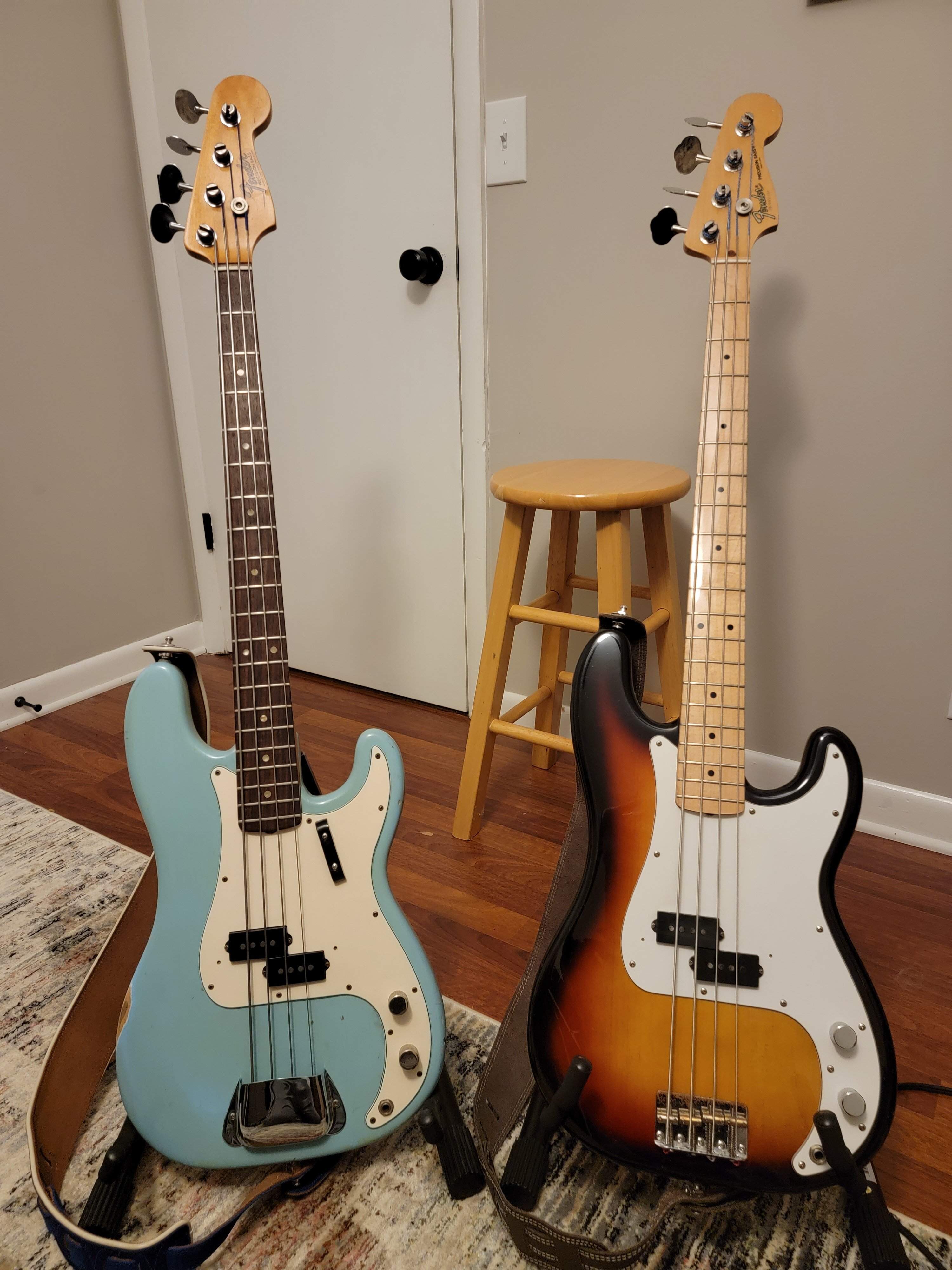
I've owned several "more modern" Precision Basses.
Around 2002, I rescued a '68 Precision from eBay that was being parted out, and I still haven't played another that feels and sounds as good as that one.
My first bass was a 1987 MIJ Precision, and that's a great bass, too, but weighs a lot compared to the '68 which is 8 lbs on the dot.
For me, that '68 just feels right. It's not just that it's vintage. It's that specific bass. The old ones aren't all created equal. I lucked out. I kept the 87 and the 68. I will never part with either of them.
Around 2002, I rescued a '68 Precision from eBay that was being parted out, and I still haven't played another that feels and sounds as good as that one.
My first bass was a 1987 MIJ Precision, and that's a great bass, too, but weighs a lot compared to the '68 which is 8 lbs on the dot.
For me, that '68 just feels right. It's not just that it's vintage. It's that specific bass. The old ones aren't all created equal. I lucked out. I kept the 87 and the 68. I will never part with either of them.
I live in a vintage '63 brick ranch. Its interesting to think about what the house and neighborhood looked like when it was new and LBJ was president. Now it's condition has charming mojo. Or it just needs maintenance and repairs depending on perspective.
Same with old instruments. Takes people back to a time. Rarity makes them special. Some have the opinion that they sound better or were made better.
Personally I would much rather live in a house that is new, constructed to more well thought out building codes, and doesnt contain generations of other people's dna. I suppose lead paint is more durable and asbestos drywall is more fire resistant though. They don't build em like that anymore.
My house isn't falling apart, it's relic'd! Honest play wear! My car, too.
Latest posts
-

-

-
 I'm back with a '51-ish P from parts (mostly), and a WB finish question
- Latest: Bruce Johnson
-

-
