

Enjoy the benefits of a premium membership!
Upgrade Account
-
TalkBass has been independent since 1998. Add your voice.
Create a free account to reply to discussions, view embedded media, and browse with fewer display ads.
Join free Log in
Want zero display ads or expanded classifieds tools? Compare plans.
You are using an out of date browser. It may not display this or other websites correctly.
You should upgrade or use an alternative browser.
You should upgrade or use an alternative browser.
Vintage Fenders. Why??
- Thread starter tb-player
- Start date
More options
Who Replied?

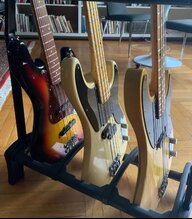
I have a 1969 Fender Telecaster Bass only because I bought it in 1969 and managed to hang on to it all this time. I owned only that bass for four decades. The truss rod has never been turned and the neck is still dead straight with no ski jump. The newer basses I have are only due to my curiosity and desire to learn and be informed.Those of you who own one, why do you love yours?
If I hadn't owned that bass all that time I would not seek out a vintage unicorn at today's collector values versus buying a new production or custom bass, as I have done.

I am sorry but doing blind tests where you compare an active bass and passive ones does not mean anything !I have a '66 Jazz Bass, a '70, Jazz, and a '97 Custom Shop Jazz Deluxe. Over the past two years or so I've done several blind tests at home and at gigs with my bassist friends. Every single time the '97 wins followed by the '66 and then the '70.
My '97 has the factory preamp and pickups. Some vintage purists poo-pah the Suhr era hardware (which is fine since everyone is entitled to their own personal preference), but it always ends up winning the blind tests. The reason I like it is because it has a MUCH wider array of tones than my other Jazz Basses.

It's the 3 you own. The 3. Not all the others that were also made in the same time period. I'm certain that if I had the time, money, and energy to to test out every surviving Fender bass from the 1960s, I'd find at least 3 that were very good. But that doesn't count all mediocre to bad basses that never made it to 1970 without being pieced out or trashed. And that doesn't even take into account the fact that your perfect bass could be one I wouldn't like. Once you get beyond objective criteria like "stays in tune" and "a signal comes out the jack and the controls work", it's a matter of personal taste.It's not bias from me - it's from hands on meticulous experimentation over the last 20+ years.
I literally don't even know what you just said or why you said it…It's the 3 you own. The 3. Not all the others that were also made in the same time period. I'm certain that if I had the time, money, and energy to to test out every surviving Fender bass from the 1960s, I'd find at least 3 that were very good. But that doesn't count all mediocre to bad basses that never made it to 1970 without being pieced out or trashed. And that doesn't even take into account the fact that your perfect bass could be one I wouldn't like. Once you get beyond objective criteria like "stays in tune" and "a signal comes out the jack and the controls work", it's a matter of personal taste.


I'm a simple man.
As a teenage boy in 1979, Tracy McLeary had the biggest boobs in my high school....and she liked musicians! So I bought a 1966 Jazz, joined my first band, did my first show and in the summer of 79 walking home with Tracy...I got to see the gods.
Vintage Fenders. Why?
Vintage Fenders = Boobs
Or maybe they just make us older guys remember a simpler younger time. I don't know.
I don't like to make life too complicated.
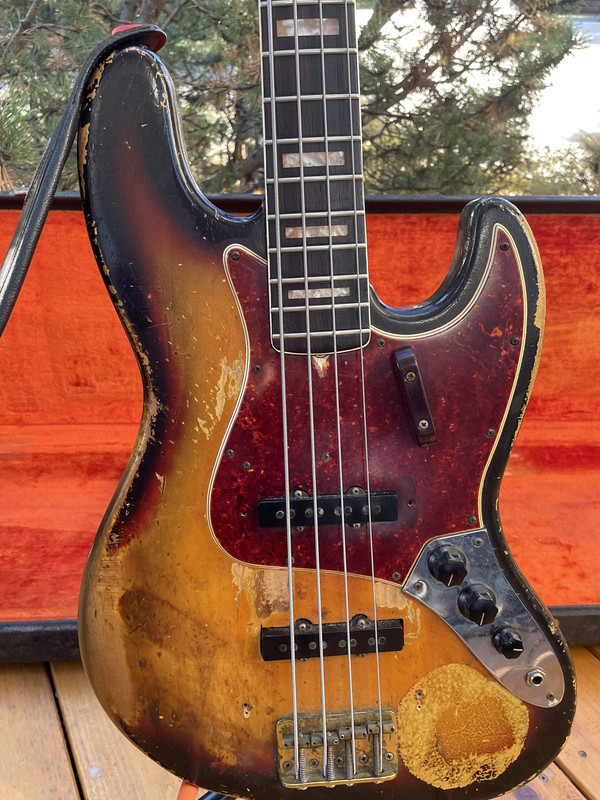
Oh....and here is a recent purchase....a 1966 Jazz.....I wonder what Tracy is up to??
As a teenage boy in 1979, Tracy McLeary had the biggest boobs in my high school....and she liked musicians! So I bought a 1966 Jazz, joined my first band, did my first show and in the summer of 79 walking home with Tracy...I got to see the gods.
Vintage Fenders. Why?
Vintage Fenders = Boobs
Or maybe they just make us older guys remember a simpler younger time. I don't know.
I don't like to make life too complicated.
Oh....and here is a recent purchase....a 1966 Jazz.....I wonder what Tracy is up to??

What you say about the quality of the work made by machines seem logical but on the other hand, in different business sectors, the objects made by craftsmen are known to have a better quality than what is made by machines.It is 100% true. In general, and in specifics.
The most masterful craftsman has tolerances of an 1/8"
Machines have tolerances of 1/1000"
Now, after the machines have done their job, it's in the hands of the craftsmen to finish the job. But, to start from 1/1000, compared to starting from 1/8 is a gigantic leap forward in every aspect.
Thank you Hartley. You are the man.
Oh, this was in agreement with you, on the guy you quoted. Not really quoting your post.


I think musicians will always have a yearning to own rare and iconic instruments. The older the current ones get, the more they are in demand. A new trend is the "birth year instrument". Buying a bass that was made the year you were born. For guys older than me that wasn't even possible! The more basses are reissued and copied, the more the originals will be sought after, IMHO. I never read the DC resistance, but I perceive the volume to be about the same as other basses. The tone is balanced and has no harshness. Even when it had rounds on it. The '76 had the stock pickup in it and sounded gritty and harsh. I replaced it with an old mongrel pickup that was in the spare parts drawer. I don't know what brand it is or how old it is but is one of the best sounding pickups I've ever heard. A little brighter than the '68 with the same clarity and even response. Very smooth sounding even with rounds.Have you ever read DC resistance across your 68 P's pickups? I have TI flats on mine also.
I'm not sure that buying a 60s or 70s Fender now would still be a good investment. The bass-buying public is getting younger every day, and soon the average buyer will not have any special attachment to that era, if they are even aware of it at all. Or, I could be wrong and they will keep appreciating.

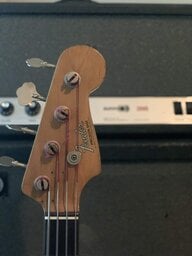
Still a better love story than twilightI'm a simple man.
As a teenage boy in 1979, Tracy McLeary had the biggest boobs in my high school....and she liked musicians! So I bought a 1966 Jazz, joined my first band, did my first show and in the summer of 79 walking home with Tracy...I got to see the gods.
Vintage Fenders. Why?
Vintage Fenders = Boobs
Or maybe they just make us older guys remember a simpler younger time. I don't know.
I don't like to make life too complicated.
Oh....and here is a recent purchase....a 1966 Jazz.....I wonder what Tracy is up to??
My hand-filed bespoke 12-bore side-by-side's wood to metal fit would argue otherwise.The most masterful craftsman has tolerances of an 1/8"
I'm deeply shocked. It's like being hit by a megger!I literally don't even know what you just said or why you said it…

devnulljp
Supporting Member
I like they way the old basses feel in my hands better than newer ones.
I have a bunch of older Fenders (and a couple pf others) from the 60s and 70s. I also have an FBass built in 2017, which is about as good as it gets wrt craftmanship. I still like the feel of the old ones.
That said, I don't think I'd be buying them now -- prices are nuts. I've seen early-but-still-CBS basses for 5 figures. If I'm spending 20grand on a bass (I'm not), it's probably be a Wal or something...and it would have to be hand delivered by Salma Hayek.
I have a bunch of older Fenders (and a couple pf others) from the 60s and 70s. I also have an FBass built in 2017, which is about as good as it gets wrt craftmanship. I still like the feel of the old ones.
That said, I don't think I'd be buying them now -- prices are nuts. I've seen early-but-still-CBS basses for 5 figures. If I'm spending 20grand on a bass (I'm not), it's probably be a Wal or something...and it would have to be hand delivered by Salma Hayek.

I have a 1969 Fender Telecaster Bass only because I bought it in 1969 and managed to hang on to it all this time. I owned only that bass for four decades. The truss rod has never been turned and the neck is still dead straight with no ski jump. The newer basses I have are only due to my curiosity and desire to learn and be informed.
If I hadn't owned that bass all that time I would not seek out a vintage unicorn at today's collector values versus buying a new production or custom bass, as I have done.
I bought one around 1975 for $150. Not sure what year it was, but it was hanging on the wall in a used instrument store,Thoroughbred Instruments, in Tampa. It had the humbucker at the neck, and I believe was the best sounding bass I have owned. They were not highly regarded at the time, but judging from prices on Reverb they are now.

Latest posts
-
 How can Fender release a "Vintage" series with an unplayable bridge?
- Latest: Fernando Costa
-
-
-
