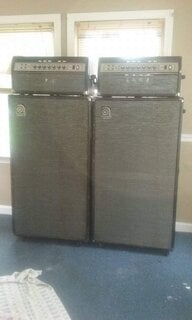
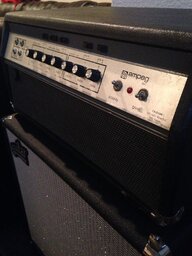
Psycho Bass Guy said:
ReidK said:
I said I thought you were exaggerating the risk. I didn't say there wasn't any.
Consider that this is a public forum and a BUNCH of young players here are convinced they can crack open any amp and resolder it to become the holy grail of bass tone. Since most are going to go off half-cocked regardless of all the warnings to the contrary, it's important that the fundamentals be stressed, especially since the issue of tube amp output impedance is so commonly misunderstood or flat-out wrong in MOST cases.
I don't see how this refutes my assertion that you were exaggerating the risks. Are you saying that you
should exaggerate the risks, to keep newbies out of trouble? Is that what you mean by "stressing the fundamentals"? I don't equate "stressing" with "exaggerating".
Psycho Bass Guy said:
ReidK said:
Yes, running a higher Z load stresses the OT and tubes and they will age faster, I wouldn't have disputed that.
..and you're still wrong.
Well, here's what you yourself said earlier in this thread:
Psycho Bass Guy said:
Also, since it puts your output tubes above their rated limits, you may have had to replace tubes much sooner than you should under normal conditions.
I call that "stressing the tubes".
And here's what Jerrold said in one of the threads you referred to:
Jerrold Tiers said:
What CAN happen if the load is too high?
1) Some amplifiers use feedback around the output transformer. Without proper loading, the transformer may not provide correct phase feedback, and that may cause oscillation, either an audible squeal, or an oscillation at above-audio frequency. Neither is good for the amplifier, output tubes can be "worn out" in seconds to the point where emission and power output is very low.
2) "Spike" voltages from transients may be considerably higher because the "reflected impedance" is higher than designed. That can cause damage of varying severity. In an amplifier that already "pushes" the tube ratings, that can be serious.
The SVT falls into category 1, BTW, since it has a global feedback loop from the OT secondary to the cathode of the first driver in the power amp.
Psycho Bass Guy said:
ReidK said:
But your first comment on the subject was that your amp "might blow up" and you didn't say much else.
That's because I have a few dozen OTHER posts that go into greater detail, as well as a much more comprehensive explanation in the FAQ that nobody seems to bother to read.
I was replying to what you posted in this thread.
Psycho Bass Guy said:
ReidK said:
When questioned about that, you replied with links to an earlier thread in which you explained how running an amp with no load can damage an amp, implying (in the context of the OP's question) that the same thing would happen with an 8 ohm load. That's the context in which I posted my comment about exaggeration.
If you don't understand the relationship between a higher load and no load, all you're doing here is splitting hairs to argue semantics. You've offered no technical info to back up your assertions; you've just said that mine are wrong. They're not.
I have not demonstrated any such lack of understanding. What I did was point out that there's a huge difference between a factor of 2 and a factor of several million, a difference which has a very real impact on potential damage to the amp. That is in no way "splitting hairs".
Anyone reading this thread can examine my previous postings, and they will find that I have, in fact, posted technical information, and that I have not, in fact, said anywhere that your technical information was wrong.