From our manual:
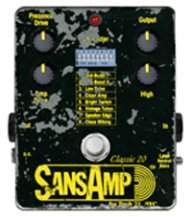
If desired, however, you can defeat the speaker simulation by disengaging the speaker switch (up
position). This will provide a slight 6dB per octave high-rolloff. As many amplifiers have a pre-amp
section with highs emphasized, this compensation will provide a more natural pre-amp sound
when going into the front of such an amp. Conversely, when going directly into a power amp or
an amp without highs emphasized, you may need to increase the High control on the pedal to
compensate for the lack thereof.
The tone controls on our Character Series pedals are post SansAmp circuitry. The sound of the pedal itself is really the Character and Drive controls. Everything else is after. The tone controls at noon are flat. The treble control is not adding anything. The treble control like the other controls allows you to boost or cut. The mids are fixed at 500 Hz.
The reason people sometimes "think" the pedal is bright is that they assume that their amp is flat. Most amps are anything but flat. There is no way for us or any other manufacturer to anticipate how a given player will set their amp's tone controls. Some pedals utilize a simple passive filter and we use active EQ as it gives you a wider range of control.
If the sound "works" with the treble control at 9 o'clock then there really is no problem.
The reason for the lack of DI on the VT Bass was it was designed to be a simple plug in and go stompbox. If you want a pedal with DI capabilities you could try our Bass Driver, Paradriver DI's or VT Bass Deluxe.
The other option is just buy an inexpensive DI (
Buy Nady DB-1 Direct Box | Direct Boxes | Musician's Friend) and that why you have a DI to use for other sources as well. Plus if you want to add other effects "after" the VT Bass you have that flexibility.
Or just get the Putnam mod. Lots of options.