
Enjoy the benefits of a premium membership!
Upgrade Account
-
TalkBass has been independent since 1998. Add your voice.
Create a free account to reply to discussions, view embedded media, and browse with fewer display ads.
Join free Log in
Want zero display ads or expanded classifieds tools? Compare plans.
You are using an out of date browser. It may not display this or other websites correctly.
You should upgrade or use an alternative browser.
You should upgrade or use an alternative browser.
VT Bass Version 2 Impression
- Thread starter Chrisk-K
- Start date
More options
Who Replied?


I'm back to using a VT Bass version 2. I used the vtbassdi more recently, I liked it enough, but the simplicity of the version 2 with the speaker sim off is all I need to find my happy place.
In direct comparison the v2 sounded fatter and ballsier with less hiss than the VT DI. It was a bit unsatisfying since the VT DI has such a high amount of features packed into that small box.

Thank you very much! It is very useful for me.I think the issue with your theory is that you are assuming that all the speaker sim is emulating is a high-end roll off. However, all cabinets have their own voice that contributes to lots of changes in frequencies across the spectrum. Tech21 has stated that they based the VT off of American-style 10" speaker cab, which of course is the Ampeg 810 fridge. It follows that the speaker simulation would emulate that cabinet, not a 15" loaded B15 cabinet.
Regardless, I think the key to using the pedal is to know that the character knob acts like a second mid control, but once you get above noon it adds a whole lot of harmonics, so use it sparingly. When dialed up, it makes the treble response of the original VT more harsh as there is so much harmonic content layered on top of it. To de-emphasize treble, definitely dial it down to 9 o'clock, and adjust the character knob to 10 o'clock or so. Then use the Mid knob to put the mids that the character knob removed back into the tone, and then go even higher to dial up a warmer sound. Then add low-end to get the fullness you want. The end result will be anything other than a clanky treble. In short, active EQ controls are always interactive, so you there are ways to change the treble response without ever having to touch the treble knob.
In the end, it doesn't matter where the knobs are set as long as the sound is good.
I've read that the same or very similiar tones are available on all versions of the VT Bass. I haven't been able to produce the same tones with the pedal versions. I like the vtbassdi better than version 1, but the speaker sim bypass seems to work better for me on version 2.
The blend on the vtbassdi is after the eq, maybe if it was pre eq it would have been more useful for me.
The blend on the vtbassdi is after the eq, maybe if it was pre eq it would have been more useful for me.
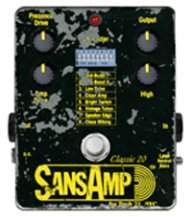
There is going to be a big difference when using the VT Bass into the front end of a bass amp vs into a power amp vs direct. The VT Bass V2 with the speaker sim switch has the high cut filter that makes it easier to use as a stompbox into the front end of an amp. The VT Bass DI's speaker sim is just a bypass of the speaker emulation and there is no additional high cut filter in its place like the V2 pedal. Plus the VTBass DI has the "Bite" switch. When engaged that is the stock VT Bass sound. When disengaged the subsonic filter and presence boost are removed and the pedal is running full range. Part of the rationale for the DI version was for studio use if a player wanted to use IR's or something like the Torpedo cab.

I don't know what they changed between V1 and V2 but I 'upgraded' a couple of years ago and can no longer get the same sizzle that's apparently just residing in a different dial setting... If anyone knows what the difference is between them, I'd be interested.
I don't know what they changed between V1 and V2 but I 'upgraded' a couple of years ago and can no longer get the same sizzle that's apparently just residing in a different dial setting... If anyone knows what the difference is between them, I'd be interested.
The pedals should sound the same. Do you maybe have the speaker sim bypassed?
The pedals should sound the same. Do you maybe have the speaker sim bypassed?
Hi, no I always have it engaged. Were any different components used when creating the V2? The level is obviously less hot for a start, which is a good thing as after 9 o'clock my V1 used to be incredibly loud. Has increasing the headroom made the drive act differently? I have seen it on here somewhere that the exact same sound should be achievable albeit with a slightly different dial position, but I've never found it, and my settings used to be very specific with the V1 which I now miss. How would I achieve the same sound found in the V1 with the dials set as follows? (Level 9, Mid 10, Character 2, Drive 11, Low 1, High 8) surely not with the same settings, as I'm getting zero of the sizzly mild beginnings of breakup I used to get.
Thanks for your reply.
Think I finally hit it. And for other's reference (and according to my ears only):
V1 Level 9 = V2 Level 10:30
V1 Mid 10 = V2 Mid 8:30
V1 Character 2 = V2 Character 3:30
V1 Drive 11 = V2 Drive 10:30
V1 Low 1 = V2 Low 1
V1 High 8 = V2 High 9
YRMV
V1 Level 9 = V2 Level 10:30
V1 Mid 10 = V2 Mid 8:30
V1 Character 2 = V2 Character 3:30
V1 Drive 11 = V2 Drive 10:30
V1 Low 1 = V2 Low 1
V1 High 8 = V2 High 9
YRMV

Potentiometer tapers vary, which may explain some of the difference. Have you tried with the speaker sim disengaged? I'm wondering if it works in the opposite way? IIRC, the V2 sounds brighter with the sim engaged due to the addition of a LPF when bypassed (which is counterintuitive).
Potentiometer tapers vary, which may explain some of the difference. Have you tried with the speaker sim disengaged? I'm wondering if it works in the opposite way? IIRC, the V2 sounds brighter with the sim engaged due to the addition of a LPF when bypassed (which is counterintuitive).
Hi, yes and I find it's a whole different flavour without it there. Had tried unsuccessfully to recreate the sound with it disengaged, but it's like it makes it all looser and less compressed.
Hi, no I always have it engaged. Were any different components used when creating the V2? The level is obviously less hot for a start, which is a good thing as after 9 o'clock my V1 used to be incredibly loud. Has increasing the headroom made the drive act differently? I have seen it on here somewhere that the exact same sound should be achievable albeit with a slightly different dial position, but I've never found it, and my settings used to be very specific with the V1 which I now miss. How would I achieve the same sound found in the V1 with the dials set as follows? (Level 9, Mid 10, Character 2, Drive 11, Low 1, High 8) surely not with the same settings, as I'm getting zero of the sizzly mild beginnings of breakup I used to get.
Thanks for your reply.
The "taper" of the Level control was changed but there is no difference in headroom. On the V1 the volume came on quickly which didn't work for everyone. There is still the same amount of Level available from off to maximum. As a previous poster stated there are variances in potentiometers. When we test we use an oscilloscope to test against our test unit and the control positions will vary. You have to use your ears for the best results as you've discovered.
Indeed, thanks.The "taper" of the Level control was changed but there is no difference in headroom. On the V1 the volume came on quickly which didn't work for everyone. There is still the same amount of Level available from off to maximum. As a previous poster stated there are variances in potentiometers. When we test we use an oscilloscope to test against our test unit and the control positions will vary. You have to use your ears for the best results as you've discovered.

From our manual:
If desired, however, you can defeat the speaker simulation by disengaging the speaker switch (up
position). This will provide a slight 6dB per octave high-rolloff. As many amplifiers have a pre-amp
section with highs emphasized, this compensation will provide a more natural pre-amp sound
when going into the front of such an amp. Conversely, when going directly into a power amp or
an amp without highs emphasized, you may need to increase the High control on the pedal to
compensate for the lack thereof.
.....
After years of loving the sound of the V1, and recently getting the VT Deluxe with defeatable speaker sim, I decided to get the VT v2 as well.
Comparing the V1 and the V2 (w. speaker sim engaged), with the same "settings" (setting the knobs on both pedals the same) the difference in tone surprised me:
The V2 was way more quiet, but overdriven. In order to compensate for this, I had to increase the Vol pot from 10 o'clock to 1 o'clock and decrease the Drive pot from 11 o' clock to 9 o'clock. I don't think this can be attributed to pot tolerances.
Did I get something wrong?
Yes. The V1, V2, and Deluxe are based on the same circuit but can't be compared in the same way. The taper of the Level control on the v1's comes on earlier and the settings on the Deluxe are not at all related because we use 256 step digi-pots that work with the microprocessor vs analog pots. You must have the speaker sim on to compare the units.
In the end you should adjust for the sound you want vs trying to visually match settings. Even two identical pedals will not match at the same settings due to pot tolerance. That's why we use a scope to test.
In the end you should adjust for the sound you want vs trying to visually match settings. Even two identical pedals will not match at the same settings due to pot tolerance. That's why we use a scope to test.
I've owned the VTDI, both versions of the original VT and the Deluxe. I thought they all sounded different which was strange and a little annoying. The VTDI is my favorite, largely because of functionality, but I still think the original VT sounds the best.
I got the Deluxe a few weeks ago for my small board. It is the later version with the speaker sim defeat button.
I prefer not to use the speaker sim (disengage the button).
This made me buy the V2 for my bigger board where I only need one VT sound.
After clarifying the differences between the V2 and V1 (which I am playing for more than 10 years), the V2 might replace it on that particular pedal board.
Thanks a lot @tech21nyc !!!
I prefer not to use the speaker sim (disengage the button).
This made me buy the V2 for my bigger board where I only need one VT sound.
After clarifying the differences between the V2 and V1 (which I am playing for more than 10 years), the V2 might replace it on that particular pedal board.
Thanks a lot @tech21nyc !!!


