• TalkBass has been independent since 1998. Add your voice.
    Create a free account to reply to discussions, view embedded media, and browse with fewer display ads.
    Join freeLog in
    Want zero display ads or expanded classifieds tools? Compare plans.

Walnut wishes, and six string dreams

Pardon the interruption... I have gone through this thread and fixed all of Brandon's images.

@Big B. A suggestion: Don't use photo bucket :) TalkBass offers everyone unlimited image uploads now. Just drag your image files into the text editor box, and they'll upload. Hit the button to "insert all" images as full images, and then put your caption text in between the photos. If you're on mobile, just hit the "upload a file" button (next to post reply), and you can upload from your camera roll etc.

Screenshot at Mar 12 22-35-40.png
 
For the sake of catching this thread up to my current progress we're going to skip a few steps. Before I finish sand and spray I always pre assemble the bass to make sure everything works properly. For pickups and electronics I'm using a set of Bartolini deep tone dual coils and a Bartolini NTMB 3 band preamp.

20150228_152354.jpg


Everything went together smoothly and the bass plays great so I broke it down again and got on to the tedious job of finish sanding.

In the past I've always used nitrocellulose as my finish but I'm frustrated with the cure time so I've decided to try a high grade conversion varnish on my next batch of personal basses so I don't have to experiment on customers' instruments. It's not quite as easily applied as a traditional laquer but it builds very quickly and cures to a very durable final finish. I'm used to spraying 10 - 12 coats of laquer before I buff and sand but after 4 coats the conversion varnish was built up enough to fill the grain of the walnut.

20150308_172736.jpg


The best part is that after 24 hours the finish is cured and ready for buffing and sanding.
 
Now that the finish is cured it's time to sand. Instead of wetsanding like I usually do I started with thin, flexible sanding sponges from my local paint store and expected to move on to wetsanding but the sponge did an unexpectedly good job. After a fairly light sanding the body and neck both are at a nice satin sheen that is very pleasing to the hands.

20150317_233709.jpg


20150317_233830.jpg


20150317_233359.jpg


20150317_233145.jpg


The sanding sponges also did a great job of removing the excess finish from the frets and left a perfect satin finish on the neck and fingerboard. The neck will keep the satin sheen, except for the walnut headplate that will be polished to a high gloss along with the body.
20150317_233432.jpg


20150317_233536.jpg
 
[QUOTE
arrow-10x10.png
="HaMMerHeD, post: 17108573, member
arrow-10x10.png
: 57295"]Do you have a make/model on those sanding sponges?[/QUOTE
arrow-10x10.png
]

They are just standard 3M sponges you can find at most paint shops. They are the preferred
arrow-10x10.png
sponge for most shops I've worked in but for some reason I can never find them at Lowes or HD.

20150321_113704.jpg


I use the super fine grit but even those are too rough when they are new. I like to use them to pre sand the body before I spray. Not only do the flexible sponges work great for that last bit of touch up sanding, it removes the sharp edges and dulls the grit. Once they are fairly worn I wash them out and save them for sanding between coats or after the final coat as I am here.

[QUOTE
arrow-10x10.png
="Ol'Bass'ead, post: 17109917, member: 49762"]Care to share the details of the finishing product?[/QUOTE
arrow-10x10.png
]

The finish I am spraying is a 2 part conversion varnish. The particular product is called Sher-Wood and is made by Sherwin Williams. Being a two part mix a catalyst is required as well. Its a fairly expensive initial investment as the catalyst is about 45$ a bottle, but I estimate will catalize around 10 gallons. A gallon of the varnish cost me a bit over 60$ but I found that I ended up saving a little bit over lacquer due to the higher build.
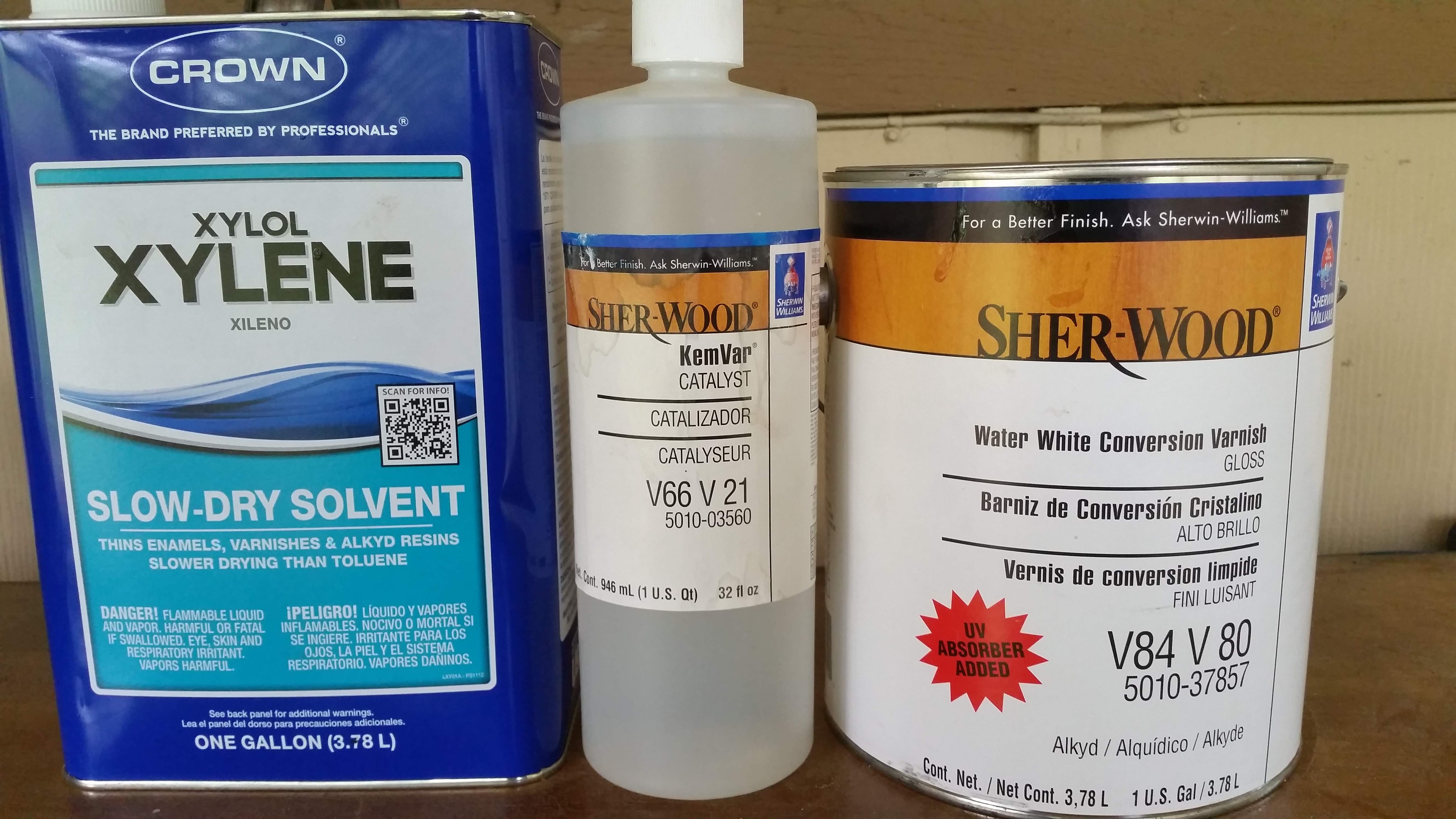
20150404_104355.jpg


Conversion varnishes are not a common finish unless you work in high end woodshops. They are high solid finishes designed to build quickly. Its generally agreed that Xylene is the best solvent to use, though thinning is really only advised for the sealer coat(s). For years I have been spraying lacquer for my guitars and furniture and I would estimate that one good coat of CV is equivalent to 3 coats of lacquer once the finish dries. If you wait more than a couple of hours between coats it is required to lightly sand the previous coat for adhesion but if you spray one coat after another with just enough time to flash off it can be built up without sanding. One cool advantage is that blushing is just not an issue for whatever reason, so that's one less problem to deal with. I've found that it takes about 5 coats to build to what I want for a guitar and that takes about 2 hours or so. Another great thing about CV is that it cures fast and can be wetsanded and buffed in 24 hours or so.

Obviously all these positives will be balanced by drawbacks as well. Cleanup is much more necessary than lacquer because once the varnish is catalized there is a pot life of a couple days or so if you keep the excess in a covered container in a fridge. Left in the gun though, it will start setting up quite quickly and once it sets the gun becomes really hard to clean. I get around this by buying a 20$ gun from harbor freight and disposing of it once I finish that project. It sounds crazy but those cheap guns work quite well if you clean them properly before use. It's also important to monitor the temperature as it definitely needs to be sprayed at 65 degrees or higher.

So, if you only consider the final product it's hard to argue with the conversion varnish as it applies and cures much more quickly and the finish itself dries very hard and is quite resistant to chemicals. In the big picture though, CV is a more difficult finish to work with and things like proper gun setup can be much more touchy. Also keep in mind that I work 20 feet from one of the best finishers in Austin. I would probably have had much more difficulty without his guidance. I'm also not convinced yet that CV is quite as attractive as lacquer, I'll have to build a couple more to find out.
 
  • Like
Reactions: Ol'Bass'ead
I'm going to have to give the conversion varnish a try. Its not quite as expensive as the 2k urethane I am using now and it seems to flash faster. With the 2k urethane one coat a day is the maximum
 
I'm going to have to give the conversion varnish a try. Its not quite as expensive as the 2k urethane I am using now and it seems to flash faster. With the 2k urethane one coat a day is the maximum

1 coat a day sounds like a drag. The conversion varnish flashes at about the same speed as a lacquer and you can immediately recoat with no sanding in between. It's very doable to completely spray a guitar in one afternoon. I originally considered a 2k urethane but after looking at the price I wasn't too thrilled. The conversion varnish might not be quite as tough as the urethane but it dries quite hard and is still very resistant to chemicals.
 
1 coat a day sounds like a drag. The conversion varnish flashes at about the same speed as a lacquer and you can immediately recoat with no sanding in between. It's very doable to completely spray a guitar in one afternoon. I originally considered a 2k urethane but after looking at the price I wasn't too thrilled. The conversion varnish might not be quite as tough as the urethane but it dries quite hard and is still very resistant to chemicals.

Do you spray a tack coat/wet coat or just a single wet coat like you would with nitro?

I think the advantage that the 2k urethane still has over conversion varnish it that it may be a higher build finish. I can do a solid color instrument in 4 coats with the 2k stuff, the first sealer coat basically gets completely absorbed into the wood, so the second coat starts building.
 
I just spray single coats like lacquer.

I can't speak on the 2K but I was surprised how quickly the CV builds. Much like you describe, the first coat mostly soaked up but the 2nd coat builds nicely. The pores in the walnut are relatively small but 4 coats were enough to fill the pores completely. After the 4th coat I waited a day, sanded it smooth with a sponge, and then sprayed a final coat that laid down like glass.
 
Last edited:
I just spray single coats like lacquer.

I can't speak on the 2K but I was surprised how quickly the CV builds. Much like you describe, the first coat mostly soaked up but the 2nd coat builds nicely. The pores in the walnut are relatively small but 4 coats were enough to fill the pores completely. After the 4th coat I waited a day, sanded it smooth with a sponge, and then sprayed a final coat that laid down like glass.

Cool, I think I will stick with the 2k for flake finishes, and solid colors (may experiment with the CV over a urethane color coat), and go with the CV on natural finished instruments.
 

Latest posts