Torted it!Another iteration of this bass: now with a MIM Fender Player Jazz neck.
The body is a 15-ish years old Warmoth, mahogany with nitro Shoreline Gold finish.
Invalid Link Removed
Invalid Link Removed
Last edited:

TalkBass has been independent since 1998. Add your voice.
Create a free account to reply to discussions, view embedded media, and browse with fewer display ads.
Join free Log in
Want zero display ads or expanded classifieds tools? Compare plans.
Torted it!Another iteration of this bass: now with a MIM Fender Player Jazz neck.
The body is a 15-ish years old Warmoth, mahogany with nitro Shoreline Gold finish.
Invalid Link Removed
Invalid Link Removed

I'm normally not a big fan of tort, but that works well.
Me neither, especially when it's a dull brown.I'm normally not a big fan of tort, but that works well.
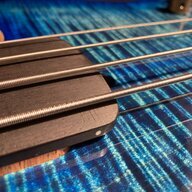
I’m curious why it won’t be staying on that beautiful bass? Are you going to put it on something else?I have one and it’s fantastic! It won’t be staying on the Bisonic P build seen in the pic.

Thanks for the compliment. But, I have a bound and blocked neck that will look even better paired up with the turquoise body. The all rosewood neck will go back on another bass that I gig fairly often. The turquoise bisonic P will be sold when I complete it.I’m curious why it won’t be staying on that beautiful bass? Are you going to put it on something else?

Found/copied this from a post on the EBMM forum:Thinking of putting together a warmoth parts jazz bass. Does anyone know what fret size would be closest to what Ernie Ball Music Man uses on their Stingrays? That's what I'm most used to.
I don't actually know if I'd know the difference in the end
Found/copied this from a post on the EBMM forum:
According to the e-mail from MM Customers Service:
The fret wire size of a Musicman Stingray (Not Classic, Not Special) is Jescar 47104
Width: 0.104"(2.64mm) Height: 0.047"(1.19mm)
No problem… Google did the workThanks for digging that up!


Just had my Warmoth holo-flake P-J Plek'ed and a brass nut installed. Plays, looks and sounds like a dream now!
View attachment 5459027 View attachment 5459028 View attachment 5459029
Anybody had any experience with all-Rosewood necks from Warmoth?

Did you get the steel/graphite rods? I'd be interested to see how much that neck weighs. Looking forward to the pictures later this year.well order placed.... now we wait. Putting a build together with a body made by someone locally. Will be a sweet passive jazz. Warmoth is supplying the wenge neck with ebony board! Two of my favorite woods. I actually decided to go with the small vintage frets in stainless steel. Pickups will be the Kloppmann 60s pickups. Will post pics later this summer when it comes together!
Did you get the steel/graphite rods? I'd be interested to see how much that neck weighs. Looking forward to the pictures later this year.

My Warmoth neck, 34" scale, with graphite rods was 1.35 lb. in case anyone was wonderingDid you get the steel/graphite rods? I'd be interested to see how much that neck weighs. Looking forward to the pictures later this year.

My Warmoth neck, 34" scale, with graphite rods was 1.35 lb. in case anyone was wondering
I had a maple/ebony P bass neck that came in at 2lbs 5.2 oz. and that is after I shaved off some wood on the back. Graphite rods. You got a light one!My Warmoth neck, 34" scale, with graphite rods was 1.35 lb. in case anyone was wondering
Roasted maple, sorry, should have specified that. Also it was a Warmoth neck, with the Warmoth headstock, not the oversized Fender style headstock. Tiltback I believe it is referred to, so that alters weight as well. It is what I use on every build now, no finish, super smooth, but you can use 800, 1000, 1200, 1500 grit sandpaper for just a few minutes at each grit and it will be glassy smooth. The shop finishes them with 650 grit if memory serves. I have talked to people who have gone to 2000 and 2500 grit, I tried it, but I honestly can't tell the difference at that point, as you are removing only the tiniest bits of material doing it for a few minutes.What woods were used for yours?
Anything over 400 is a waste of effort. Higher than 800, and you are polishing more than removing wood, and the fine sawdust just packs into the grooves and pores.Roasted maple, sorry, should have specified that. Also it was a Warmoth neck, with the Warmoth headstock, not the oversized Fender style headstock. Tiltback I believe it is referred to, so that alters weight as well. It is what I use on every build now, no finish, super smooth, but you can use 800, 1000, 1200, 1500 grit sandpaper for just a few minutes at each grit and it will be glassy smooth. The shop finishes them with 650 grit if memory serves. I have talked to people who have gone to 2000 and 2500 grit, I tried it, but I honestly can't tell the difference at that point, as you are removing only the tiniest bits of material doing it for a few minutes.
EDIT: FYI, every roasted maple neck I have had has come in between 1.25 and 1.5 lb, whether short scale or standard scale. I'm thinking the removal of like 99% of all moisture is removing the difference in weight vs. none roasted necks. I'm sure other woods make a difference as well, but overall you probably save at least a .5 lb in weight going roasted it seems. That way I can go for a lighter body and never worry about neck dive at all. My last P bass build is 7.25 lb.


