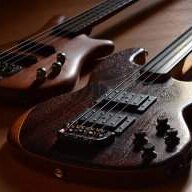
Don't get me started on Warwicks. Heh. I've been lusting after and playing them since 91 or so, my first job in a music store was at a Warwick dealer, and at that time only "golden era" basses were bein made, the bolt ons were just starting out. This was just before the Corvette was introduced, and my first Warwick was an original Bolt-on Thumb, with a Walnut body, maple neck and wenge board. I've owned, played, set up and rebuilt at least a hundred Warwicks since then, but none ever sounded quite like that bass. I was young, traded it for other stuff, and wish I hadn't.
Thumb basses are unique, and all here have listed their weaknesses quite well. I'd also buy used, as prices for the new ones are high, to me. But don't let me be a judge, I think all basses and gear are priced far too high new. The old necks are different, bigger, thicker shoulders, but a piece of info many forget were that those necks were ergonomically designed that way. The reason? The necks are the same thickness from nut to body joint, with a flat space along it's neck in the back for your thumb, promoting proper playin technique, and uniform pressure to fret each note. I love this feature! This feature also keeps mass in the neck, which adds to sustain and a neck that doesn't absorb vibration, but reflects it. Warwick basses are loud acoustically. My 90 Streamer neck is also assymetrical, slightly thinner on the G side.
The nut on Warwick basses is unique, too. I've played all three versions of the JAN, just a nut... The material doesn't matter. The adjustability DOES matter. Getting the nut height right is all the difference in playability of basses. This design, whether brass or "Wiferite", their name for the material used in the JaN II, is great!
I play Streamer basses, now. I never could get used to the narrow spacing of most of Warwicks models. If all I played was narrow spaced 5s, I could. The spacing on 4 string Warwicks is normal. But their 5s an 6s are a bit too tight fer me. I sacrifice some of the Warwick "growl", but the Streamer bodies agree with me better, in balance and weight.
As I, and others, have said, used is the way to go. In a pawn shop here, there are two 4 string Thumb bass 4 strings. An NT and a Bolt. Both in great shape. The NT is $1500 or so, the Bolt is $900 or so, prices vary as to how much cash one is carrying. I've seen 5 strings in this range used, so the prices listed are a bit high. But the basses are worth it. Tonally, there's nothing like em. With Bubinga or Ovankol, maintenance is easy. Dark, hard, oily woods handle the rigors as well, or better, than nearly any painted finish anywhere. You can wax em, but you don't have to. My maple bodied Streamers need waxing to keep their light color, but the darker woods are far more tolerant.
I've also learned the newer basses Warwick is making, on a purely construction level, are superior to the old, handmade ones. Some of the magic isn't there, but the tolerances in construction are WAY tighter than in the old days. Hardware changed awhile, but I couldn't tell a tonal difference. Only weight. The hardware on my old Stage I 5 fretless weighs 3 lbs or more, when I take it off to wax my bass? My bass is so light it is scary. The newer hardware Warwick went to in the late 90s weighs far less, and really had no bearing on sustain or punch. If I were getting a Thumb today? I'd want the heavier hardware. Tho it adds weight? It also helps balance the bass.
And a last word on wenge. Get a wenge fingerboard. That wood, along with the bell brass frets, is the absolute key to Warwick's tone, in my mind. As someone said, wenge is one wood that has a sound, and it's use defined Warwick tone in the early days. If yer getting a fretted Warwick, a wenge board is essential.
There are a ton of variations of these basses. Thru the years Warwick tried a tons of things. No two are quite alike. But I think a Thumb is the perfect second to a traditional fender style bass. Enuff common tonal ground that both can be used in similar situations, but a lot of variation that can cover virtually any gig situation that comes up. A Corvette can do lots a Thumb does, for less cash and better balanced instrument. But the Thumb is an icon for a reason. Hope you find yours.