• TalkBass has been independent since 1998. Add your voice.
    Create a free account to reply to discussions, view embedded media, and browse with fewer display ads.
    Join freeLog in
    Want zero display ads or expanded classifieds tools? Compare plans.

Warwick gnome cab has a literal tweeter ...

So I just picked up this Warwick gnome 110 as a cheap practice cab and was interested in taking a look inside of it. It turns out the tweeter brand is probird which is meant for playing bird calls to attract them.

They bothered putting a proper crossover in with level control which would have cost a bit but then they have this piezo tweeter that would cost all of $1. It sounded like tearing paper with any distortion and can not be turned off so I just disconnected it.
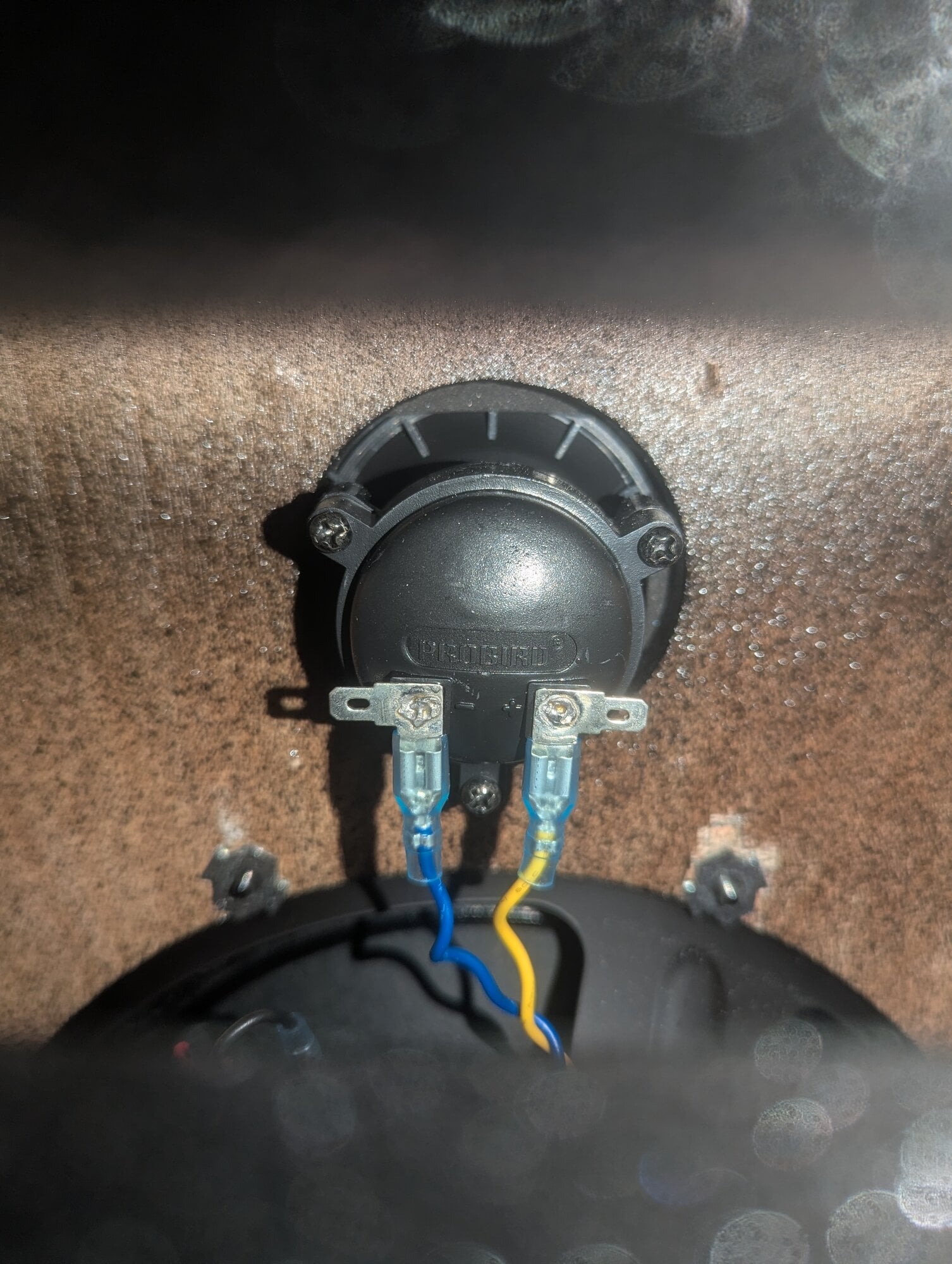
1000017461.jpg
 
Looking at the crossover it's a high pass filter control rather than a proper level control. My guess is that a level control you would have on a regular tweeter just doesn't really work because the piezo acts as a capacitor. The control cuts highs/high mids but the very top end stays the same no matter the setting.


I was contemplating wiring up a switch for the tweeter so I can turn it on and off whenever but I'll see if I end up wanting it again. It's easy enough to reconnect it because I just pulled the spade connectors and taped them
 
I looked into this (in a strictly amateur way) when I was building some tweeter top boxes for a mini and cheap PA. Best practice information for piezo tweeters is very thin on the ground in the public domain, but my understanding (FWIW) was that you're quite correct, a conventional LPAD doesn't do the job for a piezo. I ended up making a voltage divider on the far side of a high pass capacitor, and to my ears the results are perfectly adequate.

Incidentally I didn't find the end results from the piezo tweeters I used nearly as unpleasant as convention will have it, I'm quite happy with the end result, but this PA isn't required to deliver serious volume. I do have to knock the tweeter volume down a couple of notches, they seem to be pretty efficient and its easy to have them deliver too much which does indeed sound harsh. But the setup does work adequately at delivering a bit of crispness where the main drivers don't, which is all I ask for.
 
Yes, distortion through a piezo sounds like an amplified recording of a bee hive, and I also agree the an L—PAD on a piezo works more like a switch, but you can get a little level control in the last 1/16 of a turn…

To me, the best smooth sounding high end for a bass cab is produced by a small (3-5 inch or so) cone tweeter that will get up over 12KHz or so and crossed over to prevent the low end from cooking it, but that config would be better in with a single 15” speaker.

Seems a piezo in with a single 10” is a recipe for harshness, unless the piezo is padded down to just be barely audible.
 
  • Like
Reactions: eaglemachine
Seems a piezo in with a single 10” is a recipe for harshness, unless the piezo is padded down to just be barely audible.
It doesn’t have to be with the right choice of piezo and proper design. But of course, that would be more expensive.
 
  • Like
Reactions: fclefgeoff
For interest I just crudely pasted the frequency response chart for a Monacor MPT165 (piezo, thin blue line) on top of that for am Eminance APT80 (voice coil, thick red line). Quite clear that this particular piezo isn't going to deliver anything useful below about 4K. So to my inexpert understanding ISTM that and if you partner it with a driver that isn't delivering well up to that region the results are going to be pretty unsatisfactory, whereas the voice coil tweeter is going to be a much better match for a woofer that tails off in that region.

Now I don't play distorted bass, and I don't have an ear for that kind of thing, but could it be that a distorted bass puts out a lot more in the 2-4K region? Seems to me if it does, and if you turn a piezo with a response like this so its audible, then its going to be putting out bucketloads in the 7-10K region, which presumably would sound awfully harsh.

junk.jpg
 
Again, it depends on the overall design, there are many different LF and piezo drivers available.

Individual example are just that and don’t define what’s possible and why it’s possible.
 
Incidentally I didn't find the end results from the piezo tweeters I used nearly as unpleasant as convention will have it, I'm quite happy with the end result, but this PA isn't required to deliver serious volume. I do have to knock the tweeter volume down a couple of notches, they seem to be pretty efficient and its easy to have them deliver too much which does indeed sound harsh. But the setup does work adequately at delivering a bit of crispness where the main drivers don't, which is all I ask for.

This can be said for any tweeter, though. I have a set of EV PA top cabs which are meant to be mounted way up high paired with ground-level subs. When used at or nearer to ground level you have to low-pass them significantly or they will rip your ears off with treble because they weren't designed for that application. It was worse when they were run by a previous guy who insisted on the simplest path from board to amplifier... Processing is your friend for those.

Also that efficiency thing can bite you. I still believe low-priced speaker makers fudge their efficiency numbers by heavily weighting the tweeter efficiency in their numbers.