
Enjoy the benefits of a premium membership!
Upgrade Account
-
TalkBass has been independent since 1998. Add your voice.
Create a free account to reply to discussions, view embedded media, and browse with fewer display ads.
Join free Log in
Want zero display ads or expanded classifieds tools? Compare plans.
You are using an out of date browser. It may not display this or other websites correctly.
You should upgrade or use an alternative browser.
You should upgrade or use an alternative browser.
Warwick Gnome
- Thread starter Pbasslovernyc
- Start date
More options
Who Replied?

Yes it's great I've been using one for a few years. For me it's the best micro amp on the market. Hoping we see the micro tech evolve a bit though, we've been stuck at 200w for almost a decade at this point.


Looks like they make one that’s closer to 300w,,,and even 600w..Yes it's great I've been using one for a few years. For me it's the best micro amp on the market. Hoping we see the micro tech evolve a bit though, we've been stuck at 200w for almost a decade at this point.
Looks like they make one that’s closer to 300w,,,and even 600w..
They are larger. There are no amps in the 'micro' format over 200w as far as I'm aware. Micro meaning the same size as Gnome, Elf, Bam, etc.
Again my info could be out of date here but while none of the micro amps use ICE modules there are amp modules on the market that produce over 200w and would fit in a chassis that small. Could be several reasons why we've never seen anyone implement one in an amp that small though, thermal issues being the most likely.

Best micro head I’ve ever played through. All that for very little money as well. Just a crazy good bargain considering how great it sounds.

It's a fantastic peice of gear. You can throw it in you gigbag and play whatever you want. And its tone is great.
Here's mine driving an Ampeg 810:
Here's mine driving an Ampeg 810:
Attachments

Last edited:

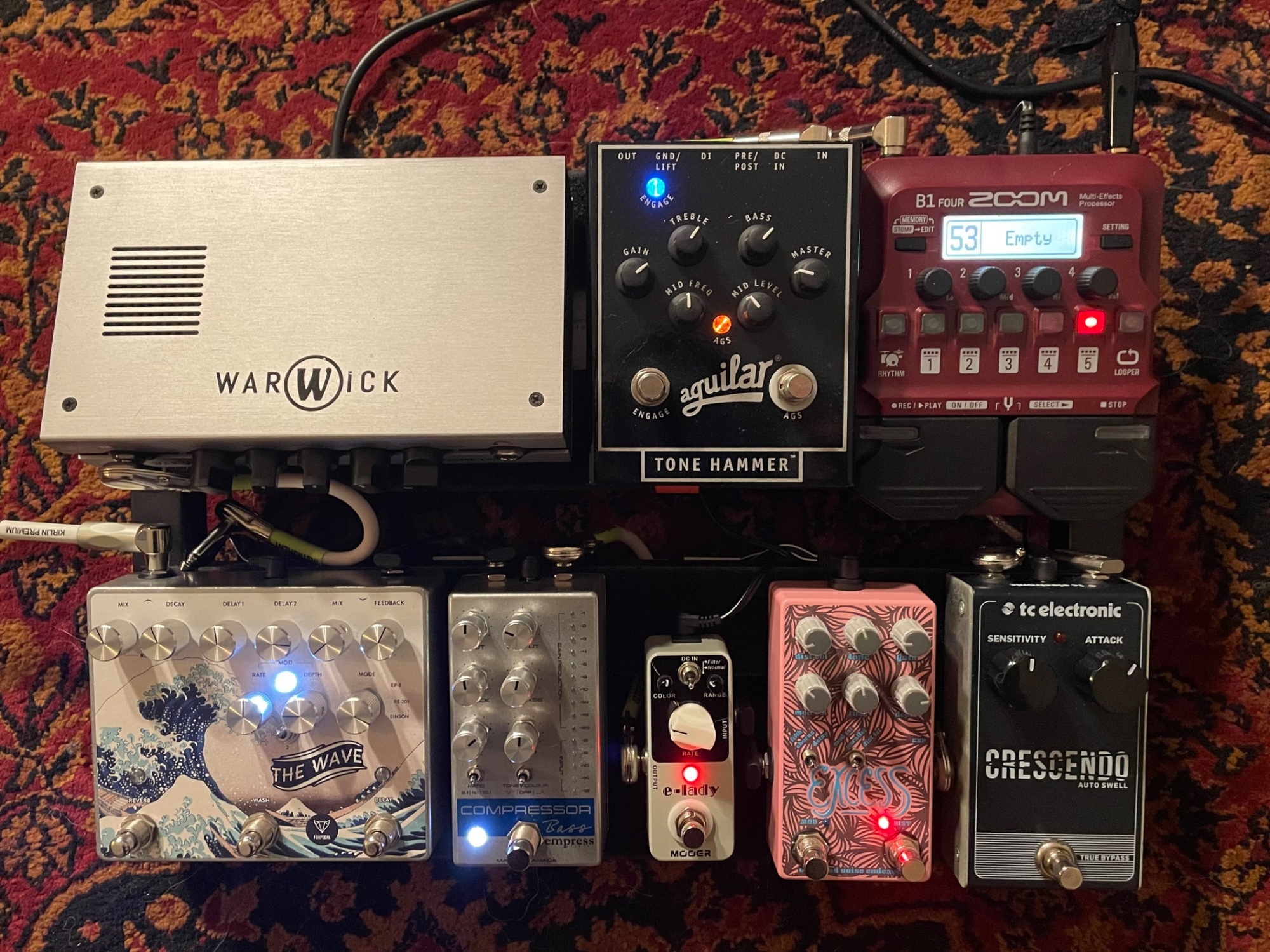
I can echo everything above. Fantastic amp that is loud, clean and so very small. Mine was a 300w unit which was loud enough for most of my needs. It used to sit on my pedalboard and people always wondered what was driving my Berg cab.
Just FYI, the Warwick Gnome i Pro V2 has 280W. I use it a lot with a 210 cab and am very happy with it.They are larger. There are no amps in the 'micro' format over 200w as far as I'm aware. Micro meaning the same size as Gnome, Elf, Bam, etc.
Again my info could be out of date here but while none of the micro amps use ICE modules there are amp modules on the market that produce over 200w and would fit in a chassis that small. Could be several reasons why we've never seen anyone implement one in an amp that small though, thermal issues being the most likely.

I have the Gnome I-Pro which is 280w into 4 ohm. I use it for smaller gigs and as a backup to my Hartke LH500. I like it - it's very transparent and the EQ points seem to be in the right place for me. The DI output makes our sound engineer happy as well.
I'm waiting for the new version of the 600w Gnome to be available in the US and I will likely buy it. The V2 version of the 600w model includes pre/post switch, mute switch, and dimmable lights.
I'm waiting for the new version of the 600w Gnome to be available in the US and I will likely buy it. The V2 version of the 600w model includes pre/post switch, mute switch, and dimmable lights.

Have you been able to compare the Gnome against a Traynor SB200H ?I like mine…a lot. To my ears it’s more musical than the other micro amps I had tried and bought.


I sold mine a few years ago and honestly regret it. I have a BAM200 now, which serves its “backup that always lives in my gigbag” purpose just fine, but the Gnome sounded much better, imo.I was totally unaware that Warwick made amps. Cruising through Reverb alerted me to their presence this Gnome head in particular. Anyone have one here? I would love to hear opinions on it..
I have not. I’m currently in western Panama, so I am happy to have the Gnome here.Have you been able to compare the Gnome against a Traynor SB200H ?
Can you play rock with an acoustic kit ..enough volume ?Just FYI, the Warwick Gnome i Pro V2 has 280W. I use it a lot with a 210 cab and am very happy with it.
Yes, I think so. I play it in a jam that typically has acoustic drums and acoustic (amped) and electric guitars and I can be too loud if needed, though seldom do.Can you play rock with an acoustic kit ..enough volume ?

I’m sure it can be done. Even better than imagined. But this effort is expensive to research, develop, and successfully bring to the market with profitability.They are larger. There are no amps in the 'micro' format over 200w as far as I'm aware. Micro meaning the same size as Gnome, Elf, Bam, etc.
Again my info could be out of date here but while none of the micro amps use ICE modules there are amp modules on the market that produce over 200w and would fit in a chassis that small. Could be several reasons why we've never seen anyone implement one in an amp that small though, thermal issues being the most likely.
Just like Vox could have made an advanced new Valvetronix Chromie amp. But this amp plateaued far below its potential.

I'll echo what everyone said. I love my Gome iPro. Predictable EQ, plenty of power and a perfect size without feeling like a toy.
Mine keeps up with a normal drummer and a rediculously loud guitar player.
Mine keeps up with a normal drummer and a rediculously loud guitar player.

- Feb 12, 2006
- 61,010
- 5
- 220,847
- Disclosures
- Development Engineer-Mesa Boogie, Development Engineer-Genzler (pedals), Product Support-Genz Benz
Whole it “can” be done, there are a LOT of practical obstacles that have to be overcome and each obstacle comes with a cost.They are larger. There are no amps in the 'micro' format over 200w as far as I'm aware. Micro meaning the same size as Gnome, Elf, Bam, etc.
Again my info could be out of date here but while none of the micro amps use ICE modules there are amp modules on the market that produce over 200w and would fit in a chassis that small. Could be several reasons why we've never seen anyone implement one in an amp that small though, thermal issues being the most likely.
An example of an amp that can come pretty close is the SWR HeadLite.
It had probably the highest power density in its class, but after the first production run it was found to be more expensive to build than originally thought. It was a 3 dimensional puzzle inside, and the cost was a deterrent.
It was rated at 400 watts RMS into 4 ohms with a rich feature set. In fact, in order to achieve this, the power module had to be derated significantly and it proved to be more costly and difficult than it was worth.
One of the limiting factors is power density, how much power per cubic inch of chassis. Different class d and SMPS topologies have different machining power densities and in general the higher the power density the greater the cost (for a reliable amp)
200 watts at 4 ohms is pretty much the sweet spot for micro amps (at this time).


