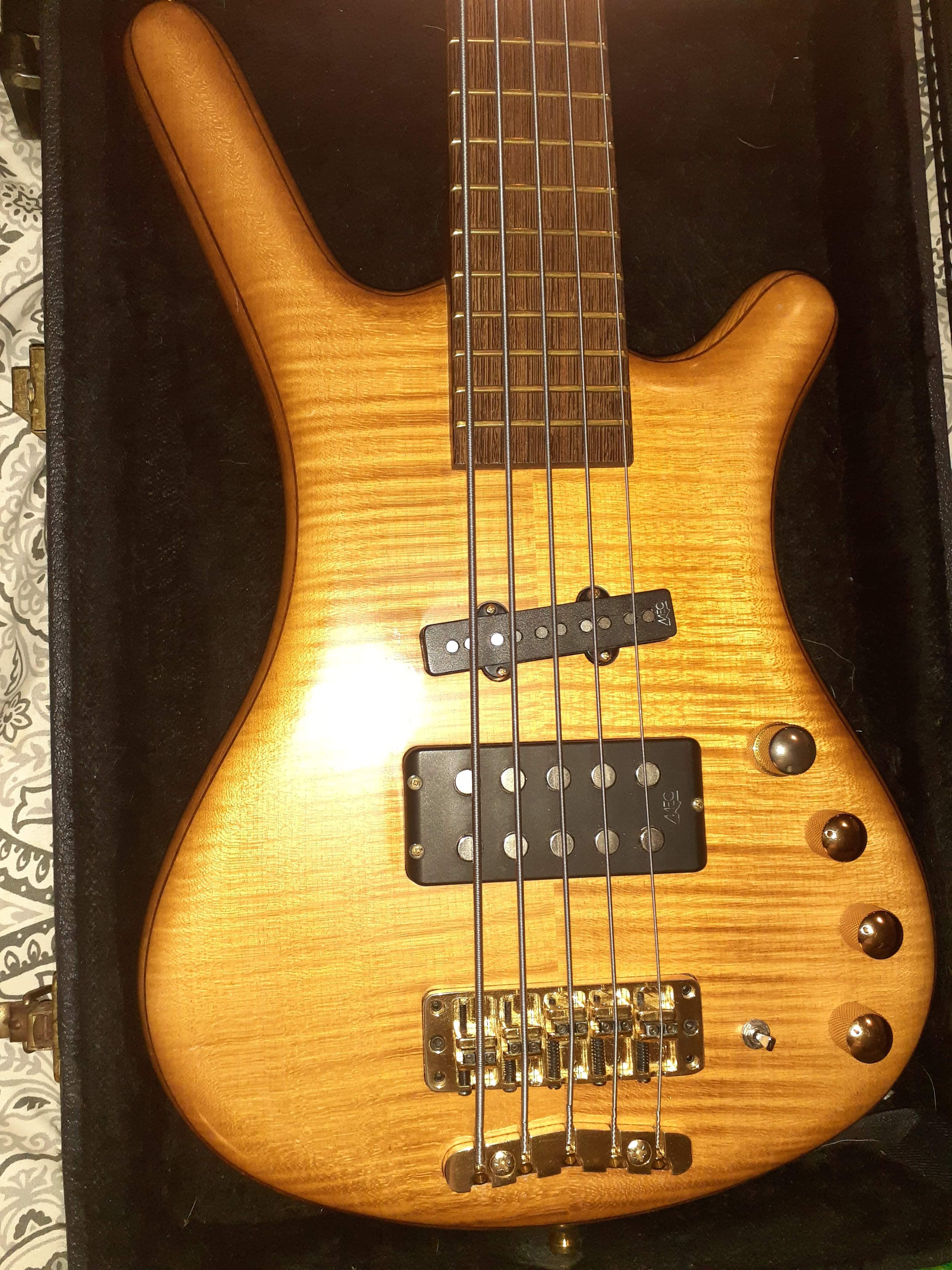
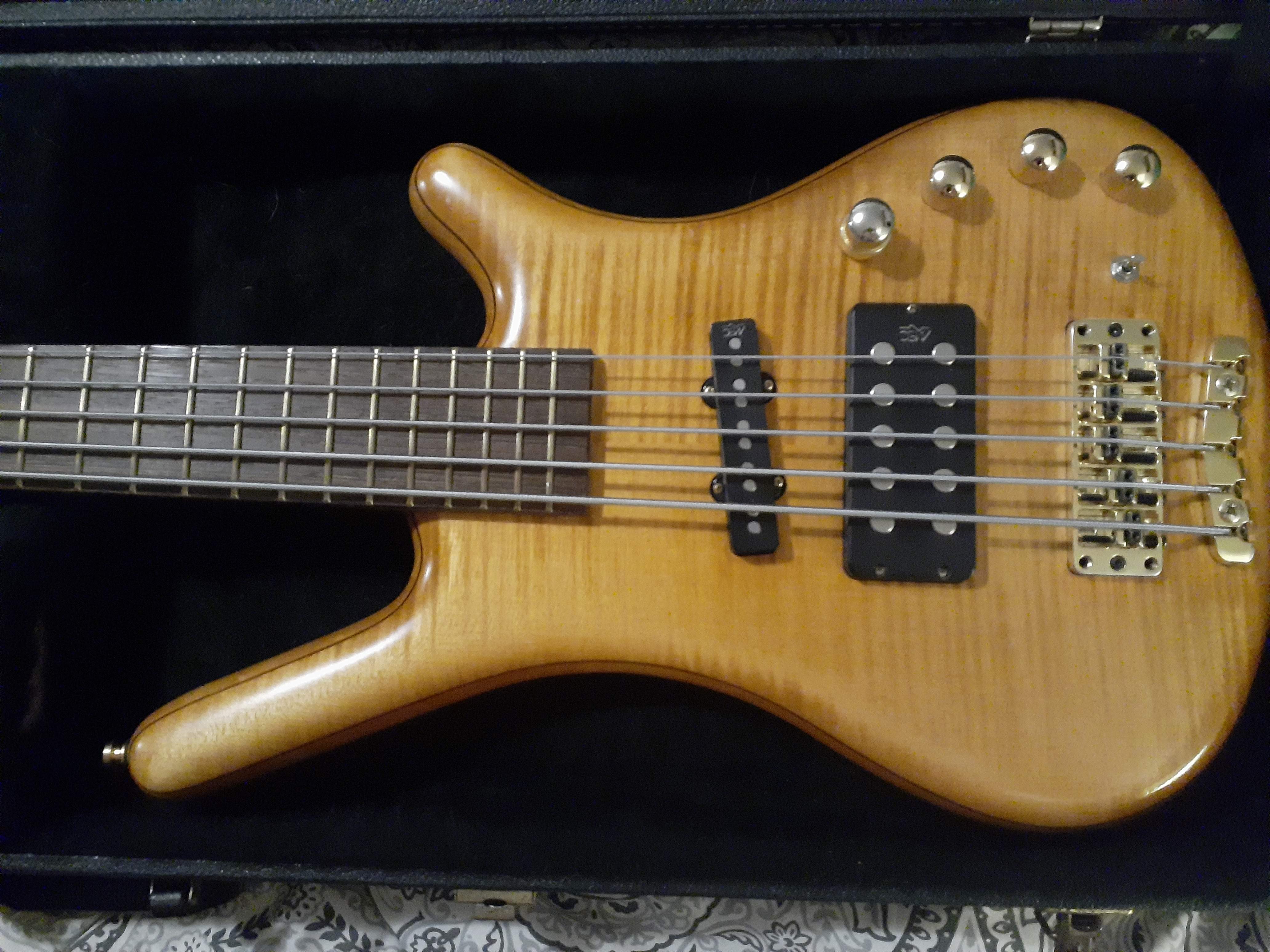
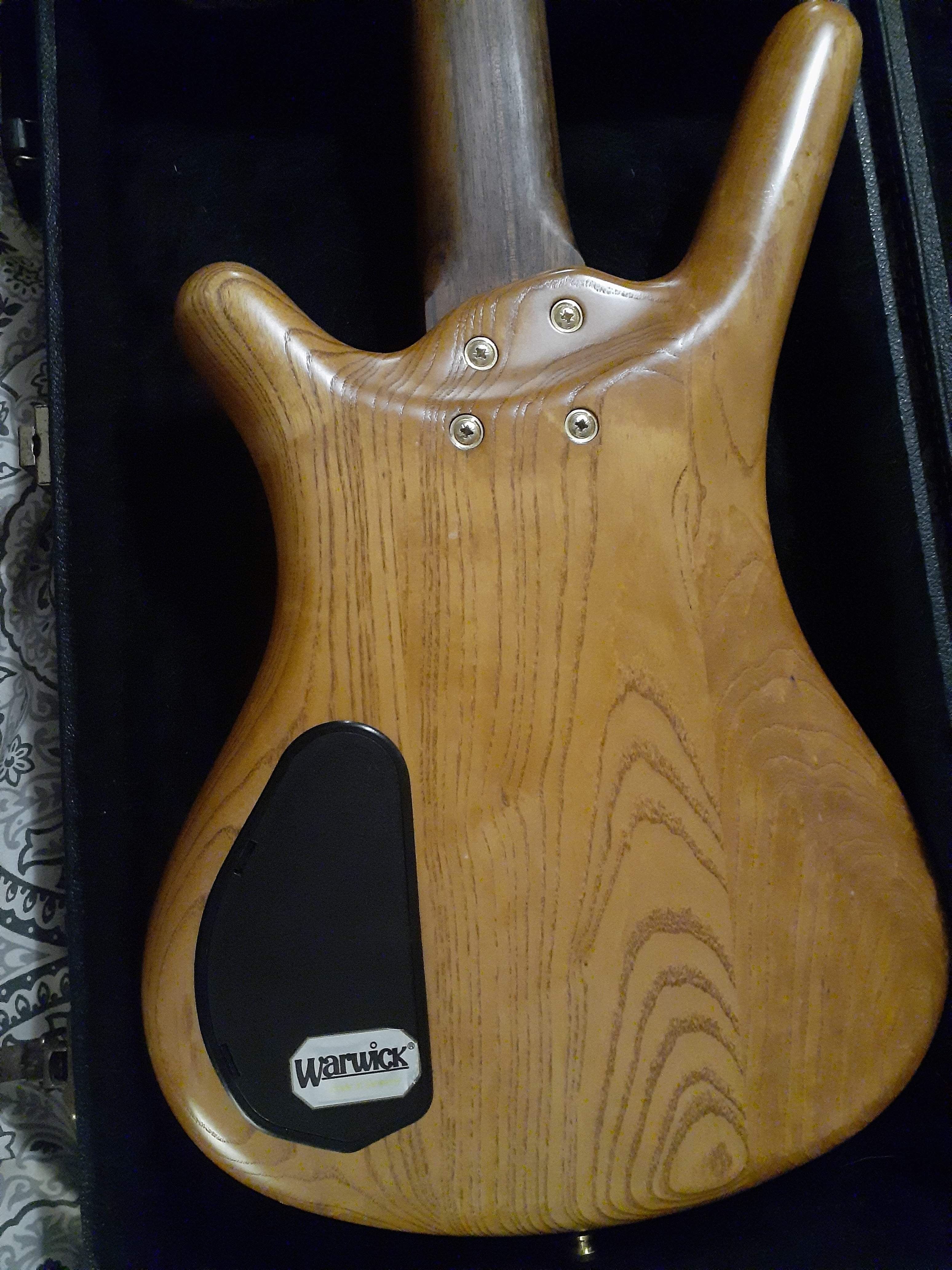
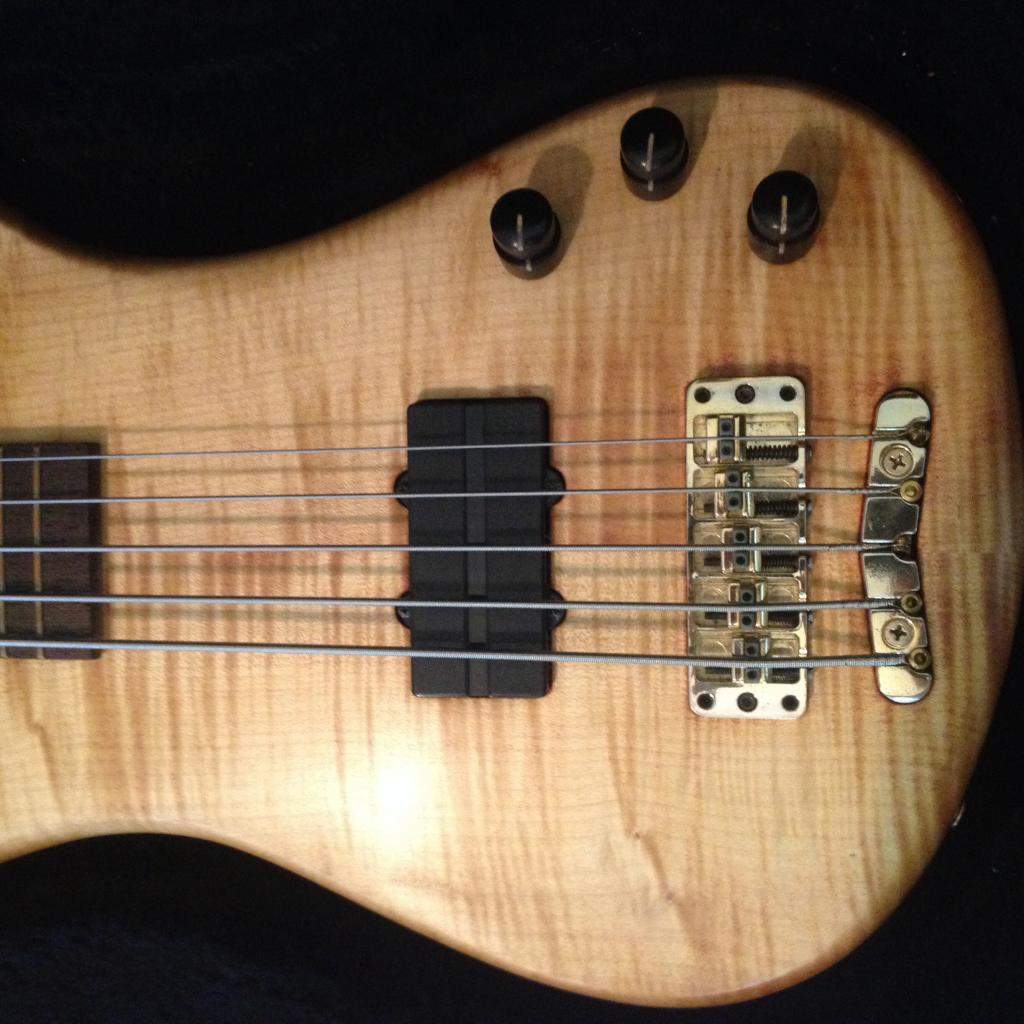
I recently aquired a nice Warwick FNA Jazzman 5 with a transparent honey violin oil finish with a satin topcoat. I would like to refinish it in transparent black with a satin finish. I've done a few basses with a solid color satin finish but nothing transparent. Warwick rep said I'd have to sand all the way down to the wood and start fresh. So I'm asking for advice, tips, tricks, product suggestions and application suggestions as I don't want to ruin a nice bass. I would like to apply the finish as a wipe on as I don't have a spray gun anymore (I used to paint cars so I know prep work is 90% of a good finish, but wood is different than cars). Can I refinish in waterbased products? Should I dye or stain? Do I need to seal the wood? Can the tinted varathane give me the finish I'm going for as a wipe on? Again, I'd like a matte/satin finish. Here are a few pics of the honey violin finish and a few pics of what I'm going for. Some transparent black finishes I've seen have a brownish tint that I want to avoid. Thanks in advance.


Enjoy the benefits of a premium membership!
Upgrade Account
-
TalkBass has been independent since 1998. Add your voice.
Create a free account to reply to discussions, view embedded media, and browse with fewer display ads.
Join free Log in
Want zero display ads or expanded classifieds tools? Compare plans.
You are using an out of date browser. It may not display this or other websites correctly.
You should upgrade or use an alternative browser.
You should upgrade or use an alternative browser.
Warwick Refinish
- Thread starter biggredd
- Start date
More options
Who Replied?
You'll likely ruin a good bass. You need to sand the wood down past any sealer that had penetrated into the pores to get a satisfactory transparent finish with some semblance of color consistency, imho.
It really has to be one extreme or the other. Sand everything 100% clean and start over, or evenly scuff the surface without breaking it and apply your new finish on top of the old. Although, based on how amber the finish currently is, and your desire to not have a "brown" look to the new black finish, I don't think the latter is really an option. The key, though, is to not end up somewhere in the middle, where some parts of the bass still have bits of old finish on them and some are bare wood.

You're going to have a hard time with the backside of the Warwick, since the grain is not filled, it is textured and you won't be able to sand in those lines without messing up the look of the grain. You may be able to use a sand blaster lightly to get in those grains, but sandpaper will not work for that.

Don't underestimate how tedious it will be to sand, especially the interior curves (inside the horns, behind the neck). And as Slidlow said, you'll have to sand deeper than you probably want to.
Regarding Lammchop's point: you might consider a different look & technique for the ash than you use for the maple. For the back, you could use a gel stain or toner, something that sits on top of the existing finish. You could do it a more opaque black, and let the grain speak with texture, rather than color. But you won't be able to sand out the existing finish.
For your new topcoat: the best wipe-on finishes are oil-based. Tru-oil, Osmo, and wipe-on poly are my favorites. And any oil will warm up the color, which you don't want, so no oils for you. I don't know of comparable wipe-on water-based finishes. Next best thing would be dewaxed shellac. French polishing would be pretty doable, and give you a lot of control over the sheen. Shellac won't be as yellowing as oils, but it's also not as clear as water-based poly.
Lastly, I don't know if this job could be done without chewing up resale value. File under "you break it, you bought it."
Regarding Lammchop's point: you might consider a different look & technique for the ash than you use for the maple. For the back, you could use a gel stain or toner, something that sits on top of the existing finish. You could do it a more opaque black, and let the grain speak with texture, rather than color. But you won't be able to sand out the existing finish.
For your new topcoat: the best wipe-on finishes are oil-based. Tru-oil, Osmo, and wipe-on poly are my favorites. And any oil will warm up the color, which you don't want, so no oils for you. I don't know of comparable wipe-on water-based finishes. Next best thing would be dewaxed shellac. French polishing would be pretty doable, and give you a lot of control over the sheen. Shellac won't be as yellowing as oils, but it's also not as clear as water-based poly.
Lastly, I don't know if this job could be done without chewing up resale value. File under "you break it, you bought it."
Sounds like a language issue. It's probably poly, and their use of "lacquer" as a verb is an artifact of translation.
I just went to Google Translate (I don't speak German). The German word "lack" means both "lacquer" and "to paint." So, that's my story and I'm sticking to it!
I just went to Google Translate (I don't speak German). The German word "lack" means both "lacquer" and "to paint." So, that's my story and I'm sticking to it!
Shouldn't have to sand into the wood if I decide to proceed.
Yes, you will. The poly still gets into the grain, especially the back of that bass (looks like Ash). The maple top is a much finer grain but its still there. Strip and sand. Stain, lightly sand, stain again, repeat. Figured maple has different degrees of hardness throughout the wood. Some areas will take more of the stain than others, thus making the figuring pop. Repeating the staining process will darken the softer areas more. Some folks find that desirable, others don't. That looks like a fairly thin finish now, shouldn't be too hard to strip. Oil finish is easier to repair but will change the color somewhat. IMO, it's gorgeous as is. I wouldn't touch it.

I stripped and refinished my Warwick (solid maple) a few years ago. I had to sand down to bare wood as the red colored oil (see profile pic) had really penetrated. I ended up using some diluted StewMac dye to bring out the grain and then finished with danish oil and BC wax. The finish has held up really well - it's matte and isn't the hardest finish, but I kind of like some natural wear. It'd do it again - it was a bit tedious but I enjoyed the process. Good luck!
Last edited:


Color Tone liquid stains look easy to use and alter the concentration. But man, stripping a finish is some serious work.

I just sold an identical FNA last fall, I've owned 2 and only seen them in that honey violin finish. Not a super expensive bass but I think a refinish would impact the value.Lastly, I don't know if this job could be done without chewing up resale value. File under "you break it, you bought it."
I did a similar project on a honey violin Ibanez SR1406te (didn't care for the yellow finish) with a flamed maple top... it stripped down pretty easily, the back was mahogany so a different animal all together vs that ash.
Either way, good luck with what you decide to do and please post pictures if you do refinish.

Try to trade with someone with a black one or sell and purchase a black one. My 2cents

Best way IMHO is to sell your bass and buy one like the one you want. I am saying that as a professional guitar refinisher for over 20 years. There is a good chance of ruining that bass with the type of finish you are trying to achieve. That said, I wish you best of luck whatever you decide to do.

JeezyMcNuggles
Inactive
- Feb 23, 2018
- 14,723
- 20,970
- Disclosures
- I suck, but nobody really notices
Transtint has the best black. I'm gonna flood some pictures now, but yes, you need to take it all down. And yes, it's a pain in the butt.I recently aquired a nice Warwick FNA Jazzman 5 with a transparent honey violin oil finish with a satin topcoat. I would like to refinish it in transparent black with a satin finish. I've done a few basses with a solid color satin finish but nothing transparent. Warwick rep said I'd have to sand all the way down to the wood and start fresh. So I'm asking for advice, tips, tricks, product suggestions and application suggestions as I don't want to ruin a nice bass. I would like to apply the finish as a wipe on as I don't have a spray gun anymore (I used to paint cars so I know prep work is 90% of a good finish, but wood is different than cars). Can I refinish in waterbased products? Should I dye or stain? Do I need to seal the wood? Can the tinted varathane give me the finish I'm going for as a wipe on? Again, I'd like a matte/satin finish. Here are a few pics of the honey violin finish and a few pics of what I'm going for. Some transparent black finishes I've seen have a brownish tint that I want to avoid. Thanks in advance. View attachment 4144116 View attachment 4144117 View attachment 4144119 View attachment 4144121 View attachment 4144122
Get yourself a heat gun, a putty knife, an orbital sander, sand paper, acetone, and a Red Bull...or 2. For top coats, I prefer tung oil. But, I also use spray or wipe on polyurethane, and I've used lacquer a few times too. Laquer scratches too easy though. For dyes, I use transtint and colortone. Best dyes I've found. You can dilute them however you want by putting drops in denatured alcohol, but I just use them full strength. Have fun man.
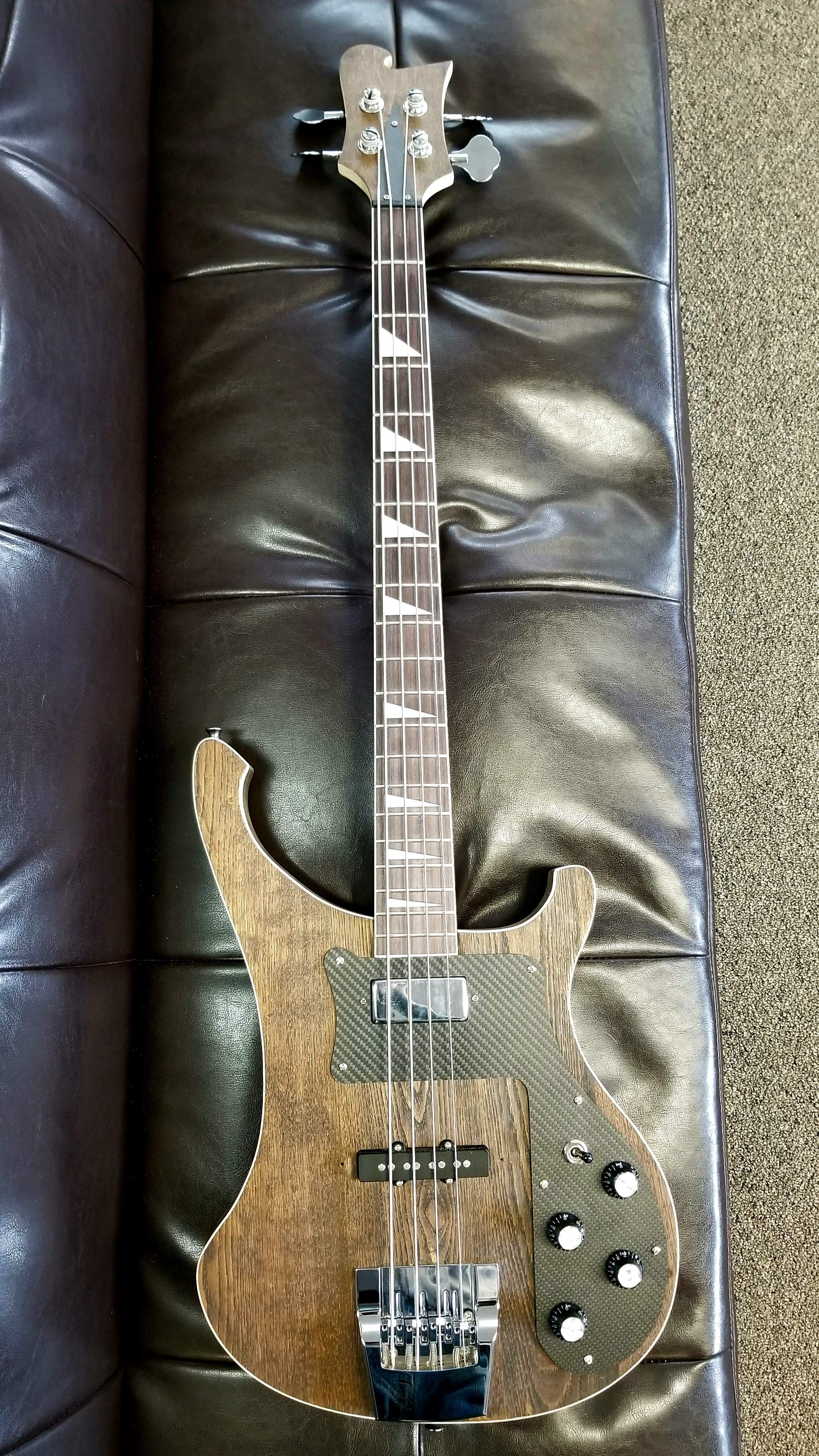
The guy on the "Guns n Guitars" Youtube channel uses Rit Dye... I haven't used it personally but he has good luck with it especially using it to get a burst effect over a stain. I used his methods on my 4003 Rick replica and it came out awesome. Worth a watch if you're looking for any kind of inspiration/tips. He uses tung oil as a topcoat and I really like the way it came out (wish I took the time to do it on mine, I may take it apart and oil it this spring) Take my advice with a huge grain of coarse salt as I am absolutely NOT a luthier nor do I pretend to be one. I say if you aren't afraid of "ruining" it, then go for it. If the possibility of it not coming out good is a no go then maybe trade for the one you want. Best of luck, take your time and enjoy the process!
This is interesting because I just completed refinishing this Corvette $$ this past weekend. It was Nirvana Black and totally beat (full disclosure - I got it at a very low price). I orbital sanded the flat parts and hand sanded the curved parts to bare wood (about 2 hours work) increasing the sandpaper grit in stages. I applied varathane yellow stain multiple times until it was dark/bright enough to show the color. Then it was multiple layers of polyurethane and hand sanding/polishing. In the end, I'm really happy with the result. I'm not concerned about resale...I just wanted a yellow bass!
![20210128_104427[1].jpg](https://www.talkbass.com/attachments/20210128_104427-1-jpg.4146320/ "20210128_104427[1].jpg")
Looks great! I've finished a couple basses including a Corvette standard in a solid color and they came out looking good. I'm trying to go for a transparent black. If I don't like the results, I'll just do it in a solid color and still be happy with it.This is interesting because I just completed refinishing this Corvette $$ this past weekend. It was Nirvana Black and totally beat (full disclosure - I got it at a very low price). I orbital sanded the flat parts and hand sanded the curved parts to bare wood (about 2 hours work) increasing the sandpaper grit in stages. I applied varathane yellow stain multiple times until it was dark/bright enough to show the color. Then it was multiple layers of polyurethane and hand sanding/polishing. In the end, I'm really happy with the result. I'm not concerned about resale...I just wanted a yellow bass!View attachment 4146320


