• TalkBass has been independent since 1998. Add your voice.
    Create a free account to reply to discussions, view embedded media, and browse with fewer display ads.
    Join freeLog in
    Want zero display ads or expanded classifieds tools? Compare plans.

Warwick-style neck, half-reinforced?

Hi all,

I'm starting build number three after being inspired by this corner of the internet in 2012, finally building in 2019. I'm always looking to experiment with materials and construction stuff, because I'm just goofing around really.

I stumbled on Warwick's method of reinforcing just half of the neck with steel rods, so that section becomes orders of magnitude more rigid (almost inflexible even though this is of course impossible).
Warwick neck.PNG

It intrigued me, and I'd like to think they know what they're doing.

Has anyone tried a method like this?
I have only come across Warwick doing this.

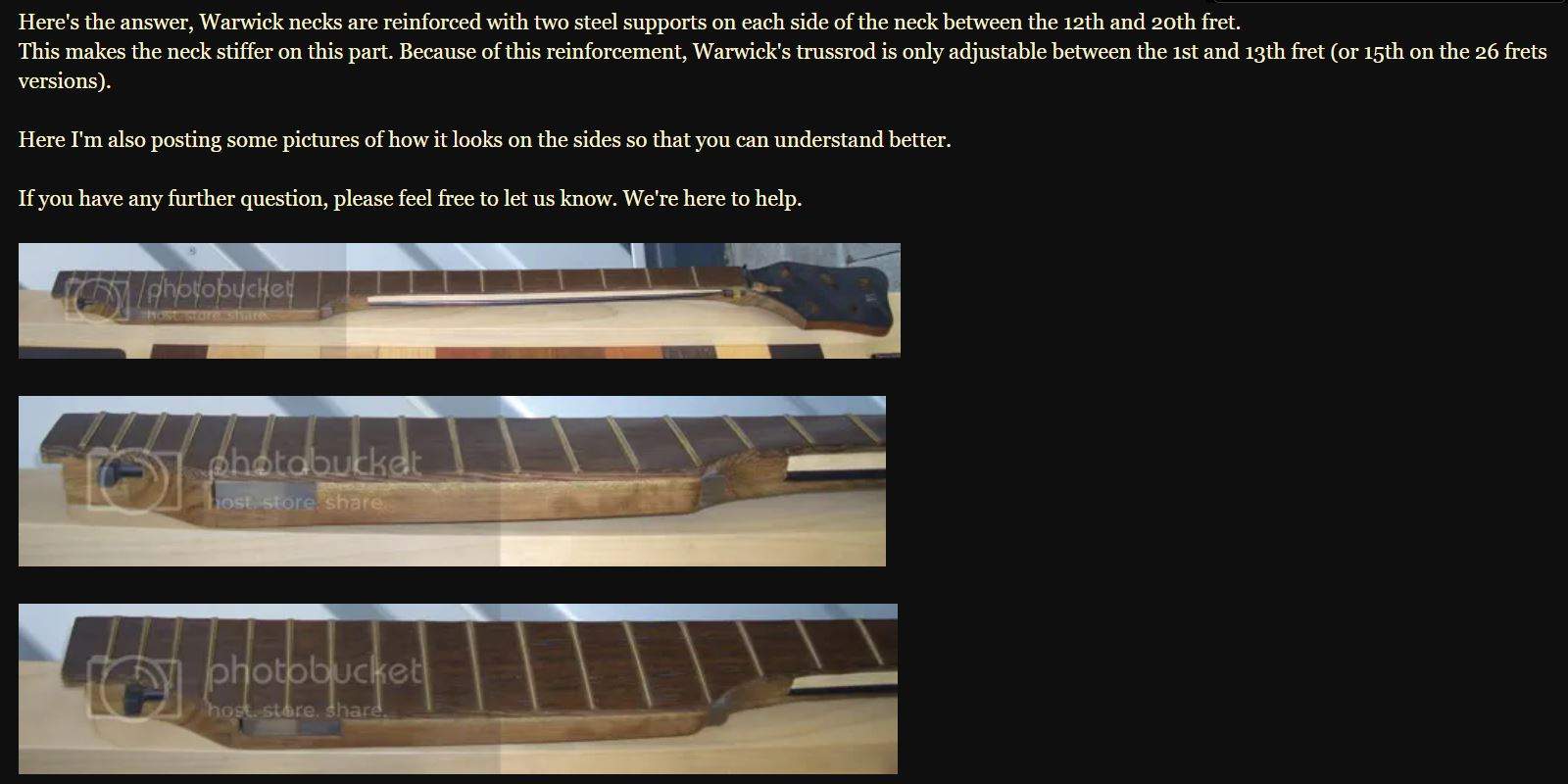
A Warwick forum rep explained their reinforcement on their forum in 2006:
warwick 2.JPG

Source: Necks Reinforced?

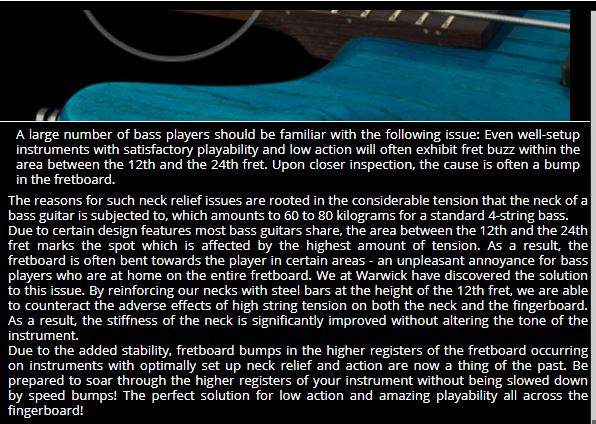
Their justification:
warwick 3.JPG

Source: en/Warwick---Company--Our-unique-instruments--Our-necks-and-fretboards--Our-steel-reinforced-necks.html

PS: I have not posted on Talkbass in many years, so sorry if my forum etiquette is rusty. Any advice on any topic is welcome.

All the best, Phil
 

Attachments

  • Warwick neck.PNG
    Warwick neck.PNG
    2.6 MB · Views: 152
  • Like
Reactions: ctmullins
There are a few other boutique builders who do this, but names escape me right now. A few members on here have done it as well. I've not used this method yet myself, but I've looked into it as well. I use long reinforcement rods that run nut to tail, so in theory, these also help with the issue as identified by Warwick. I think anything that can help a neck remain stable over it's life is going to be helpful. :thumbsup:
 
Yeah, a few of us have been doing this for a long time. I call it "back strapping", and I use carbon fiber strands (TOW) set down in a groove in a bed of epoxy near the back of the neck, in the zone from the heel to the 6th fret. The purpose is to stiffen up the back of the neck at the inboard end. This prevents the dreaded Ski Jump (aka 12th fret kink) and helps the neck pull into a better shape of relief curve under load. It also helps the sound of the bass, but I won't get into that because it always starts long arguments around here.

I started experimenting with back-strapping necks in 1993. All of my own basses since 1997, and most of the necks I've built for clients (about 1200 necks) have them.

Warmoth's and Warwick's method of using steel rods embedded up under the fingerboard is okay, but it's extra unnecessary weight. They could get the same reinforcement with 7075 aluminum rods, at 1/3 the extra weight. Or use thin aluminum plates standing vertically. Or carbon fiber stranding embedded down deep.
 
Warwick says the necks are only adjustable from frets 1 to 13. They must be pretty stiff.
Hi all,

I'm starting build number three after being inspired by this corner of the internet in 2012, finally building in 2019. I'm always looking to experiment with materials and construction stuff, because I'm just goofing around really.

I stumbled on Warwick's method of reinforcing just half of the neck with steel rods, so that section becomes orders of magnitude more rigid (almost inflexible even though this is of course impossible).
View attachment 4090399
It intrigued me, and I'd like to think they know what they're doing.

Has anyone tried a method like this?
I have only come across Warwick doing this.

A Warwick forum rep explained their reinforcement on their forum in 2006:
View attachment 4090409
Source: Necks Reinforced?

Their justification:
View attachment 4090429
Source: en/Warwick---Company--Our-unique-instruments--Our-necks-and-fretboards--Our-steel-reinforced-necks.html

PS: I have not posted on Talkbass in many years, so sorry if my forum etiquette is rusty. Any advice on any topic is welcome.

All the best, Phil
 
I'll keep it short. Carbon back strap really helps the sound.

Yes, the back strap stiffens the back of the neck from the heel to mid-length. Stiffening up the inner half of the neck. This significantly improves the low-end clarity. Combined with solid anchoring of the bridge/tailpiece, this brings out the piano-like deep lows. It also gets rid of the typical bass Dead Spots by pushing the natural resonance of the frame up out of the normal range.

But, with the half-length strap, you can leave the outer half of the neck somewhat more flexible, so it can vibrate with the strings and add warmth in the mid range. Whereas, if you made the neck really stiff over its whole length, you'd get the bottom end clarity, but the mids and highs would be cold and sterile sounding. The back strap is a big part of how I get the sound of my Scroll Basses. They have piano clarity down into the sub lows and smooth clarity up high. But the mid range is warm and rich and full of background "woody" coloration. It's not because of some magic pickup.
 
Is there a link or thread where the methods of laying the tow with epoxy in the truss rod channel?

I would love to see that, I am finishing shaping a 7 string neck with a solid beam of just the extruded sheet CF through the whole neck and I ruined one band saw blade, a really nice end mill bit and I think one of my files is toast as well. I know sanding is the way to go to remove it to save your blades and edges I just couldn't avoid it with my latest neck the way I built it. I would love to learn how to to an internal method that helps that tone as well. I need to learn this dark magic.
 
I've done it two ways.

Route a 1/4" wide slot to a depth that'll work out to 3/16" less than your full neck thickness (or whatever dimension gets the carbon where you want it). Square bottom. Get your tow cut to length and laid out on wax paper. Mask off any parts of the bass you don't want to accidentally drip epoxy on. Put on gloves and respirator. Mix epoxy. Wet out tow (use your favorite method - I just get my gloved thumb and index finger wet with epoxy and pull the tow through them. Do some practice runs, it can be hard to get right - you want the tow completely wet out but definitely not dripping wet.). Lay the tow into the channel, use disposable acid brushes to dab it down into place as needed. Then, get a scrap of maple (or whatever the neck wood is) that is 1/4" thick and just wider than the slot is deep at it's deepest point - 1/8" extra is fine - and wet it with epoxy on the sides, then push it down into the slot. The idea is to use this maple as a caul to press the tow tightly into place. Lay the neck over a hardwood caul and clamp right against the scrap maple that's pushed into the slot. Once the epoxy is cured, machine the top of the maple strip back down level with the neck. You now have carbon buried in your neck, and a nice flat clean neck surface. You can proceed to route the truss rod slot or any other machining as required.

That's the "hard" way. The "easy" way I use is much simpler but only really works with the shrimk wrapped dual action rods. I cut a normal truss rod slot but go about half a mm deeper than needed (depending on how much carbon you want to use). Give the truss rod a good heavy coat of paste wax. Then, wet out the carbon and lay it in the slot, and lay the truss rod directly on top of the carbon. Use a strip of hardwood as a caul to press the truss rod down against the carbon, holding it in place. Once the epoxy is cured, you're all done. Give the truss rod a few raps with a mallet and it'll pop free of the epoxy, then you can lay it back in place.

The "hard" way is nice because it divorces the carbon placement from the truss rod placement and you can use it with any style of truss rod (or leave the truss rod out if you don't need it).
 
Yeah, a few of us have been doing this for a long time. I call it "back strapping", and I use carbon fiber strands (TOW) set down in a groove in a bed of epoxy near the back of the neck, in the zone from the heel to the 6th fret. The purpose is to stiffen up the back of the neck at the inboard end. This prevents the dreaded Ski Jump (aka 12th fret kink) and helps the neck pull into a better shape of relief curve under load. It also helps the sound of the bass, but I won't get into that because it always starts long arguments around here.
funny, the thread got railed in that direction anyway!!

I started experimenting with back-strapping necks in 1993. All of my own basses since 1997, and most of the necks I've built for clients (about 1200 necks) have them.

Warmoth's and Warwick's method of using steel rods embedded up under the fingerboard is okay, but it's extra unnecessary weight. They could get the same reinforcement with 7075 aluminum rods, at 1/3 the extra weight. Or use thin aluminum plates standing vertically. Or carbon fiber stranding embedded down deep.
if I may humbly derail... I'm quite fascinated with your use of TOW and have read threads about it and have had a lingering question that I've wanted to ask... If I may...
I understand that when they make carbon fiber rods they put the carbon fibers under tension... do you try to assimilate this tension on the TOW strands? if so, how do you do that? And/or also... general comments on the effect that tension would have.
 
  • Like
Reactions: Phil Jolly
Thanks everyone for the feedback and the more general information and discussion; very insightful.

There are a few other boutique builders who do this, but names escape me right now. A few members on here have done it as well. I've not used this method yet myself, but I've looked into it as well. I use long reinforcement rods that run nut to tail, so in theory, these also help with the issue as identified by Warwick. I think anything that can help a neck remain stable over it's life is going to be helpful. :thumbsup:

Hi Beej, thank you for the information. I thought there must be others constructing this way.

Yeah, a few of us have been doing this for a long time. I call it "back strapping", and I use carbon fiber strands (TOW) set down in a groove in a bed of epoxy near the back of the neck, in the zone from the heel to the 6th fret. The purpose is to stiffen up the back of the neck at the inboard end. This prevents the dreaded Ski Jump (aka 12th fret kink) and helps the neck pull into a better shape of relief curve under load. It also helps the sound of the bass, but I won't get into that because it always starts long arguments around here.

I started experimenting with back-strapping necks in 1993. All of my own basses since 1997, and most of the necks I've built for clients (about 1200 necks) have them.

Warmoth's and Warwick's method of using steel rods embedded up under the fingerboard is okay, but it's extra unnecessary weight. They could get the same reinforcement with 7075 aluminum rods, at 1/3 the extra weight. Or use thin aluminum plates standing vertically. Or carbon fiber stranding embedded down deep.

Hi Mr Johnson sir, thanks very much for all the information. I'm going to go for it with my next build given all your experience.

Warwick says the necks are only adjustable from frets 1 to 13. They must be pretty stiff.

Hi bobdabilder, aye they seem to be. I have heard from another warwick forum post somewhere that it's only really the first 5 frets that move, mad.

I'll keep it short. Carbon back strap really helps the sound.

Hi MPU,
Thanks for the feedback. Your newest build looks amazing by the way.

Yes, the back strap stiffens the back of the neck from the heel to mid-length. Stiffening up the inner half of the neck. This significantly improves the low-end clarity. Combined with solid anchoring of the bridge/tailpiece, this brings out the piano-like deep lows. It also gets rid of the typical bass Dead Spots by pushing the natural resonance of the frame up out of the normal range.

But, with the half-length strap, you can leave the outer half of the neck somewhat more flexible, so it can vibrate with the strings and add warmth in the mid range. Whereas, if you made the neck really stiff over its whole length, you'd get the bottom end clarity, but the mids and highs would be cold and sterile sounding. The back strap is a big part of how I get the sound of my Scroll Basses. They have piano clarity down into the sub lows and smooth clarity up high. But the mid range is warm and rich and full of background "woody" coloration. It's not because of some magic pickup.

Hi Mr Johnson,
I have never even considered the whole concept of the resonance of the neck; thanks for the insight.

Cheers, Phil
 
  • Like
Reactions: Beej
Would this extra reinforcement still be helpful even if you're building a multi-lam neck-through? Or would the multi-lam already provide enough stiffness?

Laminating a neck doesn't inherently change the stiffness. If you take a maple board and make a one piece neck, and then take another piece of the same board and cut it up and make a 5 piece laminated neck, the properties related to strength or stiffness won't be significantly different. You may see small variations from differences in the specific portion of the board, and you may see small differences related to grain orientation (i.e. if you make the one piece neck flat sawn and the laminated neck has some of it's laminations flat and some quartered), but overall - stiffness is not improved by laminations.

The obvious exception to this is if you mix in other species. If you take that same maple board and cut it up, then add in two thin strips of purpleheart, the resulting neck will definitely be stiffer. But it's because purpleheart is stiff, not because laminating in and of itself makes things stiff.

The other factor worth mentioning is that laminating a neck can absolutely change the stability of the neck, although it depends on the wood used and the decisions made when laminating. Think of it this way - if you have a board that wants to cup a little, and you make a one piece neck, it'll probably move more than you'd like with changes in humidity. But if you cut that same board up and carefully arrange the slices so the direction each slice wants to move is cancelled out by the direction the other slices want to move, the resulting neck will be less likely to warp under normal use.

if I may humbly derail... I'm quite fascinated with your use of TOW and have read threads about it and have had a lingering question that I've wanted to ask... If I may...
I understand that when they make carbon fiber rods they put the carbon fibers under tension... do you try to assimilate this tension on the TOW strands? if so, how do you do that? And/or also... general comments on the effect that tension would have.

I'm eager to hear Bruce's response, because he's put a lot of effort into this, but my own answer would be no - there's no reason to try to put the tow fibers under tension while you glue them down. The act of clamping them tightly against the bare wood is enough to fix them in place.

A pultruded rod is pultruded not because it's desirable to have the fibers under tension in the finished product, but because pulling the fibers through a die is a really easy way to get them all oriented correctly in the finished product, while controlling the profile and the ratio of fiber to resin at the same time. Tow already has very good fiber orientation, and gluing it in place preserves that orientation. You can control the profile as much as you need to by controlling the dimensions of the slot. And you can control the ratio of fiber to resin by managing how you wet the tow with epoxy.
 
If you wanted, you could get real dorky and weigh the plain tow, then weigh it again once you wet it out. Then practice and refine your wetting technique until you get between a 50:50 and 60:40 ratio of carbon to resin. That gets you close to the optimal ratio but with enough excess to allow some for binding to the wood.
 
  • Like
Reactions: MPU
Yeah it's easy to over-wet but that's probably better than under-wetting! If I'm doing a layup that involves a vacuum bag and bleed cloth, then yeah - I have at it and probably end up throwing most of the epoxy away after all.