Anybody can swipe right; it takes self assurance and confidence to do the dance in real life. You dont get that type of positive mental attitude from simply downloading an app, and it shows. It takes a man to suffer ignorance and smile.

TalkBass has been independent since 1998. Add your voice.
Create a free account to reply to discussions, view embedded media, and browse with fewer display ads.
Join free Log in
Want zero display ads or expanded classifieds tools? Compare plans.

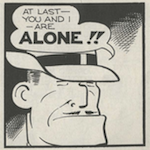
So... that comic has a 2007 copyright date, which means that kid in the last panel turns 30 this year.

Ok, but youve removed all the fun subleties of the dance. Chasing, being sought after, a glance from across the room. Real rejection, lessons learned. Romance for Gods sake. That can be fun! Are you ready to bring home the chick you hit up on Tinder? Instead of getting to know each other in a nice in- person way. You miss the point my freind.
Agree 100%. Adapt and move forward. It’s all relative. Every older generation complains about “kids these days”…Up until now. Millennials complain about Zoomers, yet their descriptions are indistinguishable to a Gen X’er. The iPhone changed EVERYTHING. Having a computer in your pocket, the social apps did a very curious thing; it brought the world to the user without them getting out of bed. You’re everywhere, but nowhere at all. Isolationism creates a host of mental health issues, and this sudden marked change in social interaction definitely has had a negative impact on society overnight.Born in 1970, the years the OP lists were my college years.
I'm an historian, and as such it's my professional opinion that blanket judgments that this or that period of time was better or worse than another are meaningless. I mean, for myself, those years I was young and learning lots of interesting things and exploring lots of experiences. But that's because I was young, not because the era itself had any more magic to it than any other.
There was an interesting article some ways back where they surveyed a bunch of people and asked them what decade they thought was best or worst for this or that, across a whole spectrum of issues - family life, morality in society, various forms of entertainment, fashion, the economy, and so on. The results they got back were garbage, all over the map with no discernible pattern, until they correlated it to the age of the respondents. Then it all fell into place. Families were most solid during the decade when you were seven. The economy was strongest the decade you got your first job. Entertainment was best in your teen years (there was some differentiation for music, TV, and movies, which tracked with how independent you were to be able to access each). Fashion hit its peak when you finished high school. And so on.
One interesting result, by the way, was responses on when the economy was worst. As I said, each respondent would usually say it was best during whatever decade they had gotten their first job. But all generations agreed that the worst economy ever was... right now. That makes sense, if you think about it; whatever financial struggles you had in the past, you overcame them and moved on, and the anxiety you felt at the time doesn't bother you any more. But the financial issues you're anxious about right now, you don't how they'll turn out. So that anxiety looms bigger in your mind than anything past.
View attachment 7285738
Agree 100%. Adapt and move forward. It’s all relative. Every older generation complains about “kids these days”…Up until now. Millennials complain about Zoomers, yet their descriptions are indistinguishable to a Gen X’er. The iPhone changed EVERYTHING. Having a computer in your pocket, the social apps did a very curious thing; it brought the world to the user without them getting out of bed. You’re everywhere, but nowhere at all. Isolationism creates a host of mental health issues, and this sudden marked change in social interaction definitely has had a negative impact on society overnight.
I'm reading Jonathan Haidt's book The Anxious Generation right now and he does argue that the smartphone and associated social media are major game-changers. His argument is that free, risky play - embodied by things like monkey bars and seesaws on playgrounds - are actually essential to childhood development, because they teach kids to manage risk. Old playgrounds (or just the woods and fields and water holes before playgrounds existed) were a little bit dangerous, and in Haidt's view that was a feature, not a bug. Playing on them taught kids to assess danger and manage it, and thus to be confident in subsequent real-life dangerous situations where the stakes were higher than a scrape or a broken arm. On the other hand, kids are doing a lot less drugs, alcohol and sex.Agree 100%. Adapt and move forward. It’s all relative. Every older generation complains about “kids these days”…Up until now. Millennials complain about Zoomers, yet their descriptions are indistinguishable to a Gen X’er. The iPhone changed EVERYTHING. Having a computer in your pocket, the social apps did a very curious thing; it brought the world to the user without them getting out of bed. You’re everywhere, but nowhere at all. Isolationism creates a host of mental health issues, and this sudden marked change in social interaction definitely has had a negative impact on society overnight.
Unfortunately there are a few millions of us who are counterexamples - Americans who were born in 1961, 1962, 1963, 1964. Can you say "disco"? I knew that you could.Born in 1970, the years the OP lists were my college years.
I'm an historian, and as such it's my professional opinion that blanket judgments that this or that period of time was better or worse than another are meaningless. I mean, for myself, those years I was young and learning lots of interesting things and exploring lots of experiences. But that's because I was young, not because the era itself had any more magic to it than any other.
There was an interesting article some ways back where they surveyed a bunch of people and asked them what decade they thought was best or worst for this or that, across a whole spectrum of issues - family life, morality in society, various forms of entertainment, fashion, the economy, and so on. The results they got back were garbage, all over the map with no discernible pattern, until they correlated it to the age of the respondents. Then it all fell into place. Families were most solid during the decade when you were seven. The economy was strongest the decade you got your first job. Entertainment was best in your teen years (there was some differentiation for music, TV, and movies, which tracked with how independent you were to be able to access each). Fashion hit its peak when you finished high school. And so on.
One interesting result, by the way, was responses on when the economy was worst. As I said, each respondent would usually say it was best during whatever decade they had gotten their first job. But all generations agreed that the worst economy ever was... right now. That makes sense, if you think about it; whatever financial struggles you had in the past, you overcame them and moved on, and the anxiety you felt at the time doesn't bother you any more. But the financial issues you're anxious about right now, you don't how they'll turn out. So that anxiety looms bigger in your mind than anything past.
View attachment 7285738
They aren't talking about individuals, they're talking about statistical trends.Unfortunately there are a few millions of us who are counterexamples - Americans who were born in 1961, 1962, 1963, 1964. Can you say "disco"? I knew that you could.
Lacking empirical data here- simply observing- one thing social media has done is allow little girls to be really mean. Mean little girls grow into mean women, and now another post-millennial descriptive term, “incels’’ gets added to the mix. NONE of this is healthy. Having just watched ‘Adolescence’ on Netflix bolstered my observations that we are currently witnessing a dumpster fire in a flood. The tool-using ape is the smartest of monkeys until the tools inadvertently outwit the monkey.
Its a language all in itself; even the emojis have arcane significance. When I was younger, if i wasn’t successful in my romantic quest(s), it was for the best; it builds character and failure is the first step towards success. The blame in my failures rested squarely on my shoulders and i recall always wanting to know exactly why my advances were rejected, and felt frustrated that was rarely communicated. I didn’t so much mind being brushed off, i just wanted to know what i was doing wrong in my presentation so as to possibly improve my appearance. Blame Culture wasn’t a thing back then. I don’t know when THAT became acceptable.I don't take the incel thing as being so much about "girls are mean" as boys thinking that sex is a commodity they're entitled to, which is definitely the messaging about sex one sees plenty of on the internet. It's the "playa" thing where dating is gamified and you think you're supposed to play a winning combo to "score." Even being a "nice guy" is assumed to be a particular game strategy rather than actual recognition of the other person's full humanity and agency. An incel is a gaming-culture boy who thinks he pushed the right buttons in the right combos but somehow failed to get laid, ergo someone must be to blame out there for cheating him out of his fair prize. The stats Haidt shows on mental health problems for GenZ kids hit girls way heavier than they hit boys, at any rate.

Yikes! I spent a lot of time with my wife before we really became involved and it was great because we became friends before we became lovers, which I think is very important. That was 1990. We had to wait for her to lose the boyfriend! It's a long story, but in this day and age, we might have had the patience to wait that long.In the time it takes to do all that, you could have hooked up with three, or four other people, and moved on to a couple more.
It's gamified now. The dopamine hit. All about the numbers.