• TalkBass has been independent since 1998. Add your voice.
    Create a free account to reply to discussions, view embedded media, and browse with fewer display ads.
    Join freeLog in
    Want zero display ads or expanded classifieds tools? Compare plans.

Weight VS sound

As to amplifiers, I'm not joking, this is serious speculation.

image-placeholder-title.jpg


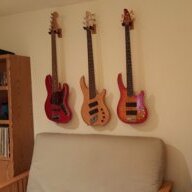
I am not sure that any of these can be accused of not having enough low end.

However, maybe there is a misunderstanding in your comparison. You say that bass amps are heavier than guitar amps. Maybe you are referring to the fact that bass amps need to be more powerful to produce the lower frequencies at the same sort of volume levels as a guitar (all else being equal, which is never the case) in which case it will be true that a 500W bass amp will be heavier than a 100W guitar amp (again, all else being equal, which it never is).

And about basses needing to be heavier to produce frequencies at the lower end of the spectrum, then hollow bodies, semi hollow bodies etc. would all be lacking in low frequencies, which is certainly not the case.
 
  • Like
Reactions: HolmeBass
Here is a demo of a lightweight bass:

I'd have a few questions about this bass...especially about neck stability and how it sits /cuts in a live context. That said; I like light weight instruments and strongly dislike chambered ones...so I'd like to try this at some point.
I HAVE seen a few 3kg basses some were really good!
 
Weight is related to the low end. A very light instrument, imagine a sheet of paper with strings, would just be fluttering back an forth, absorbing energy from the strings. The higher the frequencies, the less they would be absorbed so the overall sound would be tinny, the low end being sucked into feeding the fluttering. Make the sheet of paper thicker, turn it to cardboard or to solid wood and more of that low end would remain in the strings. The heavier the body, the less it would vibrate and the sound would remain fuller. At some point, the difference would no longer be noticeable and more weight would no longer matter. Most basses are built beyond that point.

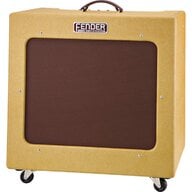
The same principle applies to amplifiers. I suppose this is why bass amplifiers are built heavier than those for guitar.
Speaker cabinets need to be stiff, not heavy. Unfortunately to make the panels stiff it usually means adding weight in the form of bracing . One of the most amazing speaker cabinets made was a horn 16 feet long with a mouth opening 11 feet by 11 feet. It was made of concrete. Perfect for a bar gig!
 
View attachment 3232753

I am not sure that any of these can be accused of not having enough low end.

However, maybe there is a misunderstanding in your comparison. You say that bass amps are heavier than guitar amps. Maybe you are referring to the fact that bass amps need to be more powerful to produce the lower frequencies at the same sort of volume levels as a guitar (all else being equal, which is never the case) in which case it will be true that a 500W bass amp will be heavier than a 100W guitar amp (again, all else being equal, which it never is).

And about basses needing to be heavier to produce frequencies at the lower end of the spectrum, then hollow bodies, semi hollow bodies etc. would all be lacking in low frequencies, which is certainly not the case.
I am obviously thinking of the cabinet. The head is pure electronics, which has nothing to do with weight.
I cannot say why exactly bass requires more power. Is it due to poorer performance of speakers in the low end or rather to the fact that lower frequencies are better absorbed by whatever they hit? I suspect the latter. All the energy wasted in shaking things doesn't bounce back as sound to make for volume. The same way, a vibrating cab absorbs energy and sucks some of the low end while a heavier one reflects and projects it.
 
  • Like
Reactions: AlexanderB
Speaker cabinets need to be stiff, not heavy. Unfortunately to make the panels stiff it usually means adding weight in the form of bracing . One of the most amazing speaker cabinets made was a horn 16 feet long with a mouth opening 11 feet by 11 feet. It was made of concrete. Perfect for a bar gig!
Stiff? Yes, maybe although… I would think modern technology has produced stiffer, lighter materials which could be used to that effect, but I'll admit I have no idea. Maybe such materials would be expensive or simply rejected by the customer base as "plastic".
 
A lot of early Fenders are light in weight. Many would argue that the lightest ones are the best. Leo used swamp ash and alder partly because they’re not too dense. CBS in the 70’s got away from using lighter ash - any ash was ok to them.

So, if you want a modern bass to sound vintage, it should be light. Roger Sadowsky agrees to the point of chambering his high end basses - he initially did it for weight, and cutomers told him they sound better.

This. I think the OPs premise is faulty. Vintage does not equal heavy. And heavy does not equal vintage sound, whatever that is.
 
  • Like
Reactions: Iridescentone
OK, short Physics lesson on sustain. This is the stuff I studied in school (Acoustical Physics)

We'll begin with a different bass than you're familiar with. It's a neck, with a zero fret and a headstock on each end - no body. No pickups, and we're operating in a vacuum. The reason to remove pickups and air is they steal some energy from the string - we'll reintroduce those losses later, but for now, we have a neck and one string.

When you pluck that one string, it decays, but as we've eliminated most of the losses, the remaining loss is that the neck vibrates, and steals energy from the string. We have losses at both ends of the string, so the decay is due to those 2 locations. Sustain is..we'll call it N seconds.

Now, we'll add a body. It's heavy. Really really heavy. Let's assume it's infinitely dense and infinitely heavy. In that case, the body won't vibrate, and all the energy that was lost at that end of the string is now returned to the string. So, we simply have half the losses we did before. It takes twice as long (with half the losses) for the string to lose a certain amount of energy, so the sustain is...2 N seconds - it's twice as long. That's our limit. What does this mean?

What this means is, assuming that mechanical losses are the only losses, the biggest improvement in sustain you can ever get by making a body heavier (assuming you're starting with absolutely no body) is a factor of 2. Since every bass has some sort of body, and since even a light body is much heavier than the neck to begin with, the factor is FAR LESS than 2. Adding in the magnetic losses from the pickup, and the air loading, which rob energy, and you've reduced that amount of sustain improvement even more.

So, the net effect of all this is, adding mass to a bass body, while it does technically improve sustain, practical speaking it isn't going to be a big factor.
 
OK, short Physics lesson on sustain. This is the stuff I studied in school (Acoustical Physics)

We'll begin with a different bass than you're familiar with. It's a neck, with a zero fret and a headstock on each end - no body. No pickups, and we're operating in a vacuum. The reason to remove pickups and air is they steal some energy from the string - we'll reintroduce those losses later, but for now, we have a neck and one string.

When you pluck that one string, it decays, but as we've eliminated most of the losses, the remaining loss is that the neck vibrates, and steals energy from the string. We have losses at both ends of the string, so the decay is due to those 2 locations. Sustain is..we'll call it N seconds.

Now, we'll add a body. It's heavy. Really really heavy. Let's assume it's infinitely dense and infinitely heavy. In that case, the body won't vibrate, and all the energy that was lost at that end of the string is now returned to the string. So, we simply have half the losses we did before. It takes twice as long (with half the losses) for the string to lose a certain amount of energy, so the sustain is...2 N seconds - it's twice as long. That's our limit. What does this mean?

What this means is, assuming that mechanical losses are the only losses, the biggest improvement in sustain you can ever get by making a body heavier (assuming you're starting with absolutely no body) is a factor of 2. Since every bass has some sort of body, and since even a light body is much heavier than the neck to begin with, the factor is FAR LESS than 2. Adding in the magnetic losses from the pickup, and the air loading, which rob energy, and you've reduced that amount of sustain improvement even more.

So, the net effect of all this is, adding mass to a bass body, while it does technically improve sustain, practical speaking it isn't going to be a big factor.


Thanks for the detailed explanation. Now I understand why high mass bridges have more sustain than lighter ones.

How does weight relates to bass frequencies?
 
My personal experience, lighter instruments sound better.

This is not directed specifically at MVE. His quote just seemed appropriate for this! The one thing they don't tell you on the Gittler webpage is how much they weigh. They're made out of titanium, so they may be heavier than they look. Personally, I'm with the mass equals sustain crowd and I like a good looking, well finished chunk of wood.

 
I'm not sure that weight factors into tone, and I'm not totally into the 'tune-the-tone-by-the-woods-used', but I can hear some of the more obvious examples where these two schemes tend to run together and show themselves in broad daylight:

The typical Warwick, made primarily with those dark (and typically) heavy (and hard) African woods tend towards a fundamental-heavy tone. Here's and example I often think of, and I am so sorry I don't know the wonderful player's name in this live 'Angry Eyes' from Loggins and Messina. Even over computer speakers, it's a solid, anchoring tone that embodies Warwick to me (SOMEBODY name this guy and give him his due!):


(I love Jim Messina's tone on this, that Tele tone off his Strat, which only goes to prove again that you can take the boy out of Bakersfield, but you can't take Bakersfield out of the boy .. . . )

I'm sure it has to do with hardness, and usually these African woods aren't light, but of course that's the mystery of it all. With another player, a different amp, who knows?

The typical, what I call 'white wood tone' is easy enough to find, all you do is think of that 'boingy new Rotosounds tone', and you're in Fendervillle. Think Geddy. Think Steve Harris. Always a Fender or Fender derivative. Some bass, but more in the 100-200hz range rather than the fundamentals you hear at the bottom of a Warwick or Alembic. And plenty of mid-range quack, tailor-made for slappers. Softer woods than the Africans, hmmm . . . . . .

It's very hard to make generalizations that hold up. Players, their touch, their amps, plus the amazing variance in wood from tree to tree makes that very difficult. But I've always thought these two were fairly obvious and usually hold up, but then again, not always . . . . . .
 
Thanks for the detailed explanation. Now I understand why high mass bridges have more sustain than lighter ones.

How does weight relates to bass frequencies?

Density is related to mass and weight. Generally speaking denser materials absorbe less of the higher frequencies thus they sound brighter to you, and vice versa.
 
  • Like
Reactions: Laurent