• TalkBass has been independent since 1998. Add your voice.
    Create a free account to reply to discussions, view embedded media, and browse with fewer display ads.
    Join freeLog in
    Want zero display ads or expanded classifieds tools? Compare plans.

Weight VS sound

Tell me how.

When was the last time you heard someone say their sub-8lb Sadowsky or Lull had no bottom end or punch? Same with a Fender Rumble combo, Greenboy and Fearless cabs, etc. if your theory was true, bassists wouldn’t be shifting to lightweight equipment. But they are in droves because they also know that weight and tone have no correlation.
 
My two main basses are a MIM Fender Jazz and a Squier VM70's Jazz.

The Squier is the heaviest bass in my arsenal. Not sure of the actual weight, but while I doubt it's 10 lbs, it's definitely in the northern hemisphere of 9 lbs. (maple body and neck) Feels like a beast, plays like a beast. It has more punch and sizzle than all my other basses. As an aside, everything is stock on this bass.

My MIM, by comparison, is lighter (8.6 IIRC from Sweetwater), and more "polite" in regards to tone....which at first, disappointed me for some reason. However, when I watched/listened to the videos from the gigs I initially did with each, I realized that overall, the MIM sounded better. I later dropped a set of Custom Shop 60's in her, which kept it's basic tonal characteristic, but added more "beef", and still sounds better than my Squier (not that the Squier sounds bad in any way)

I love the tones each gives me, while I do use the MIM more often, I do give my VM the #1 slot from time to time at gigs. I'll be dropping a set of CS60's in the Squier shortly, which should tighten up the tone and give it more focus, while still keeping it's general characteristic (punch and sizzle).

But, as has been mentioned already, there are a number of variables that will influence what you hear. Just my $.02
 
The same principle applies to amplifiers. I suppose this is why bass amplifiers are built heavier than those for guitar.


As a general rule of thumb maybe.
Bass amps have taken a lot more steps on the road towards reducing weight while retaining power.
My lightweight full stack is a class d head with two barefaced cabs and weighs in at a touch above 20kgs. My main band has both guitarists on less than 20w tube heads and celestion loaded 112cabs.
My rig (with one cab) is a lot lighter than theirs and outperforms them in any way imaginable, apart from cost, maybe.
 
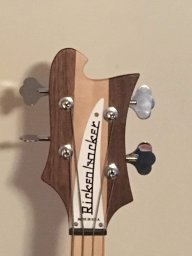
I've pretty much always thought that wood changes sound so marginally that it doesn't matter - however I am starting to think that wood with more resonance is plausible in terms of affecting tone. Maybe it's more of a feel thing, but the way the ricky resonates is wonderful to me.
 
I get your theory, but I don’t think the body weight makes a significant difference to the low end.
I would agree. This is why I say that most basses are built beyond the point where it matters. And why would anyone build a bass that no longer sounds like what people expect from one? I suppose this has been done and could be found but I'm pretty sure there is no such audible difference between the bottom end of a light Ibanez SR and a big heavy Fender Jazz, unless it comes from the electronics.
 
Big + for lightweight basses - with the high quality of amps now any low-end bass responce shortfall (as was pointed out in his assessment) can easily be compensated resulting in great tone comparable or better than any heavy (weight) bass out there vintage or new. Like many past myths about what delivers great tone - a quality bass like the 6lb/6oz Sanderg puts them to rest.
That's the next point. Why worry about physical properties that can be compensated by the now cheap and effective electronics?
Many talk about instruments as if they were allergic to turning knobs.
I would add, though, that high end is not an easy thing to compensate for. A not-so-bassy bass might be just fine but an instrument lacking treble or clarity is more of a problem.
 
When was the last time you heard someone say their sub-8lb Sadowsky or Lull had no bottom end or punch? Same with a Fender Rumble combo, Greenboy and Fearless cabs, etc. if your theory was true, bassists wouldn’t be shifting to lightweight equipment. But they are in droves because they also know that weight and tone have no correlation.
That's because so-called lightweight basses are still heavy enough. Make one half a cm thick and I'm sure there will be a difference. I am sure of this because if there weren't, then we could buy some today.

As to the Fender Rumble, I hear a good difference between the 15 and the 25, both having the same speaker but one built bigger and heavier.

Then comes this…

Now I want to see a proper review of that thing :D
 
Stiffness, thank you. I think it is the same for the bass absorbing acoustic energy from vibrating strings: stiffness is the factor, not mass.
It's both. Mount a stiff bridge onto a rubber body and the bridge will vibrate loads of energy into it. Mount it onto hard wood vibrating against a player's soft body and the same thing will happen, but to a lesser extent because the mass to move has increased. This stops when the stiff material becomes too heavy to be vibrated by the strings, when the dog can no longer be wagged by the tail. The same goes with an amplifier. A stiff but light cabinet will vibrate along and lose energy by friction on the floor.
 
  • Like
Reactions: Newbilong
That's because so-called lightweight basses are still heavy enough. Make one half a cm thick and I'm sure there will be a difference. I am sure of this because if there weren't, then we could buy some today.

As to the Fender Rumble, I hear a good difference between the 15 and the 25, both having the same speaker but one built bigger and heavier.

Your opening post assumes a speaker having a ceramic magnet would have more lows than the same speaker having a neo magnet when used in the same cab with the same amp.

The opening post also assumes the same electronics and neck would have less lows when mounted on a 7lb body than it would if mounted on a 10lb body.

I guess you agree it was nonsense and have since switched your logic to ‘well, I’m always going to be right on this because a bass or cab is heavy enough, and I’ll throw in some stiffness and power assertions for added good measure.’
 
Weight is related to the low end. A very light instrument, imagine a sheet of paper with strings, would just be fluttering back an forth, absorbing energy from the strings. The higher the frequencies, the less they would be absorbed so the overall sound would be tinny, the low end being sucked into feeding the fluttering. Make the sheet of paper thicker, turn it to cardboard or to solid wood and more of that low end would remain in the strings. The heavier the body, the less it would vibrate and the sound would remain fuller. At some point, the difference would no longer be noticeable and more weight would no longer matter. Most basses are built beyond that point.

The same principle applies to amplifiers. I suppose this is why bass amplifiers are built heavier than those for guitar.

So are we talking about weight, or rigidity?
 
It's both. Mount a stiff bridge onto a rubber body and the bridge will vibrate loads of energy into it. Mount it onto hard wood vibrating against a player's soft body and the same thing will happen, but to a lesser extent because the mass to move has increased. This stops when the stiff material becomes too heavy to be vibrated by the strings, when the dog can no longer be wagged by the tail. The same goes with an amplifier. A stiff but light cabinet will vibrate along and lose energy by friction on the floor.
I am sorry but I disagree. Stiffness prevents vibration. Mass only controls the amplitude of motion once energy had bled into the medium, not the amount of energy that bleeds into it.
 
I am sorry but I disagree. Stiffness prevents vibration. Mass only controls the amplitude of motion once energy had bled into the medium, not the amount of energy that bleeds into it.
Not if the whole thing vibrates. Try shaking your car then your house and see the difference. Or bang your head against a brick wall and a single brick. The stiffness is the same but the single brick will move a little more.
 
So are we talking about weight, or rigidity?
I am talking about weight. A fully rigid but light object will be shaken by vibrations. It would be worth an experiment: comparing a cheap light bass combo with the same one enclosed in something that prevents it from vibrating as a whole. Or maybe it's even enough to put a block of concrete on top. I would expect better basses from the one that is firmly fixed.
 
Many of the responses in this thread are based on the very subjective assumption that increased sustain and less energy transfer to the body somehow results in a more musical instrument, or at least “better” sound in specific frequencies.
This assumption is subjective at best and totally untested.
For myself, it might be equally likely that lighter softer bodies allow more transfer of energy throughout the instrument and sympathetic vibrations to the other strings and maybe even the pickups resulting in a more complex sound with richer harmonic content.
Is any of this actually true?
Who knows? Thats not my point.
My point is, that this notion that welding a bridge and tuning machine to a 2 ton piece of railroad track is going to somehow result in a magical perfect bass guitar sound is inherently flawed.
 
  • Like
Reactions: Newbilong
Not if the whole thing vibrates. Try shaking your car then your house and see the difference. Or bang your head against a brick wall and a single brick. The stiffness is the same but the single brick will move a little more.
The whole thing won’t vibrate if it is stiff. It may move, but it won’t vibrate. Shaking is different than vibration, so is translational motion or rotation.
 
  • Like
Reactions: Newbilong
The whole thing won’t vibrate if it is stiff. It may move, but it won’t vibrate. Shaking is different than vibration, so is translational motion or rotation.
If it moves, it takes energy away. And yes, something stiff can vibrate. A stiff guitar vibrates against the player's body which then absorbs energy. A stiff amplifier vibrates on the ground and loses energy to friction.
 
Last edited:
First, I do notice an effect of the weight/density of the body and the way the instrument responds to different playing styles. As to what extent that affects actual projection...maybe it doesn’t matter. It may not be possible to separate player-instrument feedback from actual tonal footprint projection. At the very least, it is difficult to separate where one leaves off and the other starts. They are interactive aspects.

I definitely notice heavier basses having a more solid slap response. And, it is interesting that players like Marcus Miller, who use that style, seem to share that preference. Can a chambered Sadowsky produce the same FOH projection? Possibly. But, if the player prefers the denser solid body, no amount of scientific analysis is going to change that equation. Player preferences are what they are.

Lighter instruments tend to have a more pleasing and “resonant” pizz response to my perception.

To balance all that out, my overall preference is around 9 pounds on a Jazz Bass chassis. Though the two builds I acquired over the last two years are quite definitely on either side of that target. I use all available styles when playing; and I guess the way I would put it is that I notice the differences, but don’t let them get in the way. If that makes sense.

Major player prefs factor. No fundamental “answer.”
 
  • Like
Reactions: Newbilong