That's the one thing I don't like about the 'Ray's B string. I'm a firm believer that you should be able to play the B with the same stroke you'd use on the rest of the strings. Could you imagine if every string required a different touch? Most of us would never be able to adapt.
QUOTE]
Hmmm... on every bass I've ever played (and I've been at it for almost 39 years), I've used different strokes on each string! It's the nature of playing a stringed instrument, assuming the strings are all different gauges and have different degrees of tension. Well, we're all different, I guess...


Enjoy the benefits of a premium membership!
Upgrade Account
-
TalkBass has been independent since 1998. Add your voice.
Create a free account to reply to discussions, view embedded media, and browse with fewer display ads.
Join free Log in
Want zero display ads or expanded classifieds tools? Compare plans.
You are using an out of date browser. It may not display this or other websites correctly.
You should upgrade or use an alternative browser.
You should upgrade or use an alternative browser.
What 5'er has the punchiest, tightest B string?
- Thread starter bassplayershane
- Start date
More options
Who Replied?
That's the one thing I don't like about the 'Ray's B string. I'm a firm believer that you should be able to play the B with the same stroke you'd use on the rest of the strings. Could you imagine if every string required a different touch? Most of us would never be able to adapt.
QUOTE]
Hmmm... on every bass I've ever played (and I've been at it for almost 39 years), I've used different strokes on each string! It's the nature of playing a stringed instrument, assuming the strings are all different gauges and have different degrees of tension. Well, we're all different, I guess...
With a Dingwall bass, all strings have the same (more or less) tension and that allows for an unparallel translation of dynamics across the board and across the strings. Even on the B string.
rockstarbassist
Inactive
Dingwall
Modulus Q5
MTD 535
Marginal difference between the 3 (owned them all, and all are great).
Modulus Q5
MTD 535
Marginal difference between the 3 (owned them all, and all are great).
yeah. And the other problem is that if you are used to playing medium or medium-heavy gauge strings on a 34 scale 4 banger, you can NAIL that E string, and it sounds glorious. You can't do that on a B string. It's just too big of a string. Increasing the scale length to 35 or 35 1/4 helps somewhat, but you still can't nail it like the E. what you CAN do however is use a thinner B string with the same tension as a larger gauge on a 34, and have less of a chance of it being floppy.I have a Dean Edge (the european one) with light guage strings and a tapered low B and it is just monsterous. However it is 35" scale and I play light.
As previous posters said low B's are pretty much always floppier than the other 4 due to physics. I learned on a cheap 5 so it has never been a problem for me.
+5 on the Moduluses...
I own a flea, the B is nice on that, but on the Q it's a bit tighter and punchier. Longer scale though....
I own a flea, the B is nice on that, but on the Q it's a bit tighter and punchier. Longer scale though....

It's been said already, but my Modulus Q5's B is tight, punchy, and never flabby. Best B I've played. Stiff composite neck, 35" scale, and DR strings have a lot to do with that.
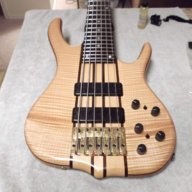
I don't think anyone has mentioned Pedulla yet. He makes one of the best balanced B strings out there. For me, it's about the entire bass, not just the B string. Much of it has to do with technique too. The closer you pluck to the bridge, the tighter any B string will sound.

- Jun 19, 2004
- 4,782
- 83
- 42
- Disclosures
- Endorsing Artist, Schroeder Cabinets
Modulus comes to mind for thumpy tones.
My first thought was the Modulus Flea model with the single MM-style humbucker pickup. You'd be hard-pressed to find something punchier than that, except maybe a Q5.
[Invalid or Expired Link Removed]

Change your strings. The tension in a string is related to the scale of the bass and the construction of the string. It has nothing to do with any other aspect of the bass.
+1 - For the most part
- Jun 19, 2004
- 4,782
- 83
- 42
- Disclosures
- Endorsing Artist, Schroeder Cabinets
Oh, were we talking about actual string tension? That changes things... I thought he just meant a tight, punchy tone à la EBMM or Modulus, etc.

alexclaber
Commercial User
With a Dingwall bass, all strings have the same (more or less) tension and that allows for an unparallel translation of dynamics across the board and across the strings. Even on the B string.
And even if you're too scared of fanned frets you can use balanced gauge string sets on standard scales but you'll have to custom order them. This works particularly well on longer scales if you want a good low B string.
Alex

My Dingwall has an awesome B. My Sadowsky and Ken Smith have excellent B strings and both are 34" scale. As I understand it, the most important factor is to have a nice stiff neck. Some basses just don't have a great low B no matter what strings you put on them or how good your touch is.
Strings help. I put a set of strings on my Smith (brand unknown?) and they sound better than the original Smith strings. Better definition on the B string.
Strings help. I put a set of strings on my Smith (brand unknown?) and they sound better than the original Smith strings. Better definition on the B string.
Perhaps another type of strings, I found some GHS's to be very tight strings (this compared to DR)

I have a Lakland 5501 with Nordy Fat Stacks in it. Absolutely love it but the B isnt as tight and punchy as I'd like. Its really fluffy compared to the rest. Any ideas on how to fix this problem? I use 45-135 gauge strings.
Cheers!
BONGO

MikeBass
Supporting Member
- Nov 4, 2003
- 11,943
- 3,137
- Disclosures
- Endorsing artist- Suhr basses, PedalTrain, GHS, Ultimate Ears
Ken Smith basses have incredable B strings.
As do Sadowsky's and my Valenti.
I have two older Yamaha's (BB5000 & TRB5P) which both have very even B's.
And no need to be gentle on the bass with regard to playing the B string (as I read earlier in the thread). I play the same way on the B that I do on the other strings.
Especially on the above mentioned basses.
As do Sadowsky's and my Valenti.
I have two older Yamaha's (BB5000 & TRB5P) which both have very even B's.
And no need to be gentle on the bass with regard to playing the B string (as I read earlier in the thread). I play the same way on the B that I do on the other strings.
Especially on the above mentioned basses.
Every Warwick 5 and 6 string I've ever played (yes even the newer ones) has had an amazing low B string.
Spector and Ernie Ball also have beefy B's.
+1


If all basses were the same scale and using the same strings, what makes a Curbow work better than a Fender? Construction, the right strings, and a good set-up should always be combined because it makes for a solid and consistent B.
It was sarcasm my friend...due to Munji's post that I quoted.

And even if you're too scared of fanned frets you can use balanced gauge string sets on standard scales but you'll have to custom order them. This works particularly well on longer scales if you want a good low B string.
Alex
I've been using a method like this for many years and have been happy since day one. Personally, I think buying in bulk takes out the sting of having to pay for each individual string.
Perhaps another type of strings, I found some GHS's to be very tight strings (this compared to DR)
Certain companies use thinner or thicker cores, which is why you'll find strings in the same diameter that don't have the same response. When it's all said and done, it's the linear density that matters, which is how you could explain a LaBella .060 tapewound string has about the same tension as the average .045.
It was sarcasm my friend...due to Munji's post that I quoted.
LOL, one must clarify otherwise people might take the info seriously.
I've tried many 5ers. Nothing has touched a Dingwall for clarity IME.
+1 Lomo. Nice to see you. What is that bass on your avatar? Looks nice


