• TalkBass has been independent since 1998. Add your voice.
    Create a free account to reply to discussions, view embedded media, and browse with fewer display ads.
    Join freeLog in
    Want zero display ads or expanded classifieds tools? Compare plans.

What benefit does owning multiple basses give you?

Here is my take. In my tool box I have a claw hammer, a ball peen hammer, a tack hammer, and a rubber mallet. Each one of them can be substituted for the other but they each do a specific job better than the others.

Same with my basses.

Sepp
 
for me, it started out as "hero-worship", meaning that I wanted basses like my hero's played. I have always had my 3 basses, and the "having a back up" thing is the secondary reason (though it is funny cause I rarely take more than one bass to any gig, and I have never broken a string or had any electrical problems happen with the bass. Now the AMPS on the other hand...)

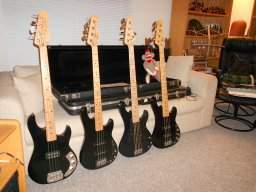
I only ever get temporary GAS, but still need to get a Ric to finish out my collection.
 
For 20+ years I only played one and one alone. Then one day it got heavy. I bought a cheap Ibby because I liked the feel. Hated the sound so I bought another...different feel and sound. Then came to hate the feel and changed pickups and preamp in the first Ibby...love the feel and sound, so now the second Ibby sounds and feels bad to me. Found a cheap 5 string in my 'hood, parted it out and turned my very heavy Yamaha BB series into a 5-string Music Man Sterling clone. TOTALLY different feel and sound. Found a cheap fretless P/J nearby and again TOTALLY different feel and sound.

Tl;dr: thought I liked one sound and feel for 20+ years; turns out I was wrong.
 
Theres no right or wrong way for me. It's just as valid to have the one bass, which you know inside out and goes everywhere with you or several which all scratch a particular itch. For many years I was the former with my trusty '92 Ray which I've had since I was a teenager. But just recently it's grown to a 5hh bongo, sadowsky pj with flats and stingray 4hh with round wounds, while the 92 ray has been converted to fretless. Gotta say that I'm now much better equipped to cover a whole range of musical situations and its great to have the variety as long as each bass is performing a valid role. It does get a bit silly when you have of ten same bass in different colours, but who am I to judge?
 
For my first decade of playing i stuck with 2 basses. An old fender tele bass and my custom fretless alembic series I. Then i began going gear crazy and gathered a few more(kubicki x-factor, other odd fenders,eko, univox)Then i came into some cash and really.went off the low frequency deep end. I would go into stores to check out basses, and if i played one that brought about a different style.or feel or such i would buy it with the idea of different form..different function/result, which did largely prove out.. though i ended up with a room full of basses(a bit overboard/extreme..)Having multiple instruments at your disposal is a good thing(sorry for the Marthism) as the wider a tonal pallet one has before oneself the greater diversity of creative potential lay within grasp. In playing or recording i used to work up through a series of basses ending up at the alembics,kubicki, or warr guitar. However, now days i just stick with two basses, a fretted and a fretless series I alembic. Although there is that one bass down at that one store.......he he
 
Well, I didn't really have time to read thru this whole thread that's grown to 8 pages in, what, 4 days? I'm sure I'm not going to add anything that hasn't been said already, but these are a few things that have happened to me:

1. Middle of a show, middle of a set, middle of a song, my bass, my only bass at the time, gave me the finger and quit! Yes, if I'd been playing a passive bass or one with a bypass, it would've been ok, but that's not the point. A backup is not necessary, but recommended.

2. Happened last weekend: broke a string! This is, maybe, the 3rd time in 20+ years of playing that I've actually broken a string during a show. The last time, I only had one bass=show stoppage. This time, I just put it down and picked up my backup=happy bandmates & happy audience.

3. Alternate tunings: I play in a cover band and we always try to play songs in the key that they're written in, which means some stuff is in standard, some stuff is 1/2 step down, some stuff is a whole step down, and then you add in your dropped tunings and that makes for a long set with very little music if you have to keep retuning=show stoppage.

4. It's fun and somewhat inspiring to pick up a different instrument and see if you can get it to sound the way you want it to sound.

I take 3 basses to every gig. Why? Because I don't have 4...yet! :D!
 
1. Middle of a show, middle of a set, middle of a song, my bass, my only bass at the time, gave me the finger and quit! Yes, if I'd been playing a passive bass or one with a bypass, it would've been ok, but that's not the point. A backup is not necessary, but recommended.

2. Happened last weekend: broke a string! This is, maybe, the 3rd time in 20+ years of playing that I've actually broken a string during a show. The last time, I only had one bass=show stoppage. This time, I just put it down and picked up my backup=happy bandmates & happy audience.

Same as you, I've been playing for decades. Bass failures have been rare during a gig, but they've happened!

1. I've broken a few strings (can happen to anyone).

2. On my brand new Music Man Cutlass (we're talking 1983), the end of the nut broke so that the E string went flopping off the side of the neck.

3. I had a jack fail on a passive bass.

I'm not sure #2 was even field-repairable, but regardless, having a backup prevents the show from stopping until the problems are fixed.
 
Other than a backup and maybe a travel bass, I'd say that excessive bass GAS kills trees and the planet. Be green, own a Dargie Delight Musicman or whatever, have a backup and a beat-up and call it quits.

If you look at the restrictions that are being imposed on certain kinds of woods, you'll realise that extinction of a species might mean you have a "one of a kind" instrument, but you endangered the survival of some small animal or local population that depended on that tree for whatever purpose.

Not saying using wood for a fine musical instrument is a crime. But be wise about what you buy and treat it well, as something died to give you and others pleasure.

- Reggae Mangle
 
I play with a couple of bands that are very different from each other. Zeppelin and sabbath tribue bands get the precision and jazz with flats and the fretless. Ska gets the the thunderbird and stingray 4. Rap group gets the Stingray 5 and 5 string jazz. I've got a couple of others that I've used in other bands before and might get rotation in one of the mentioned projects...
 
Right now its three categories’. 34” 30” and standup.
For me it’s been trying to figure out what really feels good. So far in a 34” scale, neck through fretless with a larger than 1 ½ neck and a radius of 15-20 inch feels best. I’m still trying to figure out the short scale fretless. I’m obviously a lot faster on the short scale but the string spacing feels too tight, the neck feels too small but the fret spacing is just right. As far as the standup I have a ¼ scale and this is the short scale of standups. It feels good but my hand strength still needs work so I’m not quite their on a final decision yet.