• TalkBass has been independent since 1998. Add your voice.
    Create a free account to reply to discussions, view embedded media, and browse with fewer display ads.
    Join freeLog in
    Want zero display ads or expanded classifieds tools? Compare plans.

What changed the way you make music?

What one bass, amp, effect, string, course of study or whatever, changed the way you make or view music? I know that most of us get GAS and look for new fun and exiting things to make our hobby or passionate pursuit more interesting, it’s part of being a musician. What things have you found that have actually moved the needle in finding your sound or becoming a better musician. For me it has been three things, first was becoming a bass player. 2nd was learning modes and third was buying an amp that had the sound that was my ideal. I would be interested in knowing what you have found.
 
  • Like
Reactions: dramatwist
Digital media. When it became exponentially easier to play a given track with next to no effort, it became a lot easier to follow an impulse to pick up an instrument and play along. A similar thing happened with digital recording technology. For all the change it has wrought, there are still some worthwhile benefits to being able to record, edit, and mix with far more fluidity than analog tape allowed. :thumbsup:
 
- developing the skills and (more importantly) confidence to know I could walk into any professional music scenario and get the job done; but also
- developing the taste and discretion to recognize that there are certain professional music scenarios that I have absolutely no business participating in
 
I made the most progress in my musicianship by learning about other instruments, and by learning to play a bunch of them.
In addition to being able to play bass guitar I can also play Double Bass, Cello, Violin, Drums, Piano, Saxophone, Flute, Trumpet, Trombone and Guitar.
I have gigged and recorded on most of them. By learning other instruments, my awareness of their functions in ensembles, pitch and dynamic range enables me to orchestrate and arrange parts appropriate for a given instrumentation. Multi-instrumentation allows me to be able to communicate to other instrumentalist far more effectively, such as those instrumentalist playing transposing instruments.
All the knowledge I've acquired informs my bass playing to, for example my knowledge of harmonics does not come from listening to bass players, the harmonic note options of a given fundamental come from playing brass instruments particularly trumpet, the execution of false harmonics come from guitar.
The reharmonization knowledge I've gained comes from playing piano.
Overall I recommend learning other instrument to understand music from a more informed perspective.
It helps transcription also, I can check it a lot easier, I have transcribed many horn solos and then learnt to play them on bass.
Of course I learnt to sight read, jazz theory and different styles of music too. None of it happened overnight it's been a 20+ year journey of learning.
Even with all those instruments that I could play, I still find bass to be the one I feel most at home with and I like that because it is such a new instrument it feels as though there is many innovations yet to happen, in my opinion at just under 70 years of existence it is still in the infancy of it's development.
 
Nothing from technology; I mean, it’s great and all, but I make music by playing, and I improve my playing by improving my technique, bit by bit. It doesn’t mean that technique is an end in itself, because 1, you’ll never get “there”, and 2, it is just a tool. The pivotal moment for me was when an instructor got me to start using the little finger on my left hand, and a whole new world of economy of motion opened up. As well, learning just a modicum of theory and song structure was important, for when I started out, because of the era and stylistic trends, all a song was for me was a collection of different riffs just strung together in a certain order. I finally grasped playing through changes and harmonic content.
 
Last edited:
Digital media. When it became exponentially easier to play a given track with next to no effort, it became a lot easier to follow an impulse to pick up an instrument and play along. A similar thing happened with digital recording technology. For all the change it has wrought, there are still some worthwhile benefits to being able to record, edit, and mix with far more fluidity than analog tape allowed. :thumbsup:
This. Never going back to tape. I did a lot of recording with some friends on a really old verion of Cakewalk on an old PC that's still running XP, and it's still light years better than my old Tascam 414. Going digital changed everything radically, at least for me.
 
Taking a very long (15 years or so) hiatus from playing bass. While I did play acoustic guitar during that time, it wasn't nearly as much as I normally would've.

Once I went back to playing - mainly thanks to the fact that one of my twin boys started playing bass - I found myself developing a completely different technique and creating music that had almost nothing to do with the stuff that I've written in the past.

From a technology standpoint, it's lovely to have a digital portastudio that one can keep on at all times and record every phrase that they come up with, with effects and drum patterns all at the tip of their fingers. I also found newer bass amps to be a lot more to my liking than I originally expected. Does that mean that I'll get rid of my V4B if I live to retire and move back home next year? Hell no.
 
  • Like
Reactions: el jeffe bass
I would have to agree with Thabassmon. I found that learning many other instruments to an intermediate level, from brass and banjo, to hammered dulcimer and cello, gave me an increased understanding of the role of various instruments in music. Each different class of instruments has brought something new to the bass role and its integration into the whole.
 
  • Like
Reactions: el jeffe bass
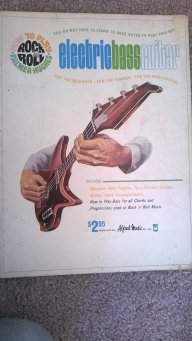
This book. I bought it for the obvious reasons (learning to play jazz) but go so much more out of it. It really changed my whole approach to writing lines in all styles.

GUEST_fde243af-1ccb-44b1-b338-2d5002079e28?wid=488&hei=488&fmt=pjpeg.jpg
 
What things have you found that have actually moved the needle in finding your sound or becoming a better musician.
playing with the very best cats. sometimes it was through effort and perseverance, but a lot of times it was just a matter of luck to have played with some great players. one drummer, in particular, taught me some serious, needle-moving concepts which have informed my musicianship/playing for the better part of a long career = a teacher.
 
It isn't one thing, it's a process of learning and improvement that never stops. If you want to form your own vocabulary and be able to express it eloquently, you piece it together with many different influences.

Pino back in the day before the fame, would play his own gig and then go and watch another somewhere in town. I don't really feel like doing that much at all after a gig. But he was absorbing the lot, putting his vocabulary together even then.
 
  • Like
Reactions: el jeffe bass