
Enjoy the benefits of a premium membership!
Upgrade Account
-
TalkBass has been independent since 1998. Add your voice.
Create a free account to reply to discussions, view embedded media, and browse with fewer display ads.
Join free Log in
Want zero display ads or expanded classifieds tools? Compare plans.
You are using an out of date browser. It may not display this or other websites correctly.
You should upgrade or use an alternative browser.
You should upgrade or use an alternative browser.
What chords/scales are equivalent to Dbm7b5?
- Thread starter MichelD
- Start date
More options
Who Replied?
Minor 7 flat 5 is 1, b3, b5, b7
So, write out the Db major scale, and determine the notes in the chord.
So, write out the Db major scale, and determine the notes in the chord.


D Maj, Em dorian, F#m Phrygian, Gsus4 Lydian, A7 mixolydian, Bm7 Aeolian, C#m7b5 aka Dbm7b5 Locrian
The notes of Dbm7b5 are: Db Fb Abb Cb.What chords and scales have the same notes as Dbm7b5?
It is enharmonic to C#m7b5 (C# E G B), which is much more likely to show up, for example, as the ii chord in B minor. By comparison, Dbm7b5 would be the ii chord of Cb minor, with a (theoretical) key signature of 3 double flats and 4 flats! I doubt anyone is perverse enough to use this.
So, I'd be curious to know: in which context do you encounter Dbm7b5?
It is in a chart I have for "All the things you are."The notes of Dbm7b5 are: Db Fb Abb Cb.
It is enharmonic to C#m7b5 (C# E G B), which is much more likely to show up, for example, as the ii chord in B minor. By comparison, Dbm7b5 would be the ii chord of Cb minor, with a (theoretical) key signature of 3 double flats and 4 flats! I doubt anyone is perverse enough to use this.
So, I'd be curious to know: in which context do you encounter Dbm7b5?
In which key is your chart ? In which bar do you find Dbm7b5?It is in a chart I have for "All the things you are."
I have the New Real Book chart (it's in Ab major, ie, key signature of 4 flats), and there is no Dbm7b5. On the other hand, the turnaround is Gm7b5 C7 resolving to Fm7 at the top of the form; so, if one does a tritone substitution on the turnaround (a very common reharmonization), one ends up with Dbm7b5 Gb7(#11). Although it is awkward to spell out, it would sound perfectly fine. Maybe this is what you have in your chart.
Otherwise, since a min7b5 chord is an inversion of a min6 chord with a root a minor 3rd higher, it could be that your Dbmin7b5 is just a misspelled Em6 chord.
In any case, to comment on what scale to use there, one needs to learn more about harmonic context (one would need to see the chart).
Last edited:

If I transpose All The Things You Are to Eb over at https://www.jazzstudies.us/ the Dm7b5 shows up in bar 21
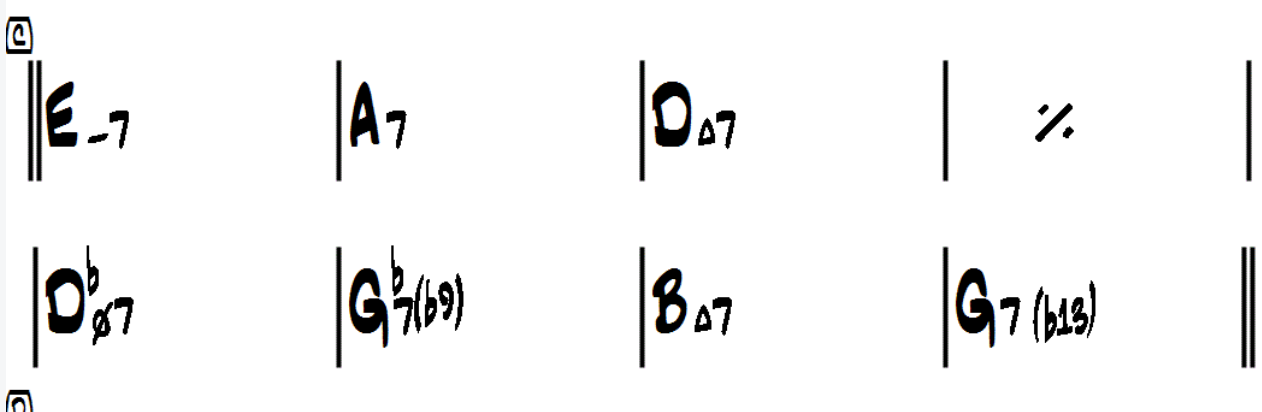
Seems to be part of a modified ii -V-I into the Bmaj7
Seems to be part of a modified ii -V-I into the Bmaj7

- Apr 1, 2000
- 17,408
- 9,865
- Disclosures
- Endorsing Artist: Roscoe Guitars, DR Strings, Aguilar Amplification
It is in a chart I have for "All the things you are."
In this instance, it's a ii chord (followed by a V) in the key of B (more accurately Cb).
I believe, in this instance, Dbm7b5 Gb7b9 is just C#m7b5 F#7b9 enharmonically misspelled, as it is a standard minor ii V resolving to BMaj7 (it is a good example of how misspelling can be confusing, as it led you to believe it is a modified ii V into BMaj7). When one asks iRealPro to transpose, it sometimes results in such enharmonic misspelling issues.If I transpose All The Things You Are to Eb over at https://www.jazzstudies.us/ the Dm7b5 shows up in bar 21
View attachment 4408376
Seems to be part of a modified ii -V-I into the Bmaj7
Last edited:

If you're looking specifically for what notes to use when soloing over the chord, try the half/whole diminished scale, which is a substitute for any sort of dominant/diminished chord:What chords and scales have the same notes as Dbm7b5?
Db, D, E, F, G, Ab, Bb, Cb

BobDeRosa
Commercial User
- May 16, 2012
- 2,445
- 4,403
- Disclosures
- Owner, Tritone Jazz Fantasy Camps
That's the Locrian mode of D major, so it contains the exact same scale notes as D major (think C# rather than Db). It also contains the 3rd, 5th, and 7th of a C major chord and the root, 3rd, and 6th of a G major chord.
Yeah, Locrian was obvious as soon as I saw it. (JK, LOL....)D Maj, Em dorian, F#m Phrygian, Gsus4 Lydian, A7 mixolydian, Bm7 Aeolian, C#m7b5 aka Dbm7b5 Locrian

Benjamin Earl
Commercial User
- Dec 31, 2008
- 281
- 469
- Disclosures
- Fretboard Visualization Author
I thought it would be fun to respond to your question with as many scales I could find that fit with Db-7(b5). This is a good exercise for matching chord tones with scale tones. I found a bunch, but I'm sure there are more. The real question is: Which scale will sound good in the song you are playing?
Db-7(b5) has the following chord tones: Db,E,G,B
The following scales (mostly) contain those notes:
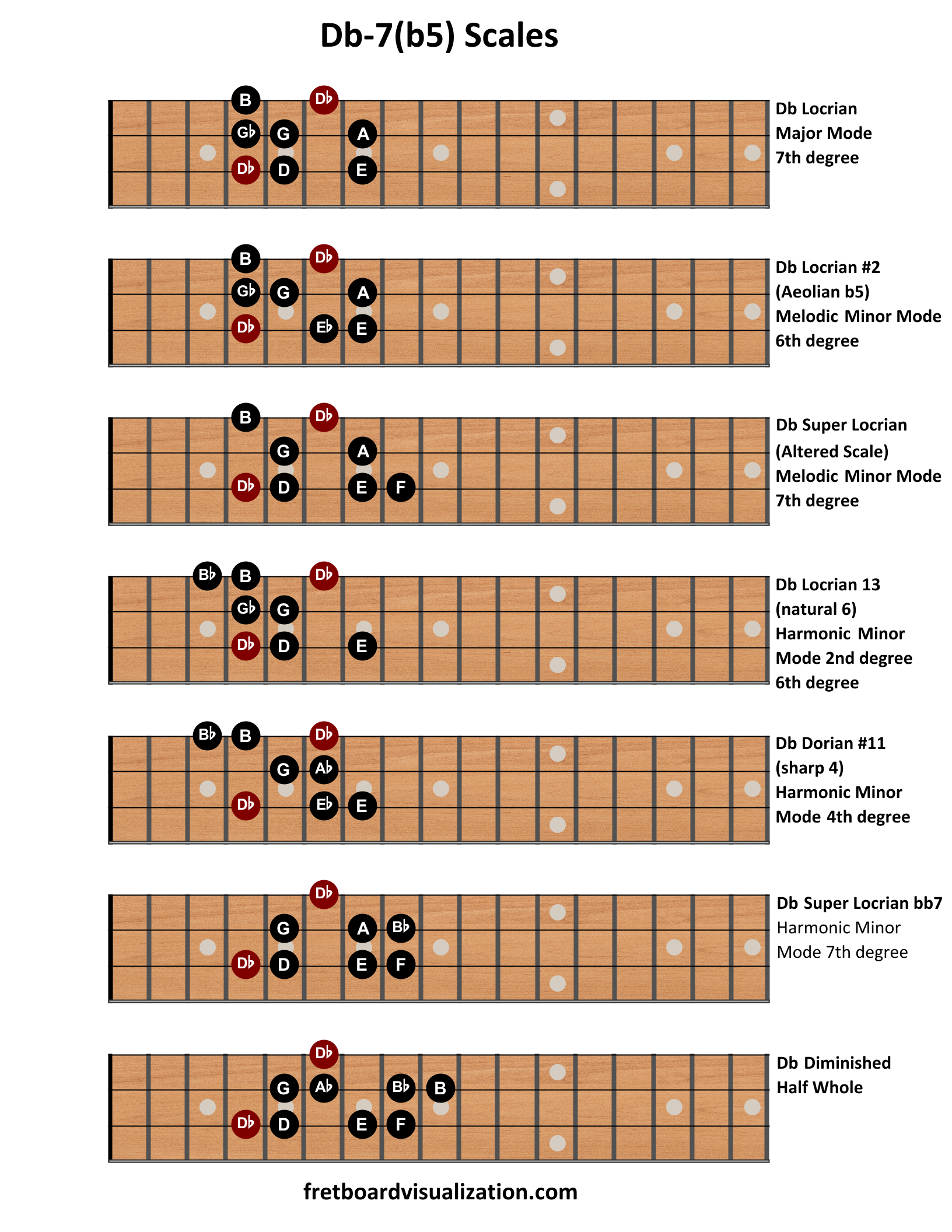
ps I did this quickly so please excuse any unnatural fingering placement.
Db-7(b5) has the following chord tones: Db,E,G,B
The following scales (mostly) contain those notes:
ps I did this quickly so please excuse any unnatural fingering placement.
Last edited:

So whenever I see the the half diminished chord in a ii-V, I think of it as just permission to play the subbed bass note and approach the V from a half step above. Of course, you don't actually NEED permission to do that (you can always sub a ii-V of V for any ii in a ii-V, and then do a tritone sub of the V of V, giving you that half step movement from above), but sometimes the chart is trying to tell you that it would be particularly un-hip to approach the V from a whole step above. I think it also implies not to approach the V from a half step below through the subbed V of V, for that matter.If I transpose All The Things You Are to Eb over at https://www.jazzstudies.us/ the Dm7b5 shows up in bar 21
View attachment 4408376
Seems to be part of a modified ii -V-I into the Bmaj7
Last edited:

So whenever I see the the half diminished chord in a ii-V, I think of it as just permission to play the subbed bass note and approach the V from a half step above. Of course, you don't actually NEED permission to do that (you can always sub a ii-V of V for any ii in a ii-V, and then do a tritone sub of the V of V, giving you that half step movement from above), but sometimes the chart is trying to tell you that it would be particularly un-hip to approach the V from a whole step above. I think it also implies not to approach the V from a half step below through the subbed V of V, for that matter.
I was attempting to play these kind of songs for a while in the way back. When I figured out the "half step movement from above" it was a revelation to understand where some of these were coming from. This kind of leading note had always intrigued me. That wonderful b5 note.


I thought it would be fun to respond to your question with as many scales I could find that fit with Db-7(b5). This is a good exercise for matching chord tones with scale tones. I found a bunch, but I'm sure there are more. The real question is: Which scale will sound good in the song you are playing?
Db-7(b5) has the following chord tones: Db,E,G,B
The following scales (mostly) contain those notes:
Nope. Db Fb Abb Cb
Thank you folks. It only appears for one-half a bar, but I was curious because I was looking for an easier way to think of the chord.
C#ø7, F#7(b9), Bmaj7
a iiø7-V7(b9)-i in B minor that lands on B major instead.
Mainly you'd want to hit the C#, E, G to get the main chord tones and sound for the chord. As a bassist, you'd mostly play only 2 or 4 notes of the 7 note scale of the moment. Best think of chord tones (1, b3, b5, b7) and then the passing tones (2, 4, 6,) can come from any of the options Ben Earl wrote in post #13. (just use the enharmonic versions spelled on C#)
This is why we are always advised to practice the basic progressions in all 12 keys, and mentally all 15 keys, so we are comfortable with them.
I'm sure you're comfy with Dm7(b5) right? So why the hangup with Dbm7(b5) or C#m7(b5)? It's the same thing, just transposed, or transposed and spelled enharmonically.
Being familiar and comfy with different spellings is the path.

Dbm7b5 would be the 7th degree of the E double flat major (ionian) scale, which is a key you would probably not play in very often anyway.
C#m7b5 is the chord associated with the 7 th degree of the D major scale.
C#m7b5 is the chord associated with the 7 th degree of the D major scale.


