• TalkBass has been independent since 1998. Add your voice.
    Create a free account to reply to discussions, view embedded media, and browse with fewer display ads.
    Join freeLog in
    Want zero display ads or expanded classifieds tools? Compare plans.

What exactly is the difference between a guitar and a bass?

Maybe the OP meant this type of bass:

Largemouth_bass-600.gif

I have a couple of those stickers on my case.
 
We all know what a guitar is, how its played, what technology goes into it, etc. Its tuning ranges from about E2 to E6 (for a standard 6 string, 24 fret guitar, this of course is different with guitars with more frets, more strings, etc).

The bass guitar is somewhat similar to guitar, but with many changes that have been made to accomodate (surprise!?) a different and lower tuning, E1 to F4 (standard 4 string, 22 fret bass, again this can change depending on number of frets and strings). Producing notes that low requires some design changes that ultimately make the bass guitar different enough from a standard 6 string guitar to be more than just a "downtuned guitar with less strings".

This means that a great guitar player will not automatically be a great bass player, and the opposite is true as well. Each instrument really has its own identity, despite sharing a similar appearance to the untrained eye. If anyone tells you bass is some kind of "secondary guitar", "guitar for failed guitarists", etc, they dont know **** and you should strangle them with the E string on your bass!
 
Interesting.

But there are some instruments that are, seemingly, neither fish nor fowl. Where would you classify an instrument (and somewhere it must exist) with the following characteristics:

34-36 scale
Played vertically on an endpin
Curved fingerboard for arco
Magnetic pickup

Yes, I know we'd call it a "short scale EUB"...or then again, would we call it a "bowable bass guitar on a stick"?

FWIW, I don't think of Ashbory basses - or the uke-bodied derivatives - as guitars. They are a new form of instrument IMO.

Adrian
 
Part of the same family means they are both the same name. A tenor sax and an alto sax are part of the same family and thus both saxes.

Technically, saxophones are all the same instrument, since they all utilize the same fingering to produce the same concert pitches, and there is zero learning curve between them all. The family to which they belong is the "woodwind" family, which includes clarinet, bassoon, etc. The common name is also due to the fact that they are a much more modern instrument than either the guitar family or the violin family... they were all invented by the same guy, a Belgian whose last name was "Sax." The guitar family was not invented by one person, nor was the violin family. They are both evolutions of stringed instruments that have been in the hands of human beings since prehistory.

All this discussion is really semantics, and I have to keep wondering "who cares?" except for a purely academic discussion.

Is anyone *not* going to play bass if we all agree it's a member of the guitar family?
 
Technically, saxophones are all the same instrument, since they all utilize the same fingering to produce the same concert pitches, and there is zero learning curve between them all. The family to which they belong is the "woodwind" family, which includes clarinet, bassoon, etc. The common name is also due to the fact that they are a much more modern instrument than either the guitar family or the violin family... they were all invented by the same guy, a Belgian whose last name was "Sax." The guitar family was not invented by one person, nor was the violin family. They are both evolutions of stringed instruments that have been in the hands of human beings since prehistory.

All this discussion is really semantics, and I have to keep wondering "who cares?" except for a purely academic discussion.

Is anyone *not* going to play bass if we all agree it's a member of the guitar family?

Sometimes classifications are more involved than you think. A sax for example has the characteristic of a conical bore in the horn. This is different from some others (clarinet) that have a conical bore. Of course some would say clarinets are wood, but they do make metal ones.

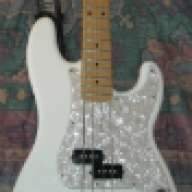
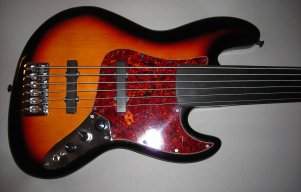
Likewise, one salient feature of guitars is the use of frets. Since a standard bass guitar is a fretted instrument, available with a guitar-shaped body and even tuned like the lower 4 strings of a Spanish guitar, it appears to pretty much be a guitar. The problem is that nothing ever stays quite so neatly partitioned. If frets are a feature of guitars, what is a fretless bass? Is it a solid body bass violin? Or for that matter a reduced size bass viol? Or does the fact you play it horizontally like a guitar make it a guitar? Somehow I don't think people call EUBs guitars. So verticality and an ability to play it with a bow seems to enter in. That makes it some kind of violin. It's all not quite so simple.
 
Sometimes classifications are more involved than you think. A sax for example has the characteristic of a conical bore in the horn. This is different from some others (clarinet) that have a conical bore. Of course some would say clarinets are wood, but they do make metal ones.

Likewise, one salient feature of guitars is the use of frets. Since a standard bass guitar is a fretted instrument, available with a guitar-shaped body and even tuned like the lower 4 strings of a Spanish guitar, it appears to pretty much be a guitar. The problem is that nothing ever stays quite so neatly partitioned. If frets are a feature of guitars, what is a fretless bass? Is it a solid body bass violin? Or for that matter a reduced size bass viol? Or does the fact you play it horizontally like a guitar make it a guitar? Somehow I don't think people call EUBs guitars. So verticality and an ability to play it with a bow seems to enter in. That makes it some kind of violin. It's all not quite so simple.

I have to say, I honestly don't care. This has to be the most useless conversation ever. Is pork white meat or red meat? What about lamb? Salmon? Will knowing increase my enjoyment eating it or its ability to sustain my body?

Everyone just go and practice....
+1
 
The physical differences between a bass guitar and a 6-string electric guitar boils down mostly to the size of everything. Bigger strings, longer neck, etc.

The electronics are the same, the materials are the same, construction and components are directly comparable.

Heck, some basses even come with guitar pickups, right Rick-o-fans?

They're guitars, just bigger. The lineage to big hollow classical instruments is very weak.