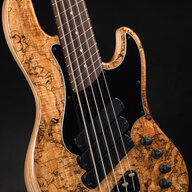
If you are doing classic rock indoors (for the most part) with a 3 piece ala SRV-type setup, to be honest with you I would bring out the jazz. Not because Tommy Shannon or anything. But because there is sonic room to hear the small nuances of the jazz that do not (IMO) get heard in a louder, larger band. And, although lots will disagree with me here, I would use rounds. Also because of the space created for a jazz type bass, with its higher highs, and lower lows to be heard.
If, however, your project were a busier mix with keys, another guitarist, etc, I would bring out the P. If the busier band were playing outdoors, I might use rounds or flats on the P, depending on how the bass is mixed to FOH. If the keyboard player has a heavy left hand, as many do, which frustrates the cr*p out of bass players, I would probably string the bass with a somewhat neutral flat, such as Sadowsky, or possibly a set of TI's or, (if you dont mind slightly higher tension) chromes. Those will allow you to hit with thick punch, and the punch will be in the frequs that key guy isnt hogging as much. The TIs are very low tension, and the least "flat sounding" flat, but still cut through and have the basic flavor of a flat. If the keyboard player is under control and doesn't try to kill everyone with the low frequ's, I think you could use a traditional flat such as Labella which is my favorite in that category. Some like GHS flats for a traditional flat, but I personally find them a little bit "meh" and lacking personality, and they do not sound as traditional out of the box as Labella (760FL my favorites in that bunch).
The P may be a safer choice in lots of instances because of its ability to own a wide swath of lower mid frequencies, and thus be heard, although often what you hear, (particularly if the mix is loud or busy), is the ability of the P to provide the foundation of the band, along with the drummer, and not the sparkling clear notes that are the business of the jazz more or less. To me, the P makes the butts shake more than the Jazz. So, the point I'm making here is, your style of playing and how you see yourself in the band has a lot to do with what instrument to play.
But to return to your questions about strings, based upon the info you provided, honestly I would use rounds in your situation, and possibly the jazz if its strictly a 3 piece, and your playing is mostly indoors.
Now, amps and cabinets, thats a whole nuther thing that you may have to wade through next!