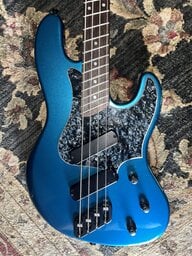
Happy hunting! They should be able to do considerably better on price than what's posted. I paid ~$4k for mine in their holiday sale.
How long have you had it? The best I could find is $5.1K

TalkBass has been independent since 1998. Add your voice.
Create a free account to reply to discussions, view embedded media, and browse with fewer display ads.
Join free Log in
Want zero display ads or expanded classifieds tools? Compare plans.
Happy hunting! They should be able to do considerably better on price than what's posted. I paid ~$4k for mine in their holiday sale.

 I always do an experiment whenever I read something like this on TB. So I go and plug in my 2015 American Standard Precision with EMG GZR pickups and Tomastik flats. I played one note at a time and let it sustain. Sure enough, the 8th fret on the G string has less sustain than all others. Nowhere near enough to ever cause any problem whatsoever in my lifetime, but it is there. I would suggest doubters to do the same experiment and report back. The term "dead spot" might be an exaggeration though (at least in my case) as there are certainly no "dead spots" on my bass.


Ah...I thought this was a thread about my bedroom.


300 level vibrations was a long time ago.It’s physics, and pretty well explained by @Killing Floor
A vibrating string, fretted or open, has contact points on each end; nut & bridge or fret & bridge on a bass. Whatever the end points consist of, they both have a resonant frequency, and in the case of a bass, the two end points are attached to each other through the neck & body, so they might have a common resonant frequency. If one or both end points have a resonant frequency very close to the frequency of the vibrating string, or a resonant frequency very close to a harmonic of the vibrating string, the end point(s) will also vibrate when the string is plucked. If the end points vibrate, they will absorb the energy of the vibrating string & the vibration of the string is greatly dampened or mostly stopped.
An example of the energy absorption has been experienced by about anyone who has operated one end of a jump rope. If the other end of the jump rope is tied to something solid, like a fence post, you can swing the rope well. If the other end is tied to something not so solid, like the wire between two fence posts, you can’t swing the rope as well. It takes more of your energy to keep the rope swinging because the movement of the wire is absorbing the energy you are applying to swing the rope.
Pretty much every bass, and other stringed instruments, have some degree of “dead spot” somewhere in its frequency range. Those basses made of a material other than wood often have less chance of the problem because the “non-wood material” has a resonant frequency outside the frequency range of a standard tuned bass. This is no guarantee; some non-wood basses still have slightly dead or weak notes.
Those that have owned dozens of basses and have never noticed a single one of them having a single dead spot anywhere are not the owner of very unique basses, they are just very unique people.
A piece of advice; don’t look too hard for dead spots on a bass or other stringed instrument, because once you know how dead spots sound and feel*, and also discover on which notes they are the most common, you get to the point where you can’t avoid noticing them.
Edit: I would define the term “dead spot” as being discussed here as: “a note where the fundamental frequency has less sustain than other notes of different, but relatively close by frequencies”. Just clarification that “dead spots” aren’t totally dead; they are just varying degrees of “weaker” when compared to other notes on the same instrument.
*(yes, you can feel dead spots on a bass from the vibration in the body & neck. The note where you can feel a significant body vibration is usually the dead spot. I’m pretty sure I can find the dead spot(s) on most electric basses while listening to moderately loud recorded music in earbuds with the bass un-amplified / unplugged)

G string fifth fret is a popular one for Fenders and FSOs.
The string sounds like it has been on a year too long. Less ring, less sustain, not many overtones.

It's a thing...

Yes, I have probably owned close to 100 basses in the last 55 years of playing and the only ones that I have ever experienced dead spots on were Fenders.G string fifth fret is a popular one for Fenders.

All standard electric basses have dead spots. Period!
The theory behing dead spots can be hard to understand (and I'm no expert) but a bit simplified: Dead spots happen because the note you're playing is at a frequency that makes the entire instrument vibrate. All physical objects have a resonant frequency like this. You can't get around the laws of physics. The energy of the vibrating string is transferred to the instrument faster than at other notes/frets. This causes the vibration of the string itself to stop almost instantly. You get poor sustain and a note that dies out almost immediately.
Dead spots may be more difficult to notice if you're playing alone, especially when using a smaller practise amp as some of the higher harmonics will still ring out (while the fundamental dies out almost instantaneously). If you take the same bass and play it through a large PA system it will suddenly feel like one or several frets are completely "dead", like all the lows are sucked out and you get no sustain whatsoever.
I posted a clips demonstrating dead spots in another thread. Some people seemed to hardly notice the dead spot and this was the absolutely worst dead spot that I could find on ANY of my basses. I suspect people were listening on laptop speakers where the dead spots will be FAR less noticable than if you're listening through better speakers.
Dead spots also tend to be far more noticable when playing with a full band or in the context of a mix because the higher harmoinics that still ring out are masked by other instruments (like guitars). The result will be that certain notes completely disappear in the mix.
I own around 50 basses (and I've owned more over the years). I also work at a guitar workshop where several bass guitar end up on my bench every week. I have yet to play a bass with no dead spots. On some basses they are less problematic than on others but they're still there.
Using composite/graphite rods inside the neck is said to reduce dead spots but I have yet to see a bass with such rods that doesn't have dead spots. I've got several basses with necks of this type and some of them have really bad dead spots.
Sometimes dead spots are centered "between" two frets. In these cases the dead spots are often perceived as less strong but they also affect more frets. When a dead spots is centered exactly on the frequency of a particular note you will get one VERY strong dead spot and almost no effect on adjacent frets. These basses with one very strong dead spot centered exactly on one particular note are the worst IMO (unless that particular note is a note you rarely need to ring out with normal sustain).
I have seen some people I regards as trustworthy claim that some headless basses and/or basses with metal necks don't have dead spots (although I think they should still have theoretical dead spots but perhaps outside the frequency range of bass guitar). I have yet to encounter one of these basses though.
Dead spots are NOT the same as fret buzz, which is caused by worn/uneven frets or poor setup. Dead spots is an inherent issue with all standard electric basses and you can't get rid of it. You can add or remove mass to MOVE the dead spot though. The "Fat Fingers" (Fender used to sell them I think) that clamp onto the headstock will do this and typically move the dead spot 1-2 frets. This can be useful if the dead spot on a particular bass is on a note that you really need to sustain (like on a specific song when playing live or recording) but you WILL get a new dead spots in an nearby fret.
No amount of compression can fix dead spots. You can't bring up the volume of something that isn't there to begin with.
Dead spots can be extremely annoying. I just assembled a Warmoth. J-bass neck with graphite rods, P-bass body. I planned on using it as my touring bass (I wanted certain visual aesthetics that I couldn't find elsewhere for a specific band). It turned out to be an amazing instrument but it's also completely useless to me as it has an extremely severe dead spot on a note I really need to ring out for specific songs we play with that band. When assembling basses from seperate bodies/necks it's lottery. You will never know exactly where the dead spots will occur until the bass is fully assembled. If I buy a new neck I might get a completely different result but at this point I think I'll just use a different bass with this band. It's a great bass and the dead spot isn't really worse than average, just on a note that I REALLY needed to have normal sustain with this particular band. I can probably sell the bass and cover most of my losses but it was still a bit disappointing.
The existence of dead spots is actually a great example of how the neck/body of the instrument affects the vibration of the strings, which seems to be something the tonewood sceptics regard as a myth. "Tone" is not just about warm vs bright but also about sustain and having an even response along the neck. And yes, the wood clearly matters.
Can you post a link to that thread here?I posted a clips demonstrating dead spots in another thread


I've got a similar issue and I'm hoping a tech tells me it's a tall fret, cause it's a real hassle. Not a Ric either, but the same zone.Worst I had was a Rick 4003 Mapleglo- 7th thru 10th frets on the D string of all places.
Loved everything else about the bass, but useless to me. Bummer
It doesn't just happen on FSO's.