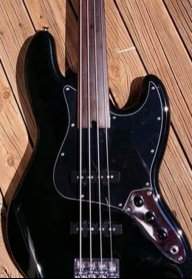
The neck on your bass is resonant. It's made of wood, which has stiffness and mass. Coupled with the geometry of things, that manes that it will resonate in several (not just one) modes. One mode has the entire neck vibrating in the same direction at once. The end of the neck moves more than any other part of the neck - that's what we Physicists call an antinode. If you have a headless bass, the strings are connected to the end of the neck - the open strings are using the end of the neck for one of the two mechanical "grounds" for the vibrating portion of the string (the other is the bridge). If you have a string tuned to the same frequency as that resonant mode, since its end is at an antinode, the energy of the string will dissipate quickly - it won't ring out, it'l be "dead". Most headless necks don't have dead spots at the ned, but I have run into a couple that have, and that dead spot is the worst location - it can be VERY dead.
The other common spot on a neck that tends to be "dead' is on the G string, somewhere around frets 4 to 7. At that point, another vibrational mode (where the neck is moving in two parts) has an antinode. If your neck is tuned to the same frequency as that mode, you have a dead spot.
Truth be told, dead spots are a matter of degree. If you start playing notes on a neck, and timing how long they ring out, you will find that every bass has areas where there is reduced sustain (no, your bass is not immune). If you listen carefully, in those areas, you will hear things like the fundamental of the note going away quicker than the overtones - the note gets thinner sounding over time. Anyway, as I said, it's a matter of degree - how bad does it have to be to call it a dead spot? To some extent, that depends on how much you paid for the bass - people with expensive basses often get a bit defensive if you suggest that their bass has a dead spot (or even an area where the sustain is less). Somehow, they believe that the builder has some magic or their experience has given them some workaround for what is really basic Physics. Sorry, but any builder can make basses with dead spots - the equations that dictate what's going on don't have money as a variable where adding more makes things better.
There is, unfortunately, more bad news - wood ages - over time, it gets lighter, stiffer, and more resonant. That means that you can buy a new bass where you don't perceive any dead spots as objectionable, but...over time your bass can develop a dead spot. It can also go the other way. One of the things that a 50 year old bass has going for it is that the wood has done it's changing - if the thing is till playable, and doesn't have objectionable dead spots, it's probably good for the duration.
Things that can help:
1) Mass loading on the headstock - by adding or subtracting mass from the headstock (heavier or lighter tuners), you can change the resonant frequencies of the neck a bit, sometimes enough to mitigate a dead spot to where it's OK.
2) Retuning - when buying a bass, ALWAYS ALWAYS ALWAYS make sure it's in tune before you evaluate it. You can avoid often dead spots by re-tuning the bass, and if the bass you're trying out isn' t in the tuning you're going to play it in, you're not hearing the true state of the neck as far as dead spots go.
3) Stiffer, heavier necks. Although every P bass neck is not necessarily better than every J bass neck, on the whole, they have less pronounced dead spots on average. For the same reason, most 5 string necks are even less prone to dead spots than even a P neck - The bigger cross section adds mass and stiffness - the impedance of the neck is going the right way. A section of railroad track would make a great bass neck, assuming you're OK with a 200 pound bass and an obscene amount of neck dive - overwhelming the tiny little string with enough mass and stiffness helps keep the energy in the string. I one owned a few aluminum necked Kramers (almost a railroad track) - the sustain on those necks was incredible, though, if you de-tuned the A string a bit, you could actually get a bit of the "headless" whole neck dead spot.
4) Roasted necks. Roasted necks are stiffer, lighter, and more resonant than ones made from unroasted maple. I buy roasted necks, with graphite reinforcement rods, and use Hipshot ultralite tuners - doing those things pushes the resonant frequency of the neck upwards enough that the area where the sustain is reduced is usually pretty well behaved.
So, roasted necks are part of my recipe but.....they have an additional twist - a roasted neck is artificially aged - the resins are crystallized, the neck is as dried out as it's going to get. In short, a roasted neck is NOT going to change - it is a stable thing (which, being made out of wood, is a neat trick). What that means is what you have is what you will have - a roasted neck that doesn't have objectionable dead spots out of the gate is not going to develop them. Of course, if it starts out bad.....If changing the mass loading works to make a roasted neck good enough for you, its a permanent fix, not a band aid for a situation that's going to change.