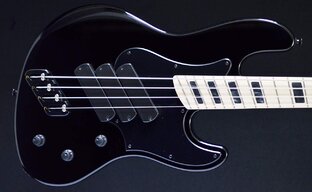
As a few others have said, G-string, 7th fret, is notorious for it. I have it on my Franklin Fender fretless, and to a lesser extent on my Ken Smith 5-string fretless.

TalkBass has been independent since 1998. Add your voice.
Create a free account to reply to discussions, view embedded media, and browse with fewer display ads.
Join free Log in
Want zero display ads or expanded classifieds tools? Compare plans.

Wolf tones are a different animal than dead spots. A wolf tone more of a hot spot than a dead spot. One of the worst instruments for wolf tones is upright bass, but there is actually somewhat of a fix for wolf tones. As previously mentioned in another post, wolf tones are more common on bowed instruments. On upright one of the contributing factors of wolf tones is the after-length of string between the bridge and tailpiece. Certain notes can cause the after length to resonate with the note and add some energy to vibrating the bridge / top of the bass. Adding weight or damping the after-length can all but eliminate wolf tones.Not positive but in classical guitar they have this thing known as wolf tones.
After reading several responses I'm wondering if a fret leveling job might correct the discrepancy.
TRUTH.Every bass whose neck is made of wood has dead spots. That’s due to physics involving resonance frequencies. If you believe your bass doesn’t have one, it’s because you didn’t look hard.
I discovered that a solution to letting a "dead spot" note ring clearer and sustain better (when holding the note NOT part of a faster moving bass line)...is to press your finger down on the string 2 strings and 2 frets lower (an octave lower). Don't PLAY the lower note, just press your finger down on the fret position 1 octave lower while you play the dead spot note. This will let the string (2 strings lower) ring out sympathetically. I found this out when needing to play ballads and have the dead spot note ring out for a measure or two. The harmonic of the lower string will augment and support the "dead spot" note and you can get much better sustain of that note. Pretty close to having NO dead spot at all!

I heard rumors that once the rust has settled in even in those parts you touch frequently, you might consider getting new ones a few years down the road.year too long... you mean you are supposed to change them?

The boring answer is resonance. Not the “this guitar rocks! It’s so resonant”.

I think there are many urban guitar/bass myths that need debunking.In all the time I've been on TalkBass, I've heard repeatedly about dead spots. During that time I've owned a lot of basses and I don't recall ever encountering this. I play up and down the neck and everything always sounds fine to me.
When you guys/gals are experiencing dead spots, what are you hearing/feeling? Or is it less frequent than it seems. Maybe I've just gotten lucky??

I'm not sure if it's a myth, but I get the impression that most folks aren't having a problem with dead spots during normal playing. This seems like one of those things where people are looking for them. Like, really looking. Then it gets turned into a debate about whether they technically exist or not.
I'm sure that if I sat in a quiet space and slowly played every note on the board 10x each and listened to how they each rang out, I might find one or 2 that sounded a tiny bit "deader" than the rest,....but,.....why would I do that? Why would anyone?
I never did stuff like that when I played. I was too busy playing and learning songs. Never heard about this dead spot thing until joining TB.
Also, I could be wrong, but it seems like it's most prevalent and in the same general area on one piece (non laminated), bolt-on maple necks with old fashioned truss rods and oversized, non angled HS? Not a fan of that style/design anyway, but even on those, I have to imagine that it's not typically a problem when playing and you'd have to stop playing and hunt for it.
Every undesirable sound I've heard from a bass I've played was due to a bad setup, ratty frets and bad playing.
This is exactly my point about this silly topic.I'm guessing you've never been in a studio situation where you're hearing raw playback and the bass fundamental just disappears every time you hit a particular string and position on the neck.
It happens. It's a real thing.
While I am skeptical of that, given the physics discussed, the fact that Dingwalls are multi scale might change things enough that there isn't a sharply defined dead spot. That would be very cool.Until my Dingwall I never knew what it was like NOT to have any dead spots.

Every bass whose neck is made of wood has dead spots. That’s due to physics involving resonance frequencies. If you believe your bass doesn’t have one, it’s because you didn’t look hard.