As it was explained to me in a microphone discussion (I had asked about a mic's ability to hear bass singers on low E), that we hear that note an octave higher/the octave overtone, so the mic would indeed pick it up.

TalkBass has been independent since 1998. Add your voice.
Create a free account to reply to discussions, view embedded media, and browse with fewer display ads.
Join free Log in
Want zero display ads or expanded classifieds tools? Compare plans.

It's not that we hear the note an octave up but that harmonics are generated an octave up (and many higher order harmonics) that are reproduced and picked up by the mic.As it was explained to me in a microphone discussion (I had asked about a mic's ability to hear bass singers on low E), that we hear that note an octave higher/the octave overtone, so the mic would indeed pick it up.

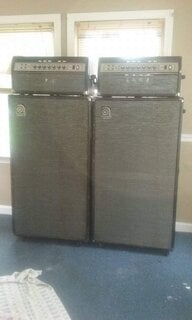
Jauqo III X can hear 17 Hz.Fundamental E and B are at frequencies that you pretty much feel and can only hear in a anechoic chamber or a good set of headphones. When you play a low E the pitch you actually hear is 82 hz which is one octave higher or the 1st harmonic. And with low B 62 hz (or so). Reproducing those fundamentals is the domain of subwoofers, pipe organs and some very large or inefficient bass cabs. There was a time when I was all crazy about reproducing those fundamentals. I bi-amped a EV S181 sub with a Hartke 4.5XL with a QSC USA 1320. It looked and sounded cool by itself but was pretty much a waste of time and energy to set it up for a gig. All that low frequency rumble caused more problems than it solved especially with a boomy room.

And also different gauge does make a difference of envelope decay (which is also effected by different string tensions).A Low E is a Low E is a Low E,the only difference another
gauge string would make is what overtones are more pronounced.


Yes and no: it's the 1st harmonic *overtone*, but the 2nd harmonic frequency. A harmonic is the fundamental frequency times a positive integer: this includes 1, so the 1st harmonic is the fundamental itself.82 hz which is one octave higher or the 1st harmonic.



Yeah but your measures would be right in tune while JMX would be a little flat...I've seen more complete charts out there but this will get the job done.
Link Removed
The lowest "E" (164.841)they are showing is 2 octaves above low "E" on the bass. Divide that by 4 and you get. (41.21025) Low "E" on the bass.
In other words,Yeah what JMX said

I was pretty much quoting my string teacher from college. He must have been using harmonic and overtone interchangeably.Yes and no: it's the 1st harmonic *overtone*, but the 2nd harmonic frequency. A harmonic is the fundamental frequency times a positive integer: this includes 1, so the 1st harmonic is the fundamental itself.

Unless you're building a sub-woofer, which typically makes for a poor substitute for a full range bass cab...Certainly works out better than focusing only on the low end extension at the cost of the rest of the performance parameters.

Nothing impressive about it in my book! I just wasted the time reading through the damn thing!!
A total of 23 posts and this has to be one of them!!
I was mostly complementing the necro-er on finding such an ancient thread and posting something somewhat relevant. There's been a number of threads on this exact topic in more recent time, so it's kind of funny that Bubbles choose such an old one.Do you ever post anything other than complaints about bumped threads?
Ffs.. Just because something is old doesn't mean someone can't learn from it.

Do you ever post anything other than complaints about bumped threads?
Ffs.. Just because something is old doesn't mean someone can't learn from it.
No time wasted when you learn bi-amping. I'm finding most of the power is used to make sound about 300hz and down. By the time you get up to 3khz and up, only 15 to 20% of the rms power is used by the tweeter. I'll have to find a power distribution chart to remember for sure, but I use a low crossover at 150 to 300hz for the smaller speakers (stereo at 300hz cause it's dainty). Those 410's will be much more reliable when you push the lows onto a 15" sub that can much easier handle it. At least on the lower priced stuff I see those how to replace a blown driver videos on YouTube.
I'm just starting into this officially on a bass amp, I have used that on stereos with great results.
It's a lot better than just trying to run both the 410 and 15 on one amp with no crossover.
+1...the only places I've seen a bi-amp concept work really well is in the GK heads and cabs, and when I used a 115 and 210 back in the 80's. Admittedly the GK solution was a much better execution - quite seamless and effective in fact.I was using Bi-amping in the late seventies, early Eighties. it worked well enough but you had to carry more equipment for it to work. Since high power crossovers became available the need is no longer there.
The problem with a 15 paired with a 4x10 is certainly not with the 4x10. A single 15 will be damaged by the lows pushed into it. The 4x10 would probably have more lows than the 15 and be able to handle considerably more power.
As an EE, retired now, I don’t get my information via Youtube.
You can not always apply what is done in a home stereo system to a bass amp. They are a different animal all together.
With the exceptional full-range products you and other premier designers have given us these days, I'm not sure even those who could easily afford the price tag and be able to handle the size and weight would feel it to be a necessity. As much as I hate to admit it, bass rigs are becoming more and more for stage monitoring and small venues than for carrying the house at big shows. The largest indoor and outdoor events I've played have required virtually nothing from me other than a signal to the board - it's almost like being in the studio.I could certainly design a killer biamped rig (real biamped, with an 18" and an 8" or 10" plus tweeter) using premium components that would be an improvement over even the Subways, Barefaced's, Greenboys etc, the size and cost would make it a pro only piece with very little real world sales. It's one of the frustrating factors when designing more oft he specialty products.
Depends on what cab you are talking about.The problem with a 15 paired with a 4x10 is certainly not with the 4x10. A single 15 will be damaged by the lows pushed into it. The 4x10 would probably have more lows than the 15 and be able to handle considerably more power.