

Enjoy the benefits of a premium membership!
Upgrade Account
-
TalkBass has been independent since 1998. Add your voice.
Create a free account to reply to discussions, view embedded media, and browse with fewer display ads.
Join free Log in
Want zero display ads or expanded classifieds tools? Compare plans.
You are using an out of date browser. It may not display this or other websites correctly.
You should upgrade or use an alternative browser.
You should upgrade or use an alternative browser.
What makes a bass a jazz bass?
- Thread starter jnevi9nr
- Start date
More options
Who Replied?
René_Julien;8252904 said:IMO... the Mark Hoppus signature bass is a jazz bass.
IMO...No, it's not. It's an amalgam.

IMO...No, it's not. It's an amalgam.
How are we going to resolve this?
You payed as much for your opinion as I did for mine.

I identify a jazz bass first by body shape, then by pickups. The body shape alone should tell me it's not a precision or some other type of double cut away body style. The nexk profile is a way to tell the difference between a Fender J and Fender P but with so many builders building custom jazz basses you can pretty much get any kind of neck profile you want on any bass. Looking at my Valenti, would you call it a jazz bass? I would.
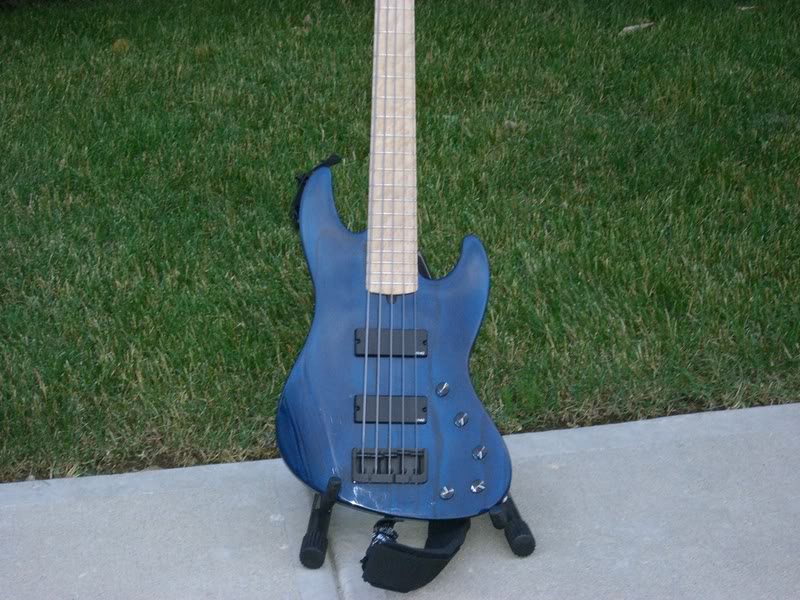

The "jazz" bass per se is usually identified by the large offset body & the two single coil pickups set in the middle of the body and by the bridge. The "special quality" of the Jazz is that the two pickups (wired in parallel) cancel eachother out a little when both at full volume, producing that trademark "burpy" out of phase sound.
I don't know whether they created the electronics like that purposely or by accident, but the design is a stroke of genius.
I don't know whether they created the electronics like that purposely or by accident, but the design is a stroke of genius.

Interesting viewpoints here. I am wondering though, if the OP, was simply refering to:
the sound of a bass that means we would then assign it to be good and tasty for jazz-based music (whatever that can truly be defined as...I'll not try, but you know...most of the stuff we hear on "smooth jazz" radio stations).
And does that truly mean only single coils wrapped by whatever formula Fender uses and cloning all the other parts of the Fender?
But I think the OP's question did not (correct me if I'm wrong, OP) mean brand. I mean, the question would be over the moment it was pointed out the only "Jazz" bass is Fender's. And pointed out it certainly was. But I don't think it was a proprietary type of question.
Heck, I love the sound some jazz bassists get---wish I could have it sometimes. Who, besides Fender, has credibility to say---"our basses sound great for jazz"? I'm sure there are some.
My 2 cents.
the sound of a bass that means we would then assign it to be good and tasty for jazz-based music (whatever that can truly be defined as...I'll not try, but you know...most of the stuff we hear on "smooth jazz" radio stations).
And does that truly mean only single coils wrapped by whatever formula Fender uses and cloning all the other parts of the Fender?
But I think the OP's question did not (correct me if I'm wrong, OP) mean brand. I mean, the question would be over the moment it was pointed out the only "Jazz" bass is Fender's. And pointed out it certainly was. But I don't think it was a proprietary type of question.
Heck, I love the sound some jazz bassists get---wish I could have it sometimes. Who, besides Fender, has credibility to say---"our basses sound great for jazz"? I'm sure there are some.
My 2 cents.

IMO...No, it's not. It's an amalgam.
P bass neck (a variation of many necks), P bass pickup. J bass body.
A Prejazz? Or a Jazzcision?
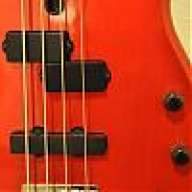
P bass neck (a variation of many necks), P bass pickup. J bass body.
A Prejazz? Or a Jazzcision?
I am building one of those.
It's a simple hybrid built for the coolness of it.
Looking at my Valenti, would you call it a jazz bass? I would.
I'd call it a Guild Pilot.

monkey wrench: the Fender Jazz Special (Duff McKagen bass):
[Invalid or Expired Link Removed]
Yep...there's very little "jazz" about these basses besides the bridge pickup. The long running saying is that they have Jazz bass necks...they don't. It's 1.6x something at the nut which is clearly not 1.5" like a regular Jazz neck. They are definitely not P necks though because they are not very thick, it's a little anomalous but I find them the most comfortable Fender necks out of any bass they've made. Now the Precision Special I think actually has a J neck on it...if that's correct the argument gets even more confusing.
but hey, Fender calls it a Jazz bass so who are we to argue?

The long running saying is that they have Jazz bass necks...they don't. It's 1.6x something at the nut which is clearly not 1.5" like a regular Jazz neck.
The original width at the nut for a Fender Jazz bass was 1-7/16" not 1-1/2" so going by neck width at the nut alone maybe it could be argued that Fender hasn't made a "regular" Jazz neck in about thirty years.


Looking at my Valenti, would you call it a jazz bass? I would.
Nope, I would call it a Valenti, which is what it is; not a Jazz Bass®, which is what it is not.
Based on the pricing on the Valenti site, it looks like you could have bought a real Jazz Bass® instead of a copy. I would imagine you got what you wanted; a Valenti.
Why would you even want to pretend it's a Jazz Bass®?

The original width at the nut for a Fender Jazz bass was 1-7/16" not 1-1/2" so going by neck width at the nut alone maybe it could be argued that Fender hasn't made a "regular" Jazz neck in about thirty years.
Well then...since Fender doesn't even agree with itself as to what a Jazz bass is, how can we argue about it here?
I don't think there's only one answer. If a Corvette changes dimensions for a new model, it's still a Corvette. Of course, that doesn't apply to copies. Since Fender is the only one that can officially be called a "Jazz bass" then the answer to this question is whatever they call one when they make a bass. That doesn't stop me from calling copies Jazz basses too though. I'm incorrect to do so, but if someone isn't familiar with offbrands, saying my SJB-75 isn't going to give them a clue as to the basic configuration of the bass I'm describing.
Ultimately it's about how it sounds. With all the variations on the basses original design I think the only things that are really fundamental to a jazz bass are two single coil pickups in either the 60s position or the 70s position. If someone wants to be so specific as to say the neck, original body shape, or hardware are also required then by similar logic a 70s jazz isn't a true jazz due to the relocated bridge pickup.
Give this guy the prize! he nailed it! Its the tone of 2 single coil pickups that make a Jazz bass IMO.


Body style. The Mark Hoppus Jazz bass has a P pickup, P neck (I think), and a Jazz body, and it's still considered a jazz bass
Since Fender is the only one that can officially be called a "Jazz bass" then the answer to this question is whatever they call one when they make a bass.
Ta-Da!
That doesn't stop me from calling copies Jazz basses too though. I'm incorrect to do so, but if someone isn't familiar with offbrands, saying my SJB-75 isn't going to give them a clue as to the basic configuration of the bass I'm describing.
Why dont you just describe it as a Jazz Bass® copy?
It was created to lure JAZZ players off the stand up double bass. Some jazz players didn't want to play P's, so they thinned the neck near the nut, put in the two pups to add more midrangy punch, and made the body contour different. Seems to have worked huh?
Actually it's that artsy mustache the bass has and the little beanie it wears while sipping espresso. It calls everyone "cat" too. Loves sweaters and plaid...
Actually it's that artsy mustache the bass has and the little beanie it wears while sipping espresso. It calls everyone "cat" too. Loves sweaters and plaid...

The original post doesn't sound like he's asking why a Fender Jazz bass is called a Fender Jazz bass. It sounds like he's asking what criteria a bass has to meet for it to be considered a bass that will work for Jazz music.
If that's the case it's whatever works for the individual in question. I played Jazz for years on a Steinberger. There's no rule book that discusses what basses must be used for certain genre's.
If that's the case it's whatever works for the individual in question. I played Jazz for years on a Steinberger. There's no rule book that discusses what basses must be used for certain genre's.


