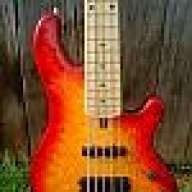
Wood takith away, never adds to the sound. If the material on which the pickups are mounted is actually vibrating enough to re-energize into motion the strings so they can cut the magnetic fields again, then, yes you'd have a point.
But they don't - it won't - it can't and it never will.
Wood is dead and the energy that is 'input' through the bridge gateway goes into a sonic black hole.
If you want to dismiss me - fine.--- but these guys think and are actually published in scientific journals along the same lines as I, and they have build their doctorates and physics degrees on this same subject::
* Abbado, Adriano (1988). "Perceptual Correspondences: Animation and Sound". MS Thesis. Cambridge: Massachusetts Institute of Technology.
* American Standards Association (1960). American Standard Acoustical Terminology. New York: American Standards Association.
* Dixon Ward, W. (1965). "Psychoacoustics". In Audiometry: Principles and Practices, edited by Aram Glorig, 55. Baltimore: Williams & Wilkins Co. Reprinted, Huntington, N.Y.: R. E. Krieger Pub. Co., 1977. ISBN 0882756044
* Dixon Ward, W. (1970) "Musical Perception". In Foundations of Modern Auditory Theory vol. 1, edited by Jerry V. Tobias,[page needed]. New York: Academic Press. ISBN 0126919011.
* Erickson, Robert (1975). Sound Structure in Music. University of California Press. ISBN 0-520-02376-5.
* Grey, John M. (1977). "Multidimensional Perceptual Scaling of Musical Timbres". The Journal of the Acoustical Society of America 61(5):1270–77. doi:10.1121/1.381428
* Lakatos, S. (2000). "A Common Perceptual Space for Harmonic and Percussive Timbres". Perception & Psychophysics 62(7):1426–39. Abstract
* Luce, David A. (1963). "Physical Correlates of Nonpercussive Musical Instrument Tones", Ph.D. dissertation. Cambridge: Massachusetts Institute of Technology.
* McAdams, Stephen, and Albert Bregman (1979). "Hearing Musical Streams". Computer Music Journal 3, no. 4 (December): 26–43.
* Samson, Jim (1977). Music in Transition: A Study of Tonal Expansion and Atonality, 1900-1920. New York: W.W. Norton & Company. ISBN 0-393-02193-9.
* Schouten, J. F. (1968). "The Perception of Timbre". In Reports of the 6th International Congress on Acoustics, Tokyo, GP-6-2, 6 vols., edited by Y. Kohasi,[Full citation needed]35–44, 90. Tokyo: Maruzen; Amsterdam: Elsevier.
* Sethares, William (1998). Tuning, Timbre, Spectrum, Scale. Berlin, London, and New York: Springer. ISBN 3-540-76173-X.
* Wessel, David (1979). "Low Dimensional Control of Musical Timbre". Computer Music Journal 3:45–52. Rewritten version, 1999, as "Timbre Space as a Musical Control Structure".