
So is that.
Snappy comeback, but it doesn't make that statement any more correct.
Adios.

TalkBass has been independent since 1998. Add your voice.
Create a free account to reply to discussions, view embedded media, and browse with fewer display ads.
Join free Log in
Want zero display ads or expanded classifieds tools? Compare plans.
So is that.



Ah, hell... just "slap some Fralin's in it. The pickups make all the sound anyway."


You can make any pickup growl by boosting 600-800Hz.

You mean all these years, I don't even need a bass, just some pickups??

Yes.
Even just moving that pickup and adding a tone knob would give you amazing results.


You almost understand it.
Firstly - the pups don't 'hear' what 'the strings sound like' They are deaf to audible noise. They only respond (a bad word, but somewhat descriptive for the nonce) to the electrical flow from the fields being cut by the strings passing through that field - the Gauss effect.
The wood that you can feel vibrating is vibrating from the energy from the strings, now wandering around inside the body. This is resonance, and is subtractive. This sound you feel or can 'hear' with no amp, is in it's death throes and will not re-vibrate the strings no matter how much you may want it to.
Wood is passive and it is only acting that way with the energy that is being lost from the strings themselves.
There is no other form of energy in the wood (A wall plug? Batteries? A wound-up spring?) for it to maintain the vibrations and it just decays there.
Otherwise we'd have perpetual, motion and you DON'T want to go there - or do you?
It may feel like the wood is 'singing' when in reality it is just destroying the very sounds you might think are being somehow amplified.
Then by another stretch of imagination, somehow this energy is sent back through the bridge by causing it to vibrate again, to re-excite the strings into motion and there to cut the magnetic fields of the p'ups again.
That's backwards. This is not a two-way street!
Sound waves check in (to the body), but they don't check out!
Different bodies attenuate (the 'take-away part) certain frequencies or zones of frequencies (my term) and they are not all alike, that's a given and answers your thought about transplanting different p'ups into different bodies.
That's correct they way you stated it - almost. You didn't go far enough with your own reasoning to see that since the wood of the bodies attenuate different frequencies for their own inherent design, they indeed will sound different.
BUT not from amplification or support for any set of frequencies in the body itself.
On the contrary, they will remove certain ranges of notes, frequencies, etc., but only by their own individual ability to absorb the ones they can and leave the others un-absorbed.
This is why some persons actually believe that their particular body adds to the range of frequencies they say they do.
What really happens is that less-desirable freqs are absorbed and the frequencies that are left may sound as though they are reinforced, when they are really the freqs that are left out of the attenuation process.
This, of course assumes that the other variables* are all in spiritual alignment with the program and are either 1) capable or or 2) incapable of allowing the preferred sounds alone.
* Variables: wood, thickness thereof, moisture content, molecular adhesion to other grains in the wood, if the wood grew on the South side of a Peruvian hillock in a Southwesterly prevailing wind, and constitution of paint, sealers, finger prints and 'Funk' or 'Mojo' on the strings, neck, pickguard, screws holding the neck on, etc, etc, ad infinity.

Yes.
Even just moving that pickup and adding a tone knob would give you amazing results.

Yes.
Even just moving that pickup and adding a tone knob would give you amazing results.

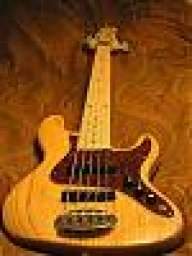
There's to be a 'tomorrow' on this - I need some sleep as all this excitement is depleting my batteries.
I shall return.
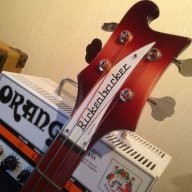
My Ric 4001C64 has lots of growl, and you can even hear a bit of that growl when the bass is played acoustically.
I believe (in the case of my particular bass) that "growl" comes from a combination of 3 elements - Pickups (hotter single coil pickups seem to have more growl than lower output singles or humbuckers), construction (in my experience, maple, alder, koa and walnut are all growl-enhancing tonewoods,) and last but not least, strings. Most here would agree that roundwounds have far more growl than flats do, and imho, a stainless steel med. or light gauge string set has the most potential for producing growl.
As for the heavy debate, I must side with Mr. Schwab on this one - years of actual hands-on lutherie experience gives an individual far more insight into this matter than simply reading & quoting "factoids" found on the internet. Lastly, I love listening to spirited debates, especially when those involved can keep things poilte & civil, while using experience, logic and facts to illustrate their points and opinions.
To each his own but if I moved that pickup it would be into another bass.
On a serious note though, I think this clip shows exactly how much the material the instrument is made of affects the sound. That thing doesnt sound like any wood bass that I have ever heard. I think you would be hard pressed to make a wooden bass sound like that and vice versa.


Cool. I'd strap some strings and a pickup on my screen door, except that clip sounds really bad to me.
Anyway, it would be cool if some folks who really understand pickup design could explain even more about how materials and design affect tone. Maybe this is all "trade secret" type of material?
I think it sounds like a fretted tone with the not-so-accurate intonation of a fretless, which is how I like my fretless basses to sound.
I bet if you put frets on that, it'd sound much closer to a typical wooden bass.
 ) affected the sound of that bass.
I think a few people in this thread don't entirely understand exactly how an electric guitar (or electric bass) produces sound. A (hopefully simple) explanation of how it works will help explain why the materials the bass is made of indeed have an effect on the sound.
The way that an electric guitar produces sound is that the picups produce a magnetic field. The steel strings vibrate within that field - thing of them as moving farther and closer to the pickups, although in reality the direction of vibration isn't exactly one-directional. But lets not be TOO technical here.
The vibrating steel strings within the magnetic field produce electrical impulses which the electronics within the guitar (and subsequently the the amplifier and speaker) translate into an audible tone. Exactly what that tone sounds like depends on the waveform of the signal that generates it, and the waveform depends on the way in which the string vibrates. Now waves have two basic units of measure: frequency and amplitude. And anything more complex than a simple sine wave has patterns of frequency and amplitude that form an incredibly complex waveform shape. So anything that changes the way the string vibrates will affect the shape of the wave created by the motion within that magnetic field.
Well guess what? All the material that physically contacts the strings will absorb some of that vibration as the string in turn causes the material to vibrate sympathetically, changing the wave form produced by the STRINGS. The vibration of the wood in the guitar is not directly measured by the pickups because wood doesn't affect the magnetic field they produced. Only ferrous material within that field (i.e. the strings) has any impact on what the pickups "hear." BUT to the extent that the wood causes the strings to vibrate differently than they would suspended in a void, it does ultimately change the final sound produced. That change could be subtle or drastic depending on any number of factors that require advanced knowledge of physics to thoroughly comprehend. But they do matter. And the absorption doesn't happen evenly over the whole frequency spectrum, meaning that the shape of the waveform - and consequently the color of the sound produced - will change. Even having the bass rest against your leg or chest, as opposed to standing it up on the bottom button strap and strumming it that way, would change the sound in ways that could be measured by an oscilloscope.
Now that's about as simple as it gets without a physics degree.



