• TalkBass has been independent since 1998. Add your voice.
    Create a free account to reply to discussions, view embedded media, and browse with fewer display ads.
    Join freeLog in
    Want zero display ads or expanded classifieds tools? Compare plans.

What makes a pickup "growly"?

This is also not correct. To give an example, if you put humbuckers in a Strat, it does not sound like a Les Paul, and the same holes true if you put Strat pickups on a Les Paul. Just as putting a P bass pickup on a Rick wont make it sound like a P bass.

The reason for this is that the pickups only sense what the strings sound like, and the instrument, even if it is a solid body, has an acoustic quality. The scale length and construction affect how the strings sound, and this in turn is picked up by the pickups.

But they wont sound the same. Both the pickups and the bass affect the tone. That's kind of like saying using the same microphone on two different singers will make them sound the same. Does it? How is a mic different from a pickup? They are really very similar; coils and magnets. But the mic senses the moving diaphragm and the pickup senses the moving strings.

You almost understand it.

Firstly - the pups don't 'hear' what 'the strings sound like' They are deaf to audible noise. They only respond (a bad word, but somewhat descriptive for the nonce) to the electrical flow from the fields being cut by the strings passing through that field - the Gauss effect.

The wood that you can feel vibrating is vibrating from the energy from the strings, now wandering around inside the body. This is resonance, and is subtractive. This sound you feel or can 'hear' with no amp, is in it's death throes and will not re-vibrate the strings no matter how much you may want it to.

Wood is passive and it is only acting that way with the energy that is being lost from the strings themselves.

There is no other form of energy in the wood (A wall plug? Batteries? A wound-up spring?) for it to maintain the vibrations and it just decays there.

Otherwise we'd have perpetual, motion and you DON'T want to go there - or do you?

It may feel like the wood is 'singing' when in reality it is just destroying the very sounds you might think are being somehow amplified.

Then by another stretch of imagination, somehow this energy is sent back through the bridge by causing it to vibrate again, to re-excite the strings into motion and there to cut the magnetic fields of the p'ups again.

That's backwards. This is not a two-way street!

Sound waves check in (to the body), but they don't check out!

Different bodies attenuate (the 'take-away part) certain frequencies or zones of frequencies (my term) and they are not all alike, that's a given and answers your thought about transplanting different p'ups into different bodies.

That's correct they way you stated it - almost. You didn't go far enough with your own reasoning to see that since the wood of the bodies attenuate different frequencies for their own inherent design, they indeed will sound different.

BUT not from amplification or support for any set of frequencies in the body itself.

On the contrary, they will remove certain ranges of notes, frequencies, etc., but only by their own individual ability to absorb the ones they can and leave the others un-absorbed.

This is why some persons actually believe that their particular body adds to the range of frequencies they say they do.

What really happens is that less-desirable freqs are absorbed and the frequencies that are left may sound as though they are reinforced, when they are really the freqs that are left out of the attenuation process.

This, of course assumes that the other variables* are all in spiritual alignment with the program and are either 1) capable or or 2) incapable of allowing the preferred sounds alone.

* Variables: wood, thickness thereof, moisture content, molecular adhesion to other grains in the wood, if the wood grew on the South side of a Peruvian hillock in a Southwesterly prevailing wind, and constitution of paint, sealers, finger prints and 'Funk' or 'Mojo' on the strings, neck, pickguard, screws holding the neck on, etc, etc, ad infinity.
 
You almost understand it.

Excuse me? You seem to be forgetting that I have been designing and building pickups and basses for some time now. You aren't telling me anything I didn't already state. I've been doing this stuff since 1972, how about you?


This sums up that you don't get it:

Firstly - the pups don't 'hear' what 'the strings sound like' They are deaf to audible noise. They only respond (a bad word, but somewhat descriptive for the nonce) to the electrical flow from the fields being cut by the strings passing through that field - the Gauss effect.

Try inductance. There is no "Gauss effect". Gauss is a unit of magnetic induction, equal to one ten-thousandth of a tesla. You measure the strength of magnets in Gauss. You measure pickups with inductance.

You contradicted yourself several times already. First you said:

It matters not what the p'ups are mounted upon as long as the string(s) move (vibrate) and travel through the magnetic field of the poles and induce electron flow to (finally) the amp and out to the drivers to the ears of the beholder.

Then you said:

Wood takith away, never adds to the sound. If the material on which the pickups are mounted is actually vibrating enough to re-energize into motion the strings so they can cut the magnetic fields again, then, yes you'd have a point.

Sorry, but you don't get it.

There is no "electrical flow from the fields being cut". The movement of the strings induces current to flow in the coil. This is based on magnetic reluctance.
 
Ego, semantics and personal bias/opinion strike again. The only thing worse than this would be if they were friends in real life and not just anonymous people on the internet. I think Joe is trying to explain things so that the layman can understand things more clearly and Dave is taking offense because he thinks Joe is trying to attack him. I don't think this is the case and don't see contradiction in Joe's overall message, however regardless of what Joe is saying I definitely don't see what he is saying as having any bearing whatever on the quality basses that Dave has been making for the last 40 years. I think we need to get back to the OP's question and try to focus on that. Cheers.
 
Beyond what's been said, the materials used in the pickups matter. I don't know a lot on this topic, but (for example) I can tell you that a Stingray is more mellow sounding than an EBMM Sterling. The difference isn't the type of pickup - its the magnet materials. The outcome though is obvious - a Sterling is much much "growlier" than a Stingray.
 
I'm experimenting with a DIY type bass this weekend made of one piece of wood. It's working out very well and it's tone is very growly.

I haven't installed pickups yet so I know it's not the pickups causing the growl.
 
Yes..... but what do you think the pickups bridge and strings are attatched to? Wood!!

And by saying it doesnt matter what material a bass is made of... concrete!?

Id like you to tell somebody who actually knows something about instruments your ideas.

Roger Sadowsky should be comming out with a concrete/plastic/drywall/tempered glass design any day now!!!

You lost all credibility with me pal

BTW.... ever play a bass with no amp?? Could you still hear it?? Something tells me it wasnt the pickups doing their job....

+1 sorry but after reading surfer joes opinions I have to agree, wood does matter my friend, your just plain wrong.
 
Electric guitars and basses have all been made out of weird stuff - acrylic, concrete, railroad rails (a Les Paul experiment in sustain). I think most of these are posted on youtube if you want a listen. The all-acrylic electric guitar had an incredible sound. The concrete electric bass (made on a cinderblock) sounded pretty good too.

If you take the word 'add' to mean 'increase the energy of' then I agree, the rest of the guitar only shapes the existing energy from plucking the string, it does not add any additional energy to the string once it's plucked. The construction materials and their shape do affect the tone, but to what degree and exactly which parameters matter most are a highly debated subject across the internet. All sorts of interactions are possible - the existence of a break in the wood of a bolt-on neck vs a solid neck through, the length and thickness of the neck, the density of the wood, the weight of the body, the nut and bridge materials and mounting all have an effect. How much this translates into the maple vs bubinga vs walnut vs 'free-range Canadian tight-grained prayer wood' tonewood debates, I don't know. It's this sort of uncertainty that keeps our conformist consumerism economy humming along.
 
Okay, I'll buy that the wood's resonance or (lack of) in certain frequencies is only "attenuating" energy... but, that's what the strings are attached to, so if portions of the energy of the string are attenuated by the wood, the pickup would sense that.... some frequencies remain stronger than others.

I re-read the entire thread, and I can't find where anyone is actually saying that the wood "added" any energy to the equation. Yeah, it's a subtractive process, but to say it has NO effect is just wrong. Go ahead and make a bass out of mud and one out of steel and put the same pickups in them... I guarantee they will NOT sound the same.

Better pickups for your bass = better microphone for your vocalist. But they'll both still sound like themselves, just more or less of themselves.

Back to the OP's question... As PilbaraBass already said, it's a combination of factors that make a bass rig (not just the pickup) produce what we refer to as growl.
 
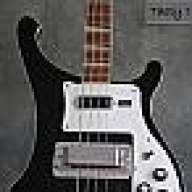
My Ric 4001C64 has lots of growl, and you can even hear a bit of that growl when the bass is played acoustically.
I believe (in the case of my particular bass) that "growl" comes from a combination of 3 elements - Pickups (hotter single coil pickups seem to have more growl than lower output singles or humbuckers), construction (in my experience, maple, alder, koa and walnut are all growl-enhancing tonewoods,) and last but not least, strings. Most here would agree that roundwounds have far more growl than flats do, and imho, a stainless steel med. or light gauge string set has the most potential for producing growl.

As for the heavy debate, I must side with Mr. Schwab on this one - years of actual hands-on lutherie experience gives an individual far more insight into this matter than simply reading & quoting "factoids" found on the internet. Lastly, I love listening to spirited debates, especially when those involved can keep things poilte & civil, while using experience, logic and facts to illustrate their points and opinions.
 
Oops, I accidentally deleted my previous post.

If you take the word 'add' to mean 'increase the energy of' then I agree, the rest of the guitar only shapes the existing energy from plucking the string, it does not add any additional energy to the string once it's plucked.

The way it really works is, because of the phase relationships of the waves, some frequences are reinforced having higher levels while other frequencies are attenuated and have lower levels.

I'm going to throw out a vote for the location of the pickup. I've never solo'd a bridge pickup that didn't sound growly/burpy. Additionally, boosting the mids helps emphasize the growl.

Pickup location is a major contributor to the final tone in that the pickup to "sees" different positions of the string which will have different levels of harmonic content depending on the location.
 
To my ears Stingray basses are practically the definition of growly. Jazz basses have some growl. My Ibanez SRX2EX2 is extremely growly (I bought it 'cause it's the poor man's Stingray). So I think the OP's original question was a good one - what makes a pickup growly? I think placement is a big part of it, but I have to wonder about the rest because the profile of the jazz pickup is quite different from the Stingray. I will say that the Stingray and Ibanez "appear" very similar, but I have no knowledge about the inner workings.
 
The way it really works is, because of the phase relationships of the waves, some frequences are reinforced having higher levels while other frequencies are attenuated and have lower levels.


No, phase and cancellation effects are only part of the effect the guitar body can have on the sound. What you've noted is only true if the body itself is a lossless medium. For example, as the body vibrates, some of the lower frequency energy will be lost as the body vibrates against your body and clothes. Based on this effect, a heavier body will sustain lower frequencies longer.


Another factor not due to phase or reflection effects - the dispersion of the medium itself (loss of wave energy because of absorption by the material itself) will also affect how the various frequencies are shaped. This effect would be imparted by the type of wood used in the guitar. I can't say how much this is a factor compared to pickup quality, pickup placement and other build factors but it is a factor in determining acoustic properties.