• TalkBass has been independent since 1998. Add your voice.
    Create a free account to reply to discussions, view embedded media, and browse with fewer display ads.
    Join freeLog in
    Want zero display ads or expanded classifieds tools? Compare plans.

What makes a really great electric bass?

Hard to argue.

Can I ask you to elaborate on what about particular necks makes them more desirable/playable? Is it just what you’re used to or dependent on the player’s hands?

My main 5-string upright’s neck is like the thick end of a baseball bat, so theres always a large degree of adaptation required by me for any EB.
 
My boutique J ( Lull MV4) is clearly superior to my P bass. The only obvious criteria I can name that is different is the weight. 7.5 lbs is way more comfortable than the 8+ lbs of the Pbass.

But it’s more than the weight that makes my Lull whisper “play me”. I can’t say what exactly makes the neck feel so much more playable. It’s the sum of all the craftsmanship that went into it.

So I guess it’s weight plus “playability”.
 
Last edited:
  • Like
Reactions: Geri O and JBarz
what about particular necks makes them more desirable/playable? Is it just what you’re used to or dependent on the player’s hands?


This is sort of both. Width and depth I've seen as a very personal thing. For instance, the Rickenbacker 4001 models are noted for having a narrower neck. The 4003 felt beefier, or at least mine did. I prefer a C or U shape neck. Tend to prefer 1 and a half inch width at the nut/jazz bass style width. You likely will feel more immediately at home with a neck that has more depth similar to your upright, as opposed to the shallower ones I prefer.
 
  • Like
Reactions: JBarz
All I know is a 1962 Fender p bass with La Bella flat strings sounds very very close to an upright bass if ever that’s what you’re looking for. A good repro of it can achieve the same sound as well.
Other than that, best thing is to try as many basses as you can and the best for you will be found………but it’s time consuming !
For me, I always come back to the original Fender p bass design with slightly overwound pickups and jazz bass neck again and again so I guess that’s what suits me well………although I love the sound of the classic jazz bass.
 
  • Like
Reactions: JBarz
Wondering: what makes a truly exceptional electric bass?
You're assuming that "truly exceptional EBs" exist in the first place. :D

Manufacturing today is astoundingly consistent and high in quality, even for a $200 bass guitar. As you noticed, the vast majority of EBs use the same designs, and it's pretty modular. I.e. I don't think there are a lot of physical differences between EBs in the first place.

But let's assume I'm wrong about that. The next issue is that there is no One Single Sweet Perfect Bass Tone.

The timbre(s) we like are all subjective... and extremely difficult to accurately recall after 30 seconds anyway. :eek: One person can easily prefer "warmer" pickups, another "brighter" pickups, and both will insist that their favorite has "more clarity" or "sits better in the mix."

Further, the bass is going to sound different because of the context anyway. Even if every venue or studio you're in has excellent sound and great engineers, the timbre will be influenced based on the timbres, volume, placement etc of the other instruments, as well as the acoustic environment and choices of the engineer. As a result, I can't imagine there is one specific set of timbral differences that are simultaneously incredibly tiny nuances, and are absolutely critical, and are consistently superior in every context.


If you blindly played 100 P or J basses (whichever your preference) all setup the same and well, how would/could you go about identifying your favorites?
Even the most discerning listener would be utterly overwhelmed by that task.

So, what happens when we're overwhelmed with choices like that? Per Barry Schwartz, one thing we do is exaggerate the minor differences. IMO this is why people obsess over tiny details that, on some level, they know will be ignored by the audience, missed by the other musicians, butchered by the engineer, and lost in the mix.

Thus, I recommend that you don't sweat the small stuff. If you're getting paid, get a Fender, as that's what the people hiring you will expect; so it goes. Otherwise, find an instrument that sounds good and feels good when you play it, and don't worry about whether it is "exceptional."
 
In a nutshell, whatever works for me may not for you. It's all personal preference. I like Ibanez necks. You may not? Does that make it a bad bass? In your estimation yes, but it's perfect in mine. That's the case with any bass / guitar IMHO.

Too many individual parameters to answer this question.
 
Last edited:
  • Like
Reactions: JBarz
Hey gang,

Upright bassist experimenting again with electric bass after a 10 year hiatus here.

Wondering: what makes a truly exceptional electric bass? What makes one mass produced fender, for example, stand out from others? — assuming the setup is right.

In the upright world, it seems you generally commit to a scale length and then from there you’re going for the loudest, beefiest acoustic tone you can find with the most comfortable neck for what you like (+ again, pro setup is implied prerequisite).

With electric basses, it seems like everything, at least on Fenders, is pretty much interchangeable. If you don’t like the pickups, but love the neck, for example - easy fix. Almost too easy?

This is not a visual aesthetics question - I know some just look cooler than others with gnarlier or more stripped exotic wood, etc, but I am thinking strictly about tone/feel.

To say it another way: if you blindly played 100 P or J basses (whichever your preference) all setup the same and well, how would/could you go about identifying your favorites? Conversely, what would identify the underdogs and duds?

I think what makes a great bass is one that allows you to fully express yourself artistically.

Brands, components, amount of strings, active, passive, fretted or unfretted are at the cross roads of a matter of taste and finance. If that make any sense.
 
  • Like
Reactions: JBarz
Hey gang,

Upright bassist experimenting again with electric bass after a 10 year hiatus here.

Wondering: what makes a truly exceptional electric bass? What makes one mass produced fender, for example, stand out from others? — assuming the setup is right.

In the upright world, it seems you generally commit to a scale length and then from there you’re going for the loudest, beefiest acoustic tone you can find with the most comfortable neck for what you like (+ again, pro setup is implied prerequisite).

With electric basses, it seems like everything, at least on Fenders, is pretty much interchangeable. If you don’t like the pickups, but love the neck, for example - easy fix. Almost too easy?

This is not a visual aesthetics question - I know some just look cooler than others with gnarlier or more stripped exotic wood, etc, but I am thinking strictly about tone/feel.

To say it another way: if you blindly played 100 P or J basses (whichever your preference) all setup the same and well, how would/could you go about identifying your favorites? Conversely, what would identify the underdogs and duds?
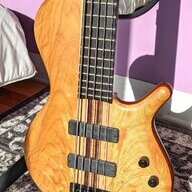
According to an increasing number of folks here it's having more than 4 strings these days. Ive seen statements go as far as to suggest the inate action of playing a 5 makes you a superior musician (LOL) If it seems like I'm salty, it's because I am. The extended range community used to be the chillest bunch on here back in the day, to see how far it's fallen from grace truly saddens me to the core.
 
Hey gang,

Upright bassist experimenting again with electric bass after a 10 year hiatus here.

Wondering: what makes a truly exceptional electric bass? What makes one mass produced fender, for example, stand out from others? — assuming the setup is right.

In the upright world, it seems you generally commit to a scale length and then from there you’re going for the loudest, beefiest acoustic tone you can find with the most comfortable neck for what you like (+ again, pro setup is implied prerequisite).

With electric basses, it seems like everything, at least on Fenders, is pretty much interchangeable. If you don’t like the pickups, but love the neck, for example - easy fix. Almost too easy?

This is not a visual aesthetics question - I know some just look cooler than others with gnarlier or more stripped exotic wood, etc, but I am thinking strictly about tone/feel.

To say it another way: if you blindly played 100 P or J basses (whichever your preference) all setup the same and well, how would/could you go about identifying your favorites? Conversely, what would identify the underdogs and duds?


The sound of course- but if you have bad ergonomics, that's a rather 'mute' question (pun intended).

Regarding the latter, the Fender American Standard P-bass from 2008 on is one of the most comfortable basses, neck geometry-wise, and relation to where it joins the body for easy reach, that I've ever played. Also the contours on the back of the body make it a comfortable fit

It also has a great sound- the thinner lacquer coating on the alder bodies of those basses probably has something to do with it, which reminds me-

The one thing you can't easily change is the type of wood, which does have an impact on sound. So you should try playing what you're interested in first, or at least listen to some well-recorded demos-
 
Last edited:
  • Like
Reactions: JBarz

Latest posts