• TalkBass has been independent since 1998. Add your voice.
    Create a free account to reply to discussions, view embedded media, and browse with fewer display ads.
    Join freeLog in
    Want zero display ads or expanded classifieds tools? Compare plans.

What makes a string go "THUD" ? Help!

Bassamatic

keepin' the beat since the 60's
Supporting Member
Dec 7, 2007
5,952
4,566
Studio City, SoCal, USA
I have a mini- bass project I have been working on for a while. It is a 23" scale on some kind of custom body. It has a piezo bridge pickup and a 2-band mono preamp. I wanted to make it a mini-fretless and Renson Guitars did a beautiful job de-fretting it.

I found that the round wound strings created a lot of finger noise, and ended up with Pyramid Flats made for the Taylor G-Bass Mini - a perfect fit!

The problem is that the A string just goes THUD with almost no tone, as if it is heavily damped.

I put the E in the A position - same thing - THUD
I had a second set of strings and changed strings - the same.
I tried an A from the Goldtone La Bella set - same thing!
I changed the piezo bridge to another piezo bridge - same thing
I rotated the bridge 180 degrees - same thing
I even changed the battery.

I am out of ideas. All the other strings sound great! Help, please!
 
Does the string sound acoustically? If it does then the issue is electronic and you need to be looking at the pickup.

If it doesn't sound acoustically then there is something wrong with the geometry of the guitar on that particular string and you need to be searching for where the issue is - fretless narrows that down but it must be contacting the fretboard somewhere, possibly at the nut or saddle.
 
  • Like
Reactions: GwennyG and RSBBass
Since it is a solid body, there is not a lot of sound, but yes, it seems to be dead acoustically also. It is dead sounding when fretted also. I have also raised the bridge to get additional clearance to no avail. I think it is haunted.
 
Last edited:
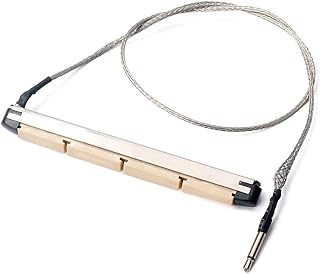
Hi - The pickup looks like this - It is in a slot on a wood holder. Could I possible have 2 defective ones?

51F4rB4u5WL._AC_UL320_.jpg
 
That pickup is a pressure sensor and it’s not a separate sensor for each string.

No electrical reason you’d have an issue with only one string. I suppose it’s possible there’s a geometric issue with just that string line along the neck? Maybe a high spot that can be smoothed?

But here’s another last glance guess.
What if the contact area under the pickup sensor has a gap around where the A crosses? That would result in less contact pressure for that string. Just a thought because piezo pickups only respond to pressure. Not sure how to check that.
 
The only thing you haven't really tested is the acoustic properties of the build, of course because that's difficult to do. You could check visually that the A string vibration has a similar decay to the other strings.

See 'wolf notes' under Double Bass to explain dead spots

If it's only the open string I would suspect the nut or tuner.
 
  • Like
Reactions: RSBBass
That pickup is a pressure sensor and it’s not a separate sensor for each string.

No electrical reason you’d have an issue with only one string. I suppose it’s possible there’s a geometric issue with just that string line along the neck? Maybe a high spot that can be smoothed?

But here’s another last glance guess.
What if the contact area under the pickup sensor has a gap around where the A crosses? That would result in less contact pressure for that string. Just a thought because piezo pickups only respond to pressure. Not sure how to check that.

Remove the E string; put the A string in the E position. Still a thud of the A = bad string. A rings out = piezo problem.
 
IMG_0095.JPG
This is what it looks like. I am thinking that it may be that the wooden part of the bridge is not contacting the piezo well - maybe it is not flat inside.

I friend and I determined that the string sounds dead acoustically as well, at any fret position. I wonder where I could get another bridge like that one!

I did reverse the strings and also put a different brand string there - still dead at the A position!
 
Last edited:
I played some sub scale ABGs a while back and the dead A appeared with some of them too.

if it is acoustic in nature messing with the PU isn’t going to change that. Can’t amplify vibrations that have already stopped happening
 
  • Like
Reactions: Derek Kay
View attachment 5376901 This is what it looks like. I am thinking that it may be that the wooden part of the bridge is not contacting the piezo well - maybe it is not flat inside.


I tend to agree at this point, unfortunately the pickup sits in a SLOT in the bridge. I don't know how I could make the bottom smoother. Maybe to take a chance and put some epoxy in the bottom of the slot and set the pickup in there solidly.
 
I played some sub scale ABGs a while back and the dead A appeared with some of them too.

if it is acoustic in nature messing with the PU isn’t going to change that. Can’t amplify vibrations that have already stopped happening

Thanks for your suggestion, but the A string sounds OK in the E position. I am thinking it is related to the mounting of the pickup in the bridge piece.
 
Last edited:
  • Like
Reactions: Stylee Mousse
I think I have found the problem! The hollowed out wood bridge is slightly curved - about 0.8mm difference between the ends and the center. So the pickup which is perfectly flat is not being supported in the center. The string tension from the string through strings must have bowed it a little.

So - What would I fill the gap with that is hard, but that I could remove the pickup if I needed to?

Thanks for all the help and suggestions.
 
I wondered if the bridge was bowed but I figured it was just camera distortion in the picture. The strings not evenly pressing on the piezo elements would definitely cause volume differences.

If the piezo element is removable you could fill the slot with good, not 5 minute hardware store, epoxy and file or machine it flat. If it was mine I might try and find aluminum or brass U channel that the peizo elements fit in snugly and make a new bridge out of that.

The picture you posted is interesting. Could you post some of the whole bass?
 
  • Like
Reactions: RSBBass
I had though about putting a thin layer of epoxy in the slop and pressing the piezo in so it would be fully supported. Of course, I would never be able to take it out. Maybe some other type of hard glue? If that doesn't work I have no other solution. I have a nice metal bridge with piezo built in, but it is about 1/4" lower than this wood bridge. I would have to make a hardwood spacer to use it, I think.

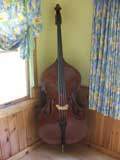
This is a very unusual bass - I got it from a fellow TBer that can only play very short scales. It was painted by Pat Wilkins - one of the best. I don't know the history - you can clearly see that it has had at least 2 other bridges previously.
IMG_0096.JPG
IMG_0097.JPG
 
  • Like
Reactions: Matt Liebenau
I wasn’t thinking to permanently epoxy the peizo elements in. I was thinking fill the slot, let the epoxy cure, level the bottom of the slot.

As a temporary test fix you could try hardwood veneer or brass shim stock in the middle, lower part and see if that helps. It depends on how far out it is. Veneer is typically around 0.022”. You can get shim stock anywhere from 0.001” on up.
 
This is acoustic guitar repair technology.

When installing an under-saddle piezo pickup in an acoustic guitar bridge the most important thing to do is to make sure that the bottom of the slot is dead flat. The way it's done on an acoustic bridge is to place a jig that accommodates a Dremel fitted with a proper sized (a shade undersized is best) bit on the top and cut (re-cut) the bottom of the slot.

We did quite of few of those in the shop in the nineties and early two thousands. We learned that a large enough percentage of the bridge slots were not flat and those guitars got brand new pickups installed, uninstalled, bridge slots cut, and reinstalled. It became standard operating procedure to cut the slots before every installation.

In your situation, you need to determine whether or not the top of the bridge is flat. If it is, you can chuck it up in a vise and run the Dremel in the slot freehand and finish up with a micro chisel.

N.B. Tune-o-matic style bridges can and do bend in the middle. Even the metal bridges do. That may or may not be a problem. The pickup may conform and retain solid contact. Or not. For added insurance, it might not be a bad idea to reinforce the bottom of the bridge with some steel angle or some T stock.

This is an advanced repair. It probably shouldn't be attempted by someone who only uses tools occasionally.
 
  • Like
Reactions: Derek Kay
Put one, ONE layer of saran wrap around the pickup, THEN imbed it in the epoxy. Once the epoxy cures you can remove the pickup to get the saran wrap out then reassemble the bridge. Stretch the saran wrap so it will go through the hole for the pickup.
 
These are all amazing suggestions - thanks!!!

Latest - When removed - I put the piezo on a solid surface, plug it into an amp and tap on the segments with my fingernail - they all sound the same. Then I re-assembled it, and do the same thing - the A segment sounds different - no bottom, and the A string is THUD. So frustrating.