

Enjoy the benefits of a premium membership!
Upgrade Account
-
TalkBass has been independent since 1998. Add your voice.
Create a free account to reply to discussions, view embedded media, and browse with fewer display ads.
Join free Log in
Want zero display ads or expanded classifieds tools? Compare plans.
You are using an out of date browser. It may not display this or other websites correctly.
You should upgrade or use an alternative browser.
You should upgrade or use an alternative browser.
Double Bass What to do??
- Thread starter KSB - Ken Smith
- Start date
More options
Who Replied?hm, maybe that dragonetti-guy who scratched his name in the plate couldn´t afford more than three strings?
i don´t know, i found the pics somewhere in the net two years ago, and can´t remember where.
sorry, i don´t have any additional info
edit:
with a little google-help i found this:
[Invalid or Expired Link Removed]
i don´t know, i found the pics somewhere in the net two years ago, and can´t remember where.
sorry, i don´t have any additional info
edit:
with a little google-help i found this:
[Invalid or Expired Link Removed]

- Mar 1, 2002
- 4,237
- 52
- 75
- Disclosures
- Owner: Ken Smith Basses, Ltd.
Aaron Noguer said:Ok I'll ask. Why is it missing a string?
That is Dragonetti's Gasparo d'Salo Bass. He played with only 3 strings so it was left that way in the museum. Stefano Pio has that Bass pictured in his recent book and is freinds with Sergio Scaramelli who may be the restorer for the Bass as he and Pio do business together. Scaramelli is the one who restored my Martini in 1999, a few years before I got it from Pio in Venice. I know of one person that has played the Bass recently and it has a huge thick Italian sound as he compared it to anoher Italian Bass he showed me last year while comparing it to my Dodd at the VSA Convention in PA and said it was similar but even bigger sounding.
Paul, Yes! The English did copy Maggini to a degree but not 100% all the time. This started later I believe and was common with Betts and Fendt in the early 1800s. Kennedy and Willian Gilkes (Samuel's son.. not 'Son of Sam'..lol) also made Basses with Brescian styling.
By the way Gilkes is actually pronounced 'Jilkes'. My English sister-in-law married to my Brother is Gill, pronounced 'Jill'. An English thing I guess. When I first met Hal Robinson and told him what Basses I had he said 'oh Jilkes, those are nice Basses' referring mainly to those of William and the few attributed to Samuel. It was not until last night, after owning the Gilkes for 2 1/2 years that I finally remember my Brothers' Wifes' name and spelling in regards to Gilkes/Jilkes. Everytime I discuss the Bass with Duane Rosengard he says 'Jilkes'. It always bothered me as if they were saying it wrong almost to the degree it was a nick-name pronounced that way but now that I look at it, they were right! For 2 1/2 years I couldn't even pronounced the name of my Bass correctly. Now, how bad is that??
- Mar 1, 2002
- 4,237
- 52
- 75
- Disclosures
- Owner: Ken Smith Basses, Ltd.
The Bass believed to be a Fendt may very well be a Bass made by John Thomas Hart, London c.1830. Since the Bass is stamped "J.HART" inside the Back and Rosengard believes this very well may be a 'lost' Hart instrument I have updated my web page attributing it to Hart with great confidence. Alot has gone into this thought and we are still digging for more information on Hart here and in London but for now and maybe forever, this Bass is the work of John Hart.
[Invalid or Expired Link Removed]
There will be no 'bSf' lettering on the rear inlaid emblem. At this time I am re-thinking this and will either make a blank Ebony Button or one with his initials JTH or JH or J.Hart..just 'H'?
Who knows?.. Lets see what more we find on yet another mystery Bass to loose sleep over..lol
[Invalid or Expired Link Removed]
There will be no 'bSf' lettering on the rear inlaid emblem. At this time I am re-thinking this and will either make a blank Ebony Button or one with his initials JTH or JH or J.Hart..just 'H'?
Who knows?.. Lets see what more we find on yet another mystery Bass to loose sleep over..lol
- Mar 1, 2002
- 4,237
- 52
- 75
- Disclosures
- Owner: Ken Smith Basses, Ltd.
The Bass believed to be a Fendt may very well be a Bass made by John Thomas Hart, London c.1830. Since the Bass is stamped "J.HART" inside the Back and Rosengard believes this very well may be a 'lost' Hart instrument I have updated my web page attributing it to Hart with great confidence. Alot has gone into this thought and we are still digging for more information on Hart here and in London but for now and maybe forever, this Bass is the work of John Hart.
[Invalid or Expired Link Removed]
There will be no 'bSf' lettering on the rear inlaid emblem. At this time I am re-thinking this and will either make a blank Ebony Button or one with his initials JTH or JH or J.Hart..just 'H'?
Who knows?.. Lets see what more we find on yet another mystery Bass to loose sleep over..lol
Ok, heres the latest on this thing. I did make mention about it in the 'English' thread but was not posting specifically about just this Bass.
The Bass is most likely the work of John Hart so I had a brass coin made to fit in the existing empty circle. The letters go around the edge as will say "J.HART" (at the top as it was originally stamped inside the Bass 4x) and "LONDON" (at the bottom where it was made). The letters were engraved in the Brass and then the Coin was put in an ultra sonic machine to pre-oxidize it to match the aged look of the brass Baker gears. The letters were filled in with black ink as well to stand out.
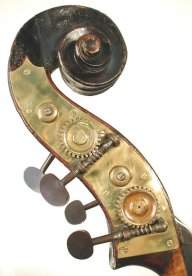
The Plates that were on the Scroll didn't fit all that well and were poorly inlaid. The Plates will go in storage along with the original business card from 'Bird & Son. I had Arnold fully repair the Scroll and re-cheek the outsides where the Plates were inlaid. The Gears are currently being mounted flush on the wood. The inlaid wood will be Varnished to match the Scroll and lightly antiqued.
I wrote out all the info that was legible on the card and Arnold will make a replica Label to go inside the Bas to preserve that part of the Bass's history.
When the Bass is done, or if possible before, I will show some pics of this work I just mentioned. When the entire restoration is done, it will not only go on my website but I will take pics of the Hart along side the Gilkes. Hart apprenticed to Gilkes for about 5 years 'articled' to Gilkes in May of 1820 till about 1825. The Gilkes of 1814 is the oldest confirmed Bass from his hand I have heard of. The Hart c.1830 is also the oldest we know of and the only one of his hand that I have heard of. The others from the 1840s were made by his son-in-law William Valentine. William Gilkes (b.1811 and son of S.Gilkes) may have worked for a period with Hart. This is my own speculation as William was only 9 years old when Hart came to work at the shop. William was also only about 16 years old when his father Samuel died in 1827. Hart was his only recorded apprentice (James Gibbs also 'worked' for Gilkes and others but might have been an outworker). I feel safe to assume that Hart was like that of a big brother to young William. The Basses seen later made by William (c1840s) look slightly similar to this Hart Bass.
- Jan 25, 2006
- 1,292
- 6
- Disclosures
- Endorsing Artist; Arnold Schnitzer/ Wil DeSola New Standard RN DB
Hey Ken, Great to see you back on TB!
I think your engraved coin idea was a good way to go for that spot.
BG
I think your engraved coin idea was a good way to go for that spot.
BG
Welcome back KB!
The Ken Smith - Paul Warburton Show Is Back Again!
- Mar 1, 2002
- 4,237
- 52
- 75
- Disclosures
- Owner: Ken Smith Basses, Ltd.
The Ken Smith - Paul Warburton Show Is Back Again!
Well Bob, at least with PW as my sidekick, there's a Bathroom nearby and nicely decorated from what I've heard..lol

Well Bob, at least with PW as my sidekick, there's a Bathroom nearby and nicely decorated from what I've heard..lol
It's overloaded with your basses Kenny Boy!

- Mar 1, 2002
- 4,237
- 52
- 75
- Disclosures
- Owner: Ken Smith Basses, Ltd.
I went up to Arnold's today for a few things including delivering the coin for the Back inlay of the Hart Bass. The Hart coin looks nearly identical in color and age as do the original Baker Gears which by the way are fantastic. Today is the first time I have seen them mounted directly to the Scroll cheeks without the brass plates. What an improvement!
Although the Bass will be at least another month before it's completely done, I did get to play it as Arnold temporarily strung it up for me to get a preview of the feel and sound.
It looked like it was delicate with all the repair work exposed on the Top, Back, Ribs and Scroll but the Bass is strong as a Tank. Even in its rough state, she sounded beautiful with sweetness on the G and D string and smooth low end spread on the A and E. The Bass was even sounding from top to bottom.
By the way, this is my personal Bass and not one I am trying to sell.
Although the Bass will be at least another month before it's completely done, I did get to play it as Arnold temporarily strung it up for me to get a preview of the feel and sound.
It looked like it was delicate with all the repair work exposed on the Top, Back, Ribs and Scroll but the Bass is strong as a Tank. Even in its rough state, she sounded beautiful with sweetness on the G and D string and smooth low end spread on the A and E. The Bass was even sounding from top to bottom.
By the way, this is my personal Bass and not one I am trying to sell.
- Mar 1, 2002
- 4,237
- 52
- 75
- Disclosures
- Owner: Ken Smith Basses, Ltd.
Here is an emailed Pic fresh from Arnold. It just went in the Back today. I will take more and better pics in about a month or so when the Bass is done. Maybe if we get lucky, Arnold will send some more pics when he has the time.
Attachments


That's a neat idea and a good choice--it looks good and is restrained. I'm looking forward to seeing that one when it's done
- Mar 1, 2002
- 4,237
- 52
- 75
- Disclosures
- Owner: Ken Smith Basses, Ltd.
That's a neat idea and a good choice--it looks good and is restrained. I'm looking forward to seeing that one when it's done
Well, I also owe a huge thanks to both Arnold and Jed his assistant. It was Jed that figured out some of the milling work for the Ebony piece it is inlaid within to match up with the slightly oversize hole once it was all cleaned out. It was estimated just under 1" (.950") before making the coin or cleaning out the opening. After it was ready for inlay the hole diameter was about 1 1/16". I had this idea about using Ebony from the start and engraving into the wood. A coin seemed more practical thought. After all is said and done, we have both. Arnold did some extra special work to further antique the coin making it look more original to the Bass.
I am guessing that the original inlay might have been something of value to whom ever ordered the Bass almost 180 years ago. Since we will never know what it was or what became of the original, this simple but beautiful inlay will act as its replacement. I had two coins milled just in case this one gets lost somehow!
Note: The two coins were made by the same shop that makes the bridges, electronics and other components for our handmade Smith Electric Basses.
As mentioned I am somewhat of a figure in the Bass world and the current owner no doubt.
What does that mean?
- Mar 1, 2002
- 4,237
- 52
- 75
- Disclosures
- Owner: Ken Smith Basses, Ltd.
What does that mean? ( Originally Posted by KSB - Ken Smith View Post
As mentioned I am somewhat of a figure in the Bass world and the current owner no doubt. )
Ok, if you read back you would have seen why I mentioned that. To help speed things up I will post the original quotes that led to that statement.
(10-14-2006, 07:45 AM, Post #14 from PJ+B) If you can't ever find what was in there or might have been in there, then I would make a period-correct Ken Smith logo in there. You are a major figure in the history of the electric bass, and you are making yourself a loving part of this bass's history--it seems entirely appropriate to me.
followed by;
(10-14-2006, 09:28 AM, Post #16 from KSB/me!) Anyway.. On all the suggestions (NOT Arnold's), I like the raise Ebony Disc plain OR the Ebony disc flush or raised with our "S" Logo in dark Abalone. As mentioned I am somewhat of a figure in the Bass world and the current owner no doubt. If there was anything there at all in there, I would have left it no matter what as long as it was a part of the past history of the Bass.
So as you can see, I was just quoting a previous comment about putting my 'S' logo in the disc to fill the empty hole. One assumption at least was that the original inlay might have been the name of the original owner or maybe some personal 'coat of arms'. Putting my logo in there suggested we ID who the Bass belongs to currently.
It wasn't my suggestion and the closest I would have gone to that was the 'bSf' as 'photo shopped' if it was a Fendt and the 'S' being the same style as my Logo.
Since we now believe the Bass to be the work of John Hart the 'S' idea is history!
By the way BassWrath, I see in your profile that you have owned several French Basses including two that you refer to as just '2 older French basses'. Did either of these bear any resemblance to my Mystery Bass at all? We are still working on that one so if you have anything to add, please do.

- Mar 1, 2002
- 4,237
- 52
- 75
- Disclosures
- Owner: Ken Smith Basses, Ltd.
The Hart is done, home and sitting in the rack next to the Gilkes...
I will post photos as soon as I can..
I will post photos as soon as I can..


