Enjoy the benefits of a premium membership!
Upgrade Account
-
TalkBass has been independent since 1998. Add your voice.
Create a free account to reply to discussions, view embedded media, and browse with fewer display ads.
Join free Log in
Want zero display ads or expanded classifieds tools? Compare plans.
You are using an out of date browser. It may not display this or other websites correctly.
You should upgrade or use an alternative browser.
You should upgrade or use an alternative browser.
What to play on suspended chords?
- Thread starter hublocker
- Start date
More options
Who Replied?

- Oct 29, 2005
- 1,038
- 39
- Disclosures
- Endorsing Artist: Aguilar Amp Gruv Gear and Mono Cases

In general avoid the 3rd and you will be okay. You can use the 4th if you like, but root, 5th, 7th are you main tones. A trick some use is to play a Maj7 arpeggio whole step down from the root.
suspended chords are frequently there to provide tension that's resolved with the next chord.. a sus4 chord is a very 'open' tension... in fact it's more of a 'lack of harmonic definition' than a dissonant tension, but anyway
what i'm trying to say is that the appearance of a sus chord is a compositional brush stroke that has a 'meaning', and your job as bass player is to underline that meaning... your choice of notes shouldn't subtract from that meaning
the first thing to consider should be whether you'd be better getting out of the way of the melody and staying on the root...
if you want to outline the chords, eg Dsus4 to D, then you could consider showing the change, by going from G to F#.. but bear in mind that someone else is probably doing that already... and if YOU don't throw in a D under the Dsus4, then it could be a Gsus2
it depends what else is going on... pounding root notes is boring but usually needs to be done... as bass player you have a job to do, and it's to underline the basic harmony of the piece
think of the famous 'pinball wizard' guitar riff.. the bass doesn't need to do anything to outline the suspended chords' resolution to standard major chords as the guitar is doing that job perfectly well on its own... as usual, your ear and sense of taste will tell you what's right..
what i'm trying to say is that the appearance of a sus chord is a compositional brush stroke that has a 'meaning', and your job as bass player is to underline that meaning... your choice of notes shouldn't subtract from that meaning
the first thing to consider should be whether you'd be better getting out of the way of the melody and staying on the root...
if you want to outline the chords, eg Dsus4 to D, then you could consider showing the change, by going from G to F#.. but bear in mind that someone else is probably doing that already... and if YOU don't throw in a D under the Dsus4, then it could be a Gsus2
it depends what else is going on... pounding root notes is boring but usually needs to be done... as bass player you have a job to do, and it's to underline the basic harmony of the piece
think of the famous 'pinball wizard' guitar riff.. the bass doesn't need to do anything to outline the suspended chords' resolution to standard major chords as the guitar is doing that job perfectly well on its own... as usual, your ear and sense of taste will tell you what's right..

These are sounds you may want to try out
In a sus chord you may want to touch upon the sus note itself esp in a walking line, since the composer chose that tone he may want it emphasized.
But I agree with others that emphasizing the root is important since it's kind of an ambigous sounding chord and one of the bassists job is to hold down the bottom.
If you decide to play an arpeggio starting from a whole step down you may want to play up to the ninth since that would be the sus4 root.
Or if you want to hear another sound play the triad a fourth up from root for a sus4 (ex: D F# A for Asus4)
For R&R you could just use the simple box pattern (R M2, P4 P5, m7 Oct)
In a sus chord you may want to touch upon the sus note itself esp in a walking line, since the composer chose that tone he may want it emphasized.
But I agree with others that emphasizing the root is important since it's kind of an ambigous sounding chord and one of the bassists job is to hold down the bottom.
If you decide to play an arpeggio starting from a whole step down you may want to play up to the ninth since that would be the sus4 root.
Or if you want to hear another sound play the triad a fourth up from root for a sus4 (ex: D F# A for Asus4)
For R&R you could just use the simple box pattern (R M2, P4 P5, m7 Oct)

In a sus4 chord, the third doesn't explictly become a note to avoid - on the contrary, its a very important note in defining the tonality. It does however require special attention. It's not functioning as the third of the chord, rather, its function as a passing tone, or if you want to think of it as part of the chord, tension 10 (yes, its an odd concept, tension 10, but you'll find that as an upper extension of a sus4 chord it doesn't sound too bad). The trick is to play it, but NOT emphasize it. This is very difficult to do, and in most cases doesn't work in things like walking lines for a variety of logistical reasons, which is why people get the impression that you should avoid it. In classical harmony, yes, in pop/jazz harmony, not necessarily.
The trick in walking a bassline over a sus4 chord is to play the 4 on a strong beat (1 or 3) WITHOUT it sounding like the sus4 chord has resolve to the tonic a perfect fourth up. In the key of C, on a G7sus chord going to C major, if you play something like G D C G - just a matter of outlining the sus4 triad, it'll sound weird and prematurely resolved to C. One option, like somebody mentioned, is to play the suspension resolution pattern in your line. This would best, in my opinion, be represented by playing a line like G D C B and then resolving it to C on the next beat. Playing G C B G probably isn't a good idea since the third is on an accented beat.
The trick in walking a bassline over a sus4 chord is to play the 4 on a strong beat (1 or 3) WITHOUT it sounding like the sus4 chord has resolve to the tonic a perfect fourth up. In the key of C, on a G7sus chord going to C major, if you play something like G D C G - just a matter of outlining the sus4 triad, it'll sound weird and prematurely resolved to C. One option, like somebody mentioned, is to play the suspension resolution pattern in your line. This would best, in my opinion, be represented by playing a line like G D C B and then resolving it to C on the next beat. Playing G C B G probably isn't a good idea since the third is on an accented beat.
This thread is nicely handled. For me, if it is a walking line I will usually play the suspension. Pop or rock type grooves I often choose to hang with the root.
JKT
JKT

Zombie thread comes alive…
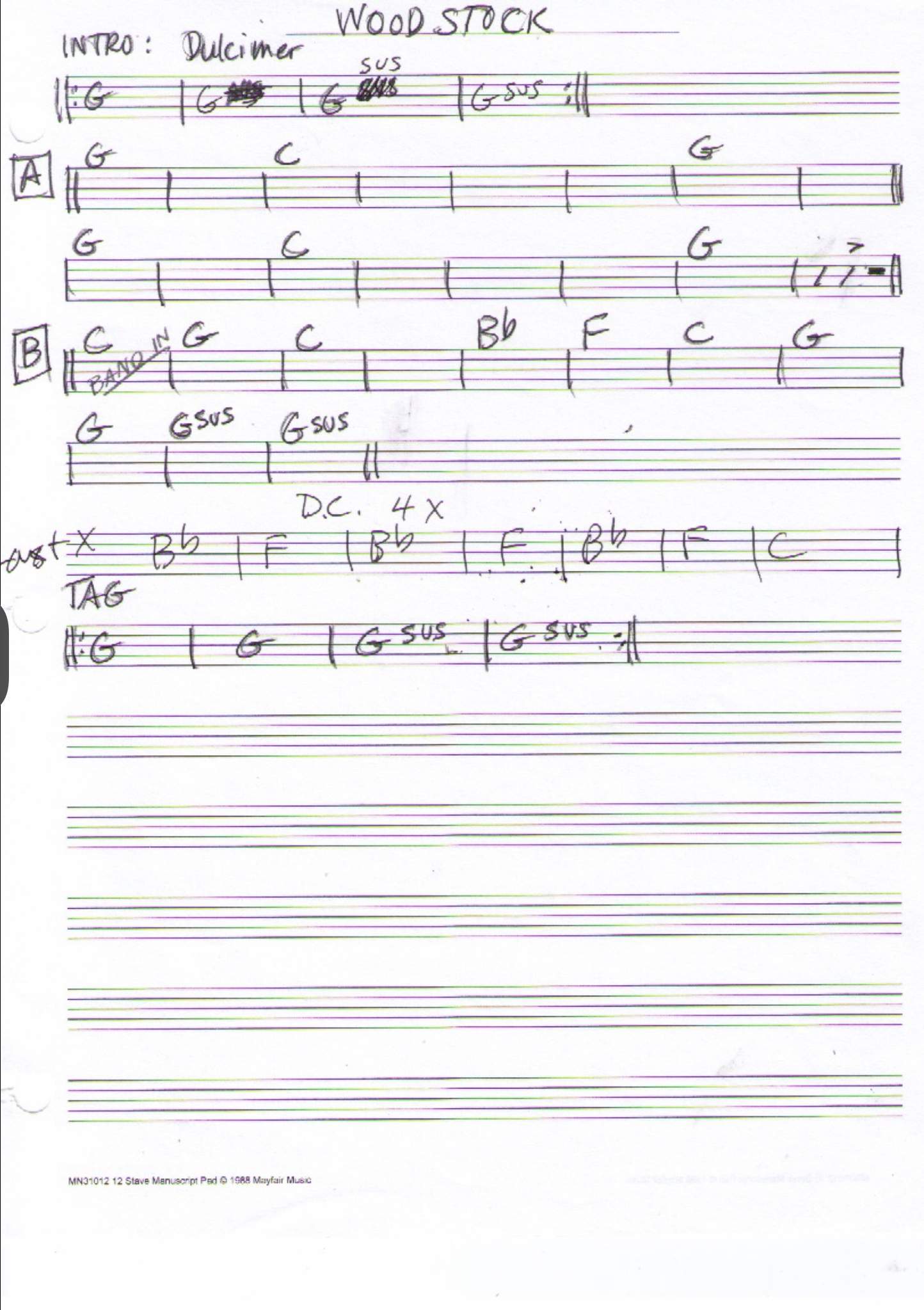
Regarding the Gsus at the end of ‘Woodstock’.
I’m playing an old vintage Fender fretless for an important 4 day gig at the end of this month. Most of the tunes are originals backing up a lady singer with her band. These show dates pay well above most. One cover though is ‘Woodstock’ which I have never played.
The sections end on a couple bars of Gsus. When I first played along her recording of it I stuck to the root, which seems to suit what she is doing. But somehow, maybe A and C notes slipped in with the root might be effective. We will have one rehearsal for this job. Basically I am expected to walk in, and play everything perfectly in every tune.
What would you do, be safe and stick to the root? Or is there some magic to be revealed with A and C?
Regarding the Gsus at the end of ‘Woodstock’.
I’m playing an old vintage Fender fretless for an important 4 day gig at the end of this month. Most of the tunes are originals backing up a lady singer with her band. These show dates pay well above most. One cover though is ‘Woodstock’ which I have never played.
The sections end on a couple bars of Gsus. When I first played along her recording of it I stuck to the root, which seems to suit what she is doing. But somehow, maybe A and C notes slipped in with the root might be effective. We will have one rehearsal for this job. Basically I am expected to walk in, and play everything perfectly in every tune.
What would you do, be safe and stick to the root? Or is there some magic to be revealed with A and C?
Last edited:

Dirt simple Sus chords the 3 is omitted and repleaded with a 2 or 4. Sus2 =R-2-5-b7 or Sus4 = R-4-5-b7. If just a Sus shown, we take for granted it is a Sus4 chord.
Last edited:

Zombie thread comes alive…
Regarding the Gsus at the end of ‘Woodstock’.
I’m playing an old vintage Fender fretless for an important 4 day gig at the end of this month. Most of the tunes are originals backing up a lady singer with her band. These show dates pay well above most. One cover though is ‘Woodstock’ which I have never played.
The sections end on a couple bars of Gsus. When I first played along her recording of it I stuck to the root, which seems to suit what she is doing. But somehow, maybe A and C notes slipped in with the root might be effective. We will have one rehearsal for this job. Basically I am expected to walk in, and play everything perfectly in every tune.
What would you do, be safe and stick to the root? Or is there some magic to be revealed with A and C?
View attachment 4786218
Is it Joni's "Woodstock?"
I've thought it's in minor.
Yes, I agree with you!Is it Joni's "Woodstock?"
I've thought it's in minor.
Groove Master
Commercial User
- Apr 22, 2011
- 1,808
- 1,291
- Disclosures
- Author of Groove 101, Slap 101 and Technique 101
Stay on root for a start. Because there is a movement in the color of the chord if you stay on the root it will be more obvious.One is just A7sus4 to A7 and the other is A suspended to A in an intro.
I once knew a scale to go over suspended chords but used it so rarely I forgot what it is.
Yes, I agree with you!
It just means that you or the singer is not(!) following the original harmony arrangement.
Do you have any piano/keyboard/guitar players in the band?
I hope someone in the band checks out Joni's beautiful harmony and "corrects" the chart. They're missing tons of beautiful harmony. (She does it in Ebmin below ...)
IMFO, of course.
Thanks.
IMFO, of course.
Thanks.
Last edited:
OK...My sincere apologies.
The chart is the CSN&Y version (in G, below.)
But there is a lot of specific/beautiful harmonic detail missing on the chart.
Carry On! (Love is coming to us all!)
Thanks.
The chart is the CSN&Y version (in G, below.)
But there is a lot of specific/beautiful harmonic detail missing on the chart.
Carry On! (Love is coming to us all!)
Thanks.