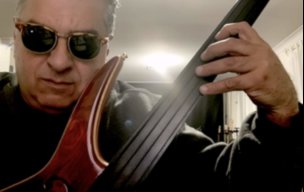
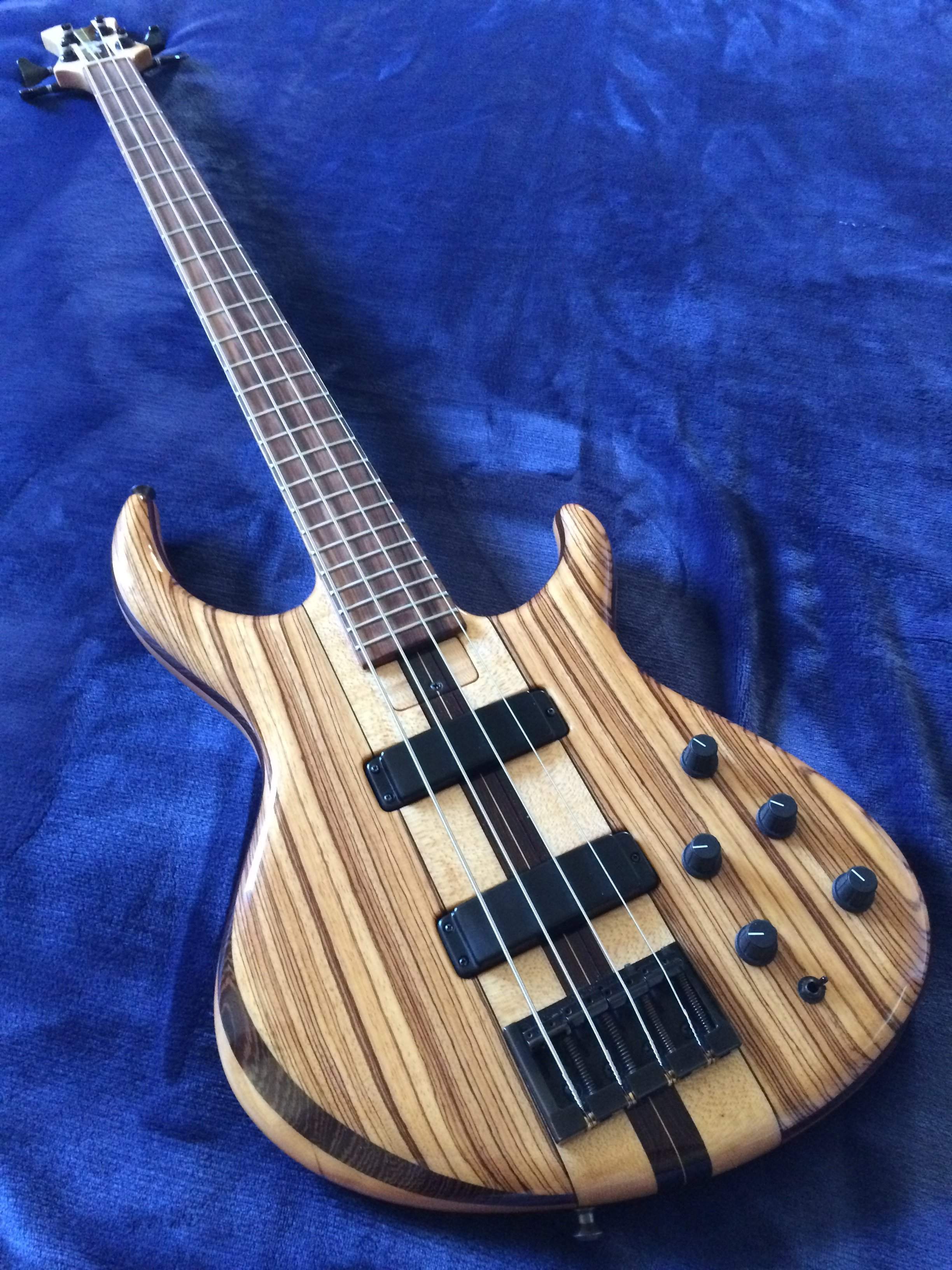
24 frets with complete access to all of them. This thing is a slap monster. There's plenty of money above the 5th fret if you know where to look.

TalkBass has been independent since 1998. Add your voice.
Create a free account to reply to discussions, view embedded media, and browse with fewer display ads.
Join free Log in
Want zero display ads or expanded classifieds tools? Compare plans.

neither you have with Wick, right? and if you'll want the 22nd fret, it will be possible with Wick and normal technique, but not with Ray as it has only 21?
I don't really see the problem in longer fretboard as long as it doesn't restrict your right hand. if you're able to reach 23 frets of a 24 fret board without having a hard time, on a 21-fret board, you're only able to go to 21st.
Got news. Speaking at the level of gross oversimplification, you could make that argument. But it doesn’t hold water if you understand how it actually works.
The protocols and underlying technology were no different then than they are today. And although you may think it’s silly to give credit to a small group of people, the people who are professionally involved in enterprise level information technology will tell you exactly who (e.g. Vint Cerf, Bob Kahn, Tim Berners-Lee, Mark McCahill, Mark Reed Crispin et al.) was responsible for what, and when each piece of the package of technologies we think of as “the web” came out. And you can even go back before the advent of the public Internet to see the people and their technical contributions (such as Ward Christensen and Randy Suess with RBBS, Tom Jennings and Fidonet; Jeff Reeder, Jim Bergman, and Mark Hayton and RIPscip, Howard Reingold who coined the notion of “virtual communities” and “electronic villages”, etc ) who pointed the way and had a big influence on what the Internet ultimately became.
Trust me. We know who was responsible for the invention of the Internet. And what their specific contributions were. And also what generation they’re from. There’s no mystery or question there.
Regarding the differences between the Internet then vs now:
The Internet is bigger and more powerful than it originally was as more resources were deployed and more people were given access to it. But that’s a natural consequence that grows out of networking things.
For example, a fax machine by itself is useless. But link two together and they now become a useful tool. But that’s only a connection between two users. However, add a thousand more fax machines and fax technology becomes extremely useful. And with each additional fax machine, the fax network becomes exponentially more powerful - and more worth it for someone to get a fax machine.
The Internet works the same way. The more resources and users, the more powerful it becomes. But the underlying technology and protocols driving it are pretty much the same as they ever were. It’s not really that different. There’s just a whole lot more of it. The only limitation to its power is the amount of bandwidth you give it. And the only limitation to the amount of bandwidth is the amount of fiber or copper cable you want to string. Because the threshold for bandwidth is infinity. You can have as much as you decide to provide.
So it’s really no different. Bigger and faster? Sure. But the underlying tech is still the same. TalkBass’s forum software traces its technical heritage to the old dial-up bulletin board systems. Wedding a BBS to the Internet just made TB globally accessible at a very low cost for its users. But it’s still just a computer bulletin board system at heart. Biggest difference is that today we call them “forums” instead of “boards.”
Old wine in new bottles.

... the money for bassists in bands are guys who actually play BASS, not the guys who think they are guitarists and go noodling all over the place...
the guys who were most successful and made tens of millions did it by holding down the bottom end, not trying to solo and wow everyone like they are Jaco.
... know your role and hold down the bottom end, that's where the money is. If you want to be Jaco or Wooten, go solo or start your own jazz fusion group and make peanuts.


I know the type of dismissive statements in regards to 24 frets based you are referring to. I don't think they are terribly serious. Just the sort of grousing traditionalists like to do. As someone else pointed out, there is a lot of heavy leaning on the old "no money above the 5th fret" axiom around there. I call it Talkbass Orthodoxy.Don't post much, but I've noticed some level of disdain for 24-fret basses, not just on this forum. What's the problem here? Is it not objectively better to have more frets to work with, why the hate for 24-frets, you can objectively do less with 20 frets


Whoa....I’m 69 and I have three 24 fret basses and I’m also a big fan of new technology. We’re not all dinosaurs. That doesn’t mean I use all 24 frets though but I don’t stick by 5th fret limitation either. I do play above the 12th occasionally and between the 5th and 12th a lot. I’ve never come across any distaste for 24 fret basses anywhere.Interesting. I have not encountered that here. So I'll have to guess.
I'm guessing anyone who would have a problem with 24 frets is ridiculously traditional.... meaning they would have a problem with ANY design feature on a bass that occured anywhere other than Leo Fender's shop and any time after 1959.
Thay being said, the "Get off my lawn!" crowd can get stirred up about pretty much anything. Baby boomers in particular tend to think there hasn't been a single good idea or quality product made since they were in high school. They'll go on the internet to piss and moan about.... the internet.

How strange that you left huge rock bands like the Who, Yes, and Rush off this list. Gee, I wonder why?Not really. It doesn't mean literally that anything above the 5th fret is useless. What it means is, the money for bassists in bands are guys who actually play BASS, not the guys who think they are guitarists and go noodling all over the place. Beatles, Zeppelin, U2, Pink Floyd, AC/DC....the guys who were most successful and made tens of millions did it by holding down the bottom end, not trying to solo and wow everyone like they are Jaco.
How strange that you left huge rock bands like the Who, Yes, and Rush off this list. Gee, I wonder why?

All three were still hugely successful and had bass players who were all over the fretboard. RHCP is another.I was listing bands from the top 20 all time best selling. None of them are on that list. Yes and Rush are prog rock bands and an anomaly. Rush is my favorite band of all time but they are a very rare exception of a band led by bass that's been successful.
Elon Musk, Brin and Page, Zuckerberg, and the founders of Twitter are among those who have had a significant impact, for better or worse. And by definition non-Boomers are under 55, so their impact is in many cases yet to be fully evaluated.So who are the post boomer exceptional people then? As in civilization/history altering invention making exceptional people.
Ive had 24 fret basses, I barely every used those frets
Sure. Though being able to play a high E would be a lot more useful in most commonly used keys than a high D#/Eb is, so in my opinion 21 frets is better and I suspect the decision to go with 20 only occurred because Leo didn't play.The cool thing about 20 frets is that it's the exact number of frets necessary to play a 2-octave scale in any key. I think this is too frequently overlooked as a reason why the Fender bass ruled 20th-century music: the ability to play up to 2-octave bass lines, in any key, in tune and with easy technique.