I recently bought two new basses....Meet my Traben Array Obsessions.
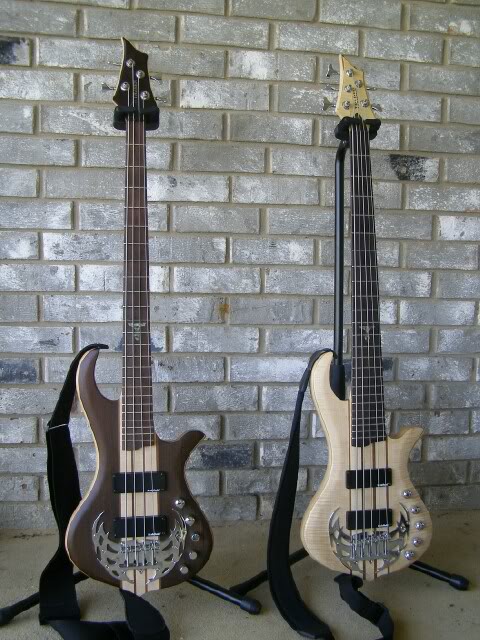
One of the things that helped me make my choice other than the way these babies sound and feel was the fact that they are made mostly of Royal Paulownia.......
Now If you have never heard of Royal Paulownia it is an awesome wood...It is a extemely fine grained, very light, and warp resistant. Not to mention Paulownia is extremely fast growing; some species of plantation Paulownia can be harvested for saw timber in as little as five years. Once the trees are harvested, they regenerate from their existing root systems, earning them the name of the "Phoenix tree." Paulownia has the ability to reclaim ecologically stressed and degenerate patches of land relatively quickly. Its root systems run deep and penetrate compacted and contaminated soils which have resulted from industrialized development. Paulownia is also a highly developed phyto-remediator, increasing the organic content of degraded soils, processing and filtering contaminants through the uptake of its vascular system, and emitting oxygen into the atmosphere. The bark is made into numerous types of dyes, and the leaves are used in vermicide preparations. Tone wise it is very similar to Ash! It is also rot resistant and a has a very high ignition point. So from an ecological (read green tree hugger) standpoint this wood cannot be beat! plus it's quite attractive
I'm married to a big Tree Hugger and this also weighed into my choice.....
you guys?
do you feel a twinge of guilt when looking at or buying basses made from Mahogony, Teak, Walnut, Cherry, Ebony and even Rosewood as they are all listed as Endangered, Threatened and/or a Vulnerable Tree Species Traded Internationally?
just curious...
One of the things that helped me make my choice other than the way these babies sound and feel was the fact that they are made mostly of Royal Paulownia.......
Now If you have never heard of Royal Paulownia it is an awesome wood...It is a extemely fine grained, very light, and warp resistant. Not to mention Paulownia is extremely fast growing; some species of plantation Paulownia can be harvested for saw timber in as little as five years. Once the trees are harvested, they regenerate from their existing root systems, earning them the name of the "Phoenix tree." Paulownia has the ability to reclaim ecologically stressed and degenerate patches of land relatively quickly. Its root systems run deep and penetrate compacted and contaminated soils which have resulted from industrialized development. Paulownia is also a highly developed phyto-remediator, increasing the organic content of degraded soils, processing and filtering contaminants through the uptake of its vascular system, and emitting oxygen into the atmosphere. The bark is made into numerous types of dyes, and the leaves are used in vermicide preparations. Tone wise it is very similar to Ash! It is also rot resistant and a has a very high ignition point. So from an ecological (read green tree hugger) standpoint this wood cannot be beat! plus it's quite attractive
I'm married to a big Tree Hugger and this also weighed into my choice.....
you guys?
do you feel a twinge of guilt when looking at or buying basses made from Mahogony, Teak, Walnut, Cherry, Ebony and even Rosewood as they are all listed as Endangered, Threatened and/or a Vulnerable Tree Species Traded Internationally?
just curious...