Another thing to consider is if you will do the work personally. Soldering is easy. Irons are cheap and the internet full of instructions. If you are new to it you'll learn with little risk. Personally, depending on the mods you want and if they require routing or something harder, I would not want to pay a tech to do simple installation stuff on a beater. If it needs fretwork maybe.

Enjoy the benefits of a premium membership!
Upgrade Account
-
TalkBass has been independent since 1998. Add your voice.
Create a free account to reply to discussions, view embedded media, and browse with fewer display ads.
Join free Log in
Want zero display ads or expanded classifieds tools? Compare plans.
You are using an out of date browser. It may not display this or other websites correctly.
You should upgrade or use an alternative browser.
You should upgrade or use an alternative browser.
when is a "beater" worth upgrading? *UPDATE - useless truss rod!*
- Thread starter Argali
- Start date
More options
Who Replied?
Great feeling and playing neck, great neck-to-body relationship, sets up easy and accurately without heroic measures, that's a keeper worth a modest upgrade to me.
Indeed, that's the criteria I apply to even more expensive "recognized brand" basses.
Indeed, that's the criteria I apply to even more expensive "recognized brand" basses.
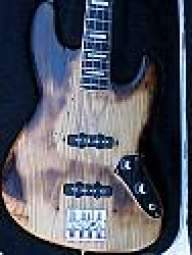
i think beaters or less expensive used stuff , is great for modding/upgrades ... make it your own ... !!

if it's a bass you intend to play more often than not, then it is worth the upgrade to whatever it may need.



when is a "beater" worth upgrading?
any old time you darn well feel like it.
Right on. I am a big booster of El Cheapos. I have owned some very nice stuff over the years including a passel of pre-CBS Fenders, some excellent Music Man basses and a few in the $1200-$1500 range (that's early 1990s money) and I know what a "nice" bass is. To me, a "nice" bass doesn't necessarily equate to the price tag on it.
I realize that the basses I have now are El Cheapos (most expensive one cost $130 shipped) but I very much enjoy making them into players.
As I said earlier, new wiring, pots, caps and jack, usually new pups, new hardware and nut as needed, fresh strings and setup, and I end up with perfectly sound, good-playing, giggable basses that are comfortable and have the components I specifically want in them.
I end up with very little invested in them, but they are more than fit to take on any job.
Best part to me, after having instruments stolen, seriously damaged, and destroyed by natural disaster over the years, is that I don't really have to worry about them much. Not overly concerned with them getting dinged up (although I take good care even of my cheap, meager equipment) or letting my kids play them, or even with them spontaneously bursting into flames for that matter.
The El Cheapos of today tend to be FAR better quality than the ones around from the late 70s to the early 90s when CNC machines came into the picture and the internet could be used to spread info and reviews of various makers. True, there were some great off-shore budget instruments made in the 70s and 80s (particularly in Japan) but not nearly as consistently as what you can get today. Also true, there are still crap makers making crap cheapies today, but they don't tend to stay around as long (IMO) because all it takes is someone going to a forum like this or looking at user reviews online and inquiring "What do people think about XXX brand basses?" To gather a lot of opinions.
Of course there are still gonna be people who say "If it doesn't cost a grand or more it's not gonna be decent." or "You always get what you pay for." or "I wouldn't even touch a Squier bass, or Epiphone (etc.)--they all suck" and other assorted complete BS. But that's all that kind of talk is--BS.

It feels nice, plays well
There you go, slap some decent hardware on her and you have a reliable backup beater.
It would likely not be worth much to sell, so you might as well fix it up and use it.

Thanks for the insight everyone. I did some research and it's really fascinating what's out there in terms of replacement tuners and bridges. I think I'm gonna stick to replacing the pickups for now, and potentially the nut if the current one breaks or whatever. The EMG GZR P seems like a nice baby step because the assembly is solderless, and I can practice doing a set-up on the bass too. I've been playing guitar and bass for 25 years so I should learn that by now, eh? 
Thanks for the insight everyone. I did some research and it's really fascinating what's out there in terms of replacement tuners and bridges. I think I'm gonna stick to replacing the pickups for now, and potentially the nut if the current one breaks or whatever. The EMG GZR P seems like a nice baby step because the assembly is solderless, and I can practice doing a set-up on the bass too. I've been playing guitar and bass for 25 years so I should learn that by now, eh?
I haven't heard a single thing that would lead me to believe you won't be happy with the GZR. Anxious to hear what you think of it.
Don't feel bad about not being a techie. There are longtime pros out there who can hardly change strings.
But a soldering iron and conductive solder is cheap and nowadays there are all kinds of videos available online that'll give you the groundwork for doing your own electronics work.
If anything, to me doing setups and setting intonation is a bigger pain in the rear than doing electronic gut work.
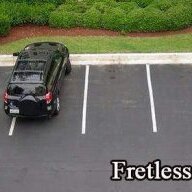
Pretty much.For me, you already answered your own question.
"It feels nice, plays well."
Then it's worth it.
I was rarely playing my first electric guitar & it wouldn't have gotten me much if I sold it.
And I didn't want to to spend more on it to fix it up (Pickups mostly) than what the guitar was worth.
But I set it up for slide otherwise and decided I liked the way it felt & the way it played--so I went for it.
Now I have a guitar I like & play that would either be taking up space & being ignored or I would have little to show for it.
(My other option was giving it away--but as it needed some work, that almost seemed cruel, unless it was to someone to fix it up.)
I replaced the pickups & wired them for different options (I found the pickups for very good prices & someone else did the work--of course doing it myself wold have been cheaper though)
I put on a new nut & a few other changes--mostly cosmetic--but now I love the guitar again.
So while I won't recover my costs if I sold it--I don't care--it's a keeper.
It can work out if you otherwise like the bass-especially if you get a good deal on the pickups.
Beaters are cool to me because there might be a potential "sleeper" there. A snoozin' Stradivarius with a black eye and skint knees. heh.
You gotta give'em a chance. Give a little love and see if it gives it back.
As long as the neck is good and the truss rod works, there's tons of possibilities.
yep...
You gotta give'em a chance. Give a little love and see if it gives it back.
As long as the neck is good and the truss rod works, there's tons of possibilities.
yep...

Somebody said on a different forum that its rediculous to spend "$50 on a setup for a $100 Bass"
I dont agree with this philosophy. I dont have to tell anybody here that a player has a personal relationship with an instrument -- and those relationships are different with each one. If a person finds that magical bass that feels like an extension of themselves so they can express themselves musically exactly the way he/she wants to, then it shouldn't matter what name is on it and what the sticker price was to invest into its further perfection for the player
On the other hand, if a "beater" doesnt have that magical quality, I wouldnt waste too much time or money on it
I dont agree with this philosophy. I dont have to tell anybody here that a player has a personal relationship with an instrument -- and those relationships are different with each one. If a person finds that magical bass that feels like an extension of themselves so they can express themselves musically exactly the way he/she wants to, then it shouldn't matter what name is on it and what the sticker price was to invest into its further perfection for the player
On the other hand, if a "beater" doesnt have that magical quality, I wouldnt waste too much time or money on it

How do you like the wood, how does it feel to you, realize that any thing you do to it (or any other bass for that matter) isn't going to increase its value. If you like the wood and feel it could be a bass you'd like to play, then go for it; if you think you'd flip it and make some money, think again..I recently acquired a weird Blade 1 bass, made in Korea some time in the '90s, P-bass copy. It feels nice, plays well. But the pickups are junk, the input jack is junk, and the nut is chipped. I keep it around just in case I break a string, which I have yet to do (knock on wood).
I've put the bass on CL for cheap, but no one seems interested, as it's a no-namer really. So I'm pondering now if it's worth upgrading. An EMG Geezer P should fit nicely, and would solve the pickup/input jack issue. I could try a precut Tusq nut, maybe even replace the bridge if something will fit.
But I wonder if this bass is worth it...if I'd be better off, say, grabbing a cheap Fender MIM and modding that. How have you guys decided this issue?

I like the idea of using this experience for practice. I'd further recommend adding soldering to that practice.

For me, you already answered your own question.
"It feels nice, plays well."
Then it's worth it.
This x 100!
You do need to exercise some common sense however. My rule is usually to confine fixes to easy things like replacing a pickup or doing some rewiring. Once you start getting into replacing mechanical things like tuners and bridges, or replacing a neck, it can get expensive fast. So you have to put a stake in the ground. Otherwise you start piddling away money that could have been better used getting something else. Because it's like a car. There reaches a point where you can get better - for fewer hassles and far less work - and for less money - by just replacing it.
I approach refurbishing things the same way I approach mods.
Let me give you a recent real world example that happened this week:
I bought a Squier Matt Freeman PBass not too long ago. I liked it just the way it came. It played well and sounded really good. But I got bored a few nights ago as I was rummaging through the store of parts I've been collecting since forever. To make a long story short, I decided to mod it. So I wired up a completely new electronic assembly consisting of an an Aguilar AG-4P-60 pickup, a couple of Emerson Custom Pro pots, a Switchcaft jack, an orange drop cap, and a new pickguard plus two new chrome knobs.
I keep track of the value of every item in my parts collection. So I know that mod cost me about $150 all in. And there wasn't going to be any option to recoup money and offset the expense by selling the original parts. Because I may decide to restore it back to stock some day.
So $379 for the bass plus $150 for the mod equals $529 current investment in that particular bass.
Would I have bought that bass to begin with if I went in with the intent to mod it because I didn't like it the way it sounded or played stock? Nope. I would have looked for something else to buy. Because that extra investment required would have put me in striking distance of getting something fancier (although not necessarily better) than that Squier. There's quite a few nice used MIMs and MIJs to be found in the $600 range if you shop.
If I hadn't gotten bored, would I have modded it anyway? Nope. I liked it the way it was. Why spend money or time ditzing around with it if that were the case?
I definitely wouldn't have done so if I actually had to go out and buy anything. But I had some time, and all the needed parts (and I could always flip it back) - so what the heck? (For the record, it sounds and looks really really sweet in its present incarnation. So I'm definitely gonna leave it that way for the time being.)
So how does this apply to a decision to refurbish a beater? Easy.
I ask myself two questions:
1. Can I get something better out of something I already like without having to go out and spend too much (or any) extra money?
If the answer is yes, I'll consider refurbishing or modding it.
2. If I'm bored - or I just want to do it - should I do it anyway?
The answer is also yes - as long as I'm not being silly and spending large amounts of money on something not worth fixing; or wasting excessive amounts of time on it when I could be playing or practicing.
There's always going to be exceptions to the above. But as a general rule of thumb, that's how I roll. YMMV.
Oh yeah...since this is TalkBass and it's "pictures or it didn't happen" - here's the lady in her new outfit:
Note: that pickguard is dark red flake - not tort. Sorry for the lousy picture.
Last edited:
So, figured I'd update the thread. I noticed that the action on this bass has been creeping steadily northward, to the point where the neck is clearly bowed. I started to adjust the truss rod, and lo and behold, it's just spinning in the void, not doing anything. Now what the hell do I do with this thing? Firewood...?
Nothing has changed except you now also have a truss rod that doesn't work. The question remains how much do you like it and want to be able to play it.So, figured I'd update the thread. I noticed that the action on this bass has been creeping steadily northward, to the point where the neck is clearly bowed. I started to adjust the truss rod, and lo and behold, it's just spinning in the void, not doing anything. Now what the hell do I do with this thing? Firewood...?
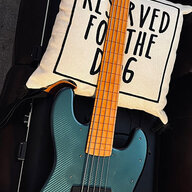
Nothing has changed except you now also have a truss rod that doesn't work. The question remains how much do you like it and want to be able to play it.
I don't feel like doing much with it until I can straighten the neck. Can a free-floating truss rod issue be fixed?
Make it fretless for $40?
Link Removed
lol, that's not a bad idea!


