
Enjoy the benefits of a premium membership!
Upgrade Account
-
TalkBass has been independent since 1998. Add your voice.
Create a free account to reply to discussions, view embedded media, and browse with fewer display ads.
Join free Log in
Want zero display ads or expanded classifieds tools? Compare plans.
You are using an out of date browser. It may not display this or other websites correctly.
You should upgrade or use an alternative browser.
You should upgrade or use an alternative browser.
When is a "modded" bass not original?
- Thread starter jeff_bass28
- Start date
More options
Who Replied?In terms of resale I would say that anything that can't be easily reversed (i.e. original parts included with sale, or some such) equals moded...
This reminds me of the Zen take on fire. A fire is constantly changing, it lives, it breathes, it consumes fuel, from one moment to the next it is never the same stuff. The fire, heat, chemical makeup and energy changes... but it's still the same fire, right? But then nobody's trying to sell a refinished '65 Fire with a Warmoth next and Fralin pickups on ebay...so.
This reminds me of the Zen take on fire. A fire is constantly changing, it lives, it breathes, it consumes fuel, from one moment to the next it is never the same stuff. The fire, heat, chemical makeup and energy changes... but it's still the same fire, right? But then nobody's trying to sell a refinished '65 Fire with a Warmoth next and Fralin pickups on ebay...so.
If it can't be returned to the original condition with the original parts, it is not original. Straplocks are indeed a modification. As a matter of fact their screws are normally bigger than the stock screws so they are, strictly speaking, an irreversible modification.
The OP is clearly not talking about "original" in the context of resale value. He's talking about identity. how much can you change a "bass X" before we no longer percieve it as a "bass X". The fact that a modded "bass X" has lower resale value has nothing to do with it, as long as it is still percieved as "bass X".
If you replace the body and pickup of an old P with some pointy black thing with soapbars, it's still a P 'cause you kept the original parts, so you can restore it anytime? Come on
If, on the other hand you drill a few holes for a thumb rest and rout out the control cavity under the pg for active electronics, then its no longer a "P"?
This is why I don't agree with the "as long as it's reversible" argument.
If you replace the body and pickup of an old P with some pointy black thing with soapbars, it's still a P 'cause you kept the original parts, so you can restore it anytime? Come on
If, on the other hand you drill a few holes for a thumb rest and rout out the control cavity under the pg for active electronics, then its no longer a "P"?
This is why I don't agree with the "as long as it's reversible" argument.
Well the resale value is just the easiest bit to answer. Simply refinishing an old piece can drastically reduce its value. Though high quality old bowed instruments (think Stradivarius) are routinely renecked without being greatly devalued. Which, while it may have an improved use value, in the case of guitars and such would generally not be accepted as being original. A '65 P bass with a new neck just ain't a '65 P-bass anymore. A '65 P-bass with a new neck and a new body is a different animal altogether. In a sense it comes down to a question of intrinsic value vs. use value. If you have good enough reason to replace the neck and the body on a bass it stands to reason that the use value will be increased (an instrument that needed such repairs would clearly have little use value), but the intrinsic value of what makes a '65 P-bass so valuable will be lost (and lets be honest, the value of classic instruments far exceeds their use value). The same can be said for upgrading tuners and electronics. If you primarily value your instrument as a tool then any changes that increase its use value are worth while. However as the OP asked, when does this affect "originality"? And the answer is that it does so quite rapidly. If the question were "when is it worth while" then an answer would have to take into account the alternative perspectives held by players as opposed to collectors. But purely in light of the notion of "originality" it's fairly simple. A '65 P-bass with a refin, Ultralite tuners and a Badass bridge is simply NOT original. It does not necessarily stand that it is somehow worse as a result, but a great many people would feel that the intrinsic value has been compromised, and that would be reflected in the market, which in a capitalist system is, in a sense, the ultimate acid test. Part of the cache of vintage instruments is a sense of nostalgia, and part of it is the notion of "the touch of the master's hand" (what Walter Benjamin has called "aura"), once you start fiddling with it these things become compromised.
More specifically, if you do replace the body and pickup on an old P, but maintain the old parts and can slap it back together, then yes its still a P (once it gets slapped back together) because it is easily reversible. In the mean time it's just a P waiting to be rejoined to the rest of itself. Obviously it's an issue of degrees, a couple of holes for a thumb rest isn't changing the essence of the bass, but adding actives might be.
"To me" a Frankenbass always has a a neck/body mismatch to start in addition to other swapped out parts. "To me" Modded means changing pups, tuners or anything else except the neck/body combo.
Well the resale value is just the easiest bit to answer.
Well, the price of low fat milk at my corner store is also an easy one to answer.
It also has exactly nothing to do with the question the OP was posting, just like resale value

More specifically, if you do replace the body and pickup on an old P, but maintain the old parts and can slap it back together, then yes its still a P (once it gets slapped back together) because it is easily reversible. In the mean time it's just a P waiting to be rejoined to the rest of itself. Obviously it's an issue of degrees, a couple of holes for a thumb rest isn't changing the essence of the bass, but adding actives might be.
But if you lose the parts, THEN it's no longer a "P"? even if you can buy new P-parts? So, once you put it back together it is a "P" that was something else for a while. But the P that you kept the parts for was always just a P.
When you see me playing my black pointy thing, knowing I have the original parts at home, you'll insist that I'm really playing a P.
Would you expect anyone else to actually agree with you?
Yeah I would expect people to agree. If you take apart a P-bass and attach the neck to a fence post, and the body to ceiling joist and then put it back together it's still a P-bass.... that's why I said "yes its still a P (once it gets slapped back together)" in my previous post
Yeah I would expect people to agree. If you take apart a P-bass and attach the neck to a fence post, and the body to ceiling joist and then put it back together it's still a P-bass.... that's why I said "yes its still a P (once it gets slapped back together)" in my previous post
I'm not talking about "when it's slapped back together". I'm (quite obviously at that) talking about what it is during the time it has a black pointy body and soapbars.
Well, my argument is that the market determines what is and what is not original which is why unadulterated vintage instruments fetch far more money then ones that people mess with; in this sense I think that there is a very significant connection between resale value and "identity". This is also why vintage parts fetch a mint on ebay, so that people can revert their instrument back to the valued state of "original." I think that this has a great deal to do with the OPs question, and the fact that several other respondents brought up resale before I did means I'm not alone.
In regards to the other issue, the "once it gets slapped back together" caveat clearly implies that, no when attached to the black pointy thing it's not a P-bass, but rather "a P waiting to be rejoined to the rest of itself" (sorry, though it was funny).
In regards to the other issue, the "once it gets slapped back together" caveat clearly implies that, no when attached to the black pointy thing it's not a P-bass, but rather "a P waiting to be rejoined to the rest of itself" (sorry, though it was funny).
Well, my argument is that the market determines what is and what is not original which is why unadulterated vintage instruments fetch far more money then ones that people mess with; in this sense I think that there is a very significant connection between resale value and "identity".
The OP still doesn't mention vintage instruments at all.
If I mod an SX, it's resale price will not be affected much, heck It might even go up if I use nice enough parts. Does that mean the SX jazz changes it's identity LESS when I put a black pointy body on it, then say a vintage Ibanez "lawsuit jazz" would? What about a new sadowsky? It would lose A LOT of it's resale value, even though it's not vintage.
More, if the SX's resale value doesn't change at all with the new body, does that mean that it's idententy has'nt changed at all. You'd have to claim that this is the case in order to maitain that there's a strong connection between changed resale value and a change in identity IN GENERAL.
A mint '65 P would lose a lot of resale value if I refinished it, changed in aftermarket P pickups and put on a badass bridge. Is it really less recognisable as a "P" after those changes? In other words is there any one who would recognise it as a P before the mods, but not afterwards?
A late '90s MIM would not have it's resale value affected nearly as much by aforementioned mods. Does that mean it's identity is not changed as much? Is the unmodded MIM less recognisible as a "P" than the unmodded '65?
This is also why vintage parts fetch a mint on ebay, so that people can revert their instrument back to the valued state of "original."
That is all about supply and demand, and the supposed superior sound of vintage basses of certain brands.
If pre-CBS Fenders where REALLY abundant and percieved as sounding worse than modern ones, they wouldn't be fetching any more than modern used ones. Thus, mods wouldn't change their resale value as much. Again, there isn't necceccarily a connection between change in price and changed identity.
I think that this has a great deal to do with the OPs question, and the fact that several other respondents brought up resale before I did means I'm not alone.
The fact that several people seemed to not have read the OP was one reason I felt the need to post in the first place.
<insert joke about the majority beeing right and Hitler beeing voted into power, here>
In regards to the other issue, the "once it gets slapped back together" caveat clearly implies that, no when attached to the black pointy thing it's not a P-bass, but rather "a P waiting to be rejoined to the rest of itself" (sorry, though it was funny).
Sorry, missed the joke. So I take it you actually agreed then, that it is not a P-bass while it has the pointy body and soapbars?

Well the neck, body and finish are original anyway.
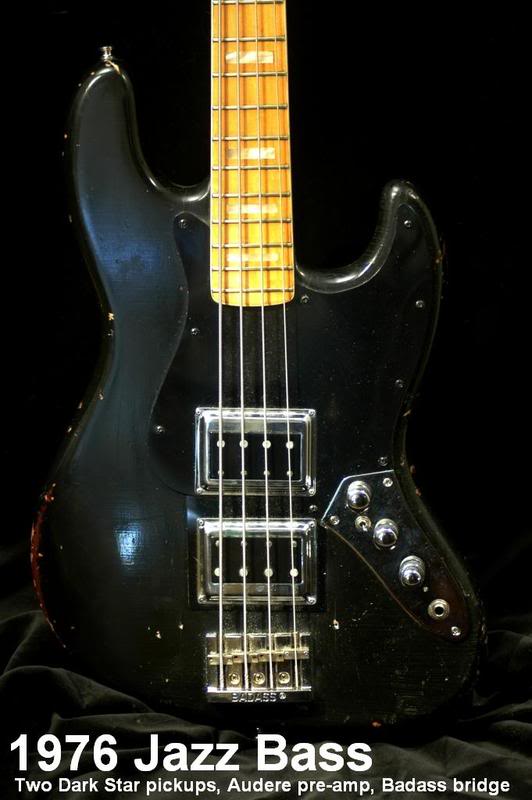
 ... Judgement call here but, I would call this one HIGHLY modded.
... Judgement call here but, I would call this one HIGHLY modded.
Beautiful!
But, is it still a jazz?
I'd say yes, but somewhat close call indeed.
Yeah it's still a jazz ...
 ... Just with a supercharger and NOS and racing slicks
I don't think it is a matter of loosing the original identity of the bass, it's more a matter of personalizing a bass. The idea is to make it yours and no one else's. As the photo exclaims in the above post 76 jazz bass with Darkstar pups etc. etc.
Put Bartolinis in Thumb and it is a Thumb with Bartolinis in it. People will still see it as a Thumb Bass, but it would take a closer look to realize that it isn't all that you think it is.
I guess if you do what Entwistle did with his "Fenderbirds", then you have an instrument with a completely different identity than what was originally intended. Same with putting a Jazz neck on a P-bass Body. Just my 2 drachma
Put Bartolinis in Thumb and it is a Thumb with Bartolinis in it. People will still see it as a Thumb Bass, but it would take a closer look to realize that it isn't all that you think it is.
I guess if you do what Entwistle did with his "Fenderbirds", then you have an instrument with a completely different identity than what was originally intended. Same with putting a Jazz neck on a P-bass Body. Just my 2 drachma
I agree, except for the P with J neck.
See, thats the essence of this thread. How far "can you"/"do you need to" go?
Where is the line?
Can we come up with a generally applicable algorithm for finding that line?
EDIT: And Thumbs did come with bartolinis from the factory in the 80's. You had the choice between barts and emgs. That makes the barts not impact identity as much, or...?
See, thats the essence of this thread. How far "can you"/"do you need to" go?
Where is the line?
Can we come up with a generally applicable algorithm for finding that line?
EDIT: And Thumbs did come with bartolinis from the factory in the 80's. You had the choice between barts and emgs. That makes the barts not impact identity as much, or...?
I agree, except for the P with J neck.
EDIT: And Thumbs did come with bartolinis from the factory in the 80's. You had the choice between barts and emgs. That makes the barts not impact identity as much, or...?
Okay I guess that was a little below the belt (P with J)
You learn something new everyday. (Wicks with Barts)
Along with building PA systems Alembic also modded Guild Starfire Basses for Jack Cassidy. I'm pretty sure they still called them Guild Starfires. The identity is still there.
If Mike Lull or Roger Sadowsky modifies the electronics in a Fender Jazz for a customer does that mean that bass is now a Lull or a Sadowsky?


