
Enjoy the benefits of a premium membership!
Upgrade Account
-
TalkBass has been independent since 1998. Add your voice.
Create a free account to reply to discussions, view embedded media, and browse with fewer display ads.
Join free Log in
Want zero display ads or expanded classifieds tools? Compare plans.
You are using an out of date browser. It may not display this or other websites correctly.
You should upgrade or use an alternative browser.
You should upgrade or use an alternative browser.
When is the Precision the wrong tool for the job?
- Thread starter Just Wrong
- Start date
More options
Who Replied?


Maybe, maybe not. Most orchestral musicians use only one instrument. Harpists don’t have twenty different harps, for example, and even jazz DB players usually only own a single DB. I sometimes think that we’re fooled by the fact that we can have many basses to think that we actually need to.We're artists - sonic artists to be more specific. If we were painters, I wonder if we'd be asking if a 3 inch wide straight brush is ever the wrong tool - Of course it is! Most painters use more than 1 brush - different tools for different jobs. Same with music.
IMHO, any bass will usually do the job just fine. Hence, a Precision is never the «wrong» choice for any particular style of music, any more than a Jazz, or a StingRay, or a Hofner is. We might find as players that a particular bass gives a different result that we like, but that is merely personal taste.
Personally, a P bass is always wrong simply because it seems I neither want nor ever need to play one.
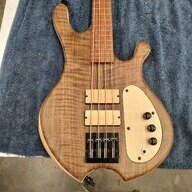
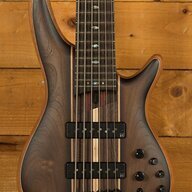
In more general terms, it isn't the best fit for prog genres. And I can't imagine using one in Jazz Fusion settings. Of course, one can maintain the low end well enough. But soloing?
Still, it can work in the sense that practically anything can be made to fit. But, then, what's the point if much more helpful axes are out there?
In more general terms, it isn't the best fit for prog genres. And I can't imagine using one in Jazz Fusion settings. Of course, one can maintain the low end well enough. But soloing?
Still, it can work in the sense that practically anything can be made to fit. But, then, what's the point if much more helpful axes are out there?
Last edited:

JeezyMcNuggles
Inactive
- Feb 23, 2018
- 14,723
- 20,970
- Disclosures
- I suck, but nobody really notices
When you need to sit around the musicIt's often said on bass forums that the Precision might not be the best tool for the job, but it's never the wrong one. Do you believe that to be the case? Can you think of an instance where the Precision is the wrong tool for the job?
It's often said on bass forums that the Precision might not be the best tool for the job, but it's never the wrong one. Do you believe that to be the case? Can you think of an instance where the Precision is the wrong tool for the job?
I’m not so sure this answers your question. I’ve got a lot of mileage out of my PBs over the years, but it is a fact that it isn’t the end all be all bass. It does however work in a lot of different applications.

I kind of buy into that, but I don’t buy into it completely because my P’s have J’s in the bridge position. They rarely get used, and lately not at all, but there are certain times where that mid scoop is what’s needed.
Is the standard Stratocaster the optimal guitar to use in every song or music genre?
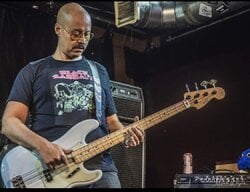
A P is great when you want the thick lower mid sledgehammer tone that comes with a neck pickup soloed. When you are playing tunes that want something less heavy - still with decent low end, but favoring the ear candy "clink and clank" up higher in the spectrum, a P is definitely the wrong tool for the job. For that you need the scoop that comes from spaced pickups that are both on - that setup removes a lot of what a P features, and that is sometimes just the ticket.
The gig I'm playing this coming weekend, the main tunes where the bass part is driving things....definitely are not P territory. Last weekend, I played a bass that isn't a P, but with the neck pickup soloed, it's in that territory, and it was the right tool. A P would have been fine, but that bass has a second pickup, and some special circuitry to combine them in a rather "unique" way - it has tonal options that a P simply doesn't. As I have a couple basses like that, I no longer have a "true" P in my arsenal - a bass that can cover that territory, but can go elsewhere as well is much more valuable that a straight P to me. I try to have as much sonic diversity as I can in a small number of basses (small by TB standards at least). A regular P doesn't help me with that.
We're artists - sonic artists to be more specific. If we were painters, I wonder if we'd be asking if a 3 inch wide straight brush is ever the wrong tool - Of course it is! Most painters use more than 1 brush - different tools for different jobs. Same with music.
you WISH the neck pickup solo’d sounds like a P. It doesn’t have the umph.
As to the clicky clacky stuff… lol keep it
Not a typical gig but I spent 13 years playing with Babatunde Olatunji and Drums of Passion - usually 10-12 piece or more with tons of African percussion and lots of low frequency competition with djun-djun, ashiko, talking drums, et al. P bass didn't work at all (tried with flats, rounds, different amps - the mids were just in the wrong place with everything else that was going on) but Jazz did very well, albeit with some tweaking. Bobby Vega had done the gig before and also used a Jazz...
Last edited:

Precision is the wrong choice 90% of the time, but the groupthink on talkbass is strong.
If you want to be sonically accurate - yeah.Playing Pearl Jam's Jeremy?
But in my band (90s Grunge Tribute), I often use a p-bass for that too. but with a flanger and stereo chorus to add the shimmer that the missing 8 strings can't provide.

Playing Pearl Jam's Jeremy?
I agree, but I do it anyway with a Pbass and Boss oC-5

For me a P-Bass just drowns in the music I play.
That is 1. modern metal with downtuned guitars - A P-Bass doesn't have the highs to compete and the guitars just take over.
2. Jazz Synth trio, where the P Bass gets drowned by synth basses or other synth patches.
That is 1. modern metal with downtuned guitars - A P-Bass doesn't have the highs to compete and the guitars just take over.
2. Jazz Synth trio, where the P Bass gets drowned by synth basses or other synth patches.



My opinion is that a good bass player can make any functional bass work in any situation. If it works, it’s not the wrong tool for the job. But you gotta make it work - it starts well before you pluck the first note. At minimum, you gotta have the right strings and setup, use the right settings and EQ, etc…
in the end, it’s all preference/opinion, and this also depends on how we conceptualize the P bass or even right vs. wrong in this context. For example, is it a P bass if it’s not a Fender? Is it a P bass if it has 24 frets? Is it a P bass if it has active electronics? Etc…
in the end, it’s all preference/opinion, and this also depends on how we conceptualize the P bass or even right vs. wrong in this context. For example, is it a P bass if it’s not a Fender? Is it a P bass if it has 24 frets? Is it a P bass if it has active electronics? Etc…


