• TalkBass has been independent since 1998. Add your voice.
    Create a free account to reply to discussions, view embedded media, and browse with fewer display ads.
    Join freeLog in
    Want zero display ads or expanded classifieds tools? Compare plans.

When it comes to the big B, how much of a difference does an inch make?

Realistically speaking, will going from a 31-inch sale to 32 or even 33 make much of a difference when it comes to the B string?

I know the question's been asked before, but:
  • It's been a while, and I thought maybe opinions have evolved since the advent of short scale 5-string basses from the likes of S. Martyn and Fodera
  • The threads have been in the "Basses" forum, and I feel like there's a lot of misconceptions or generalizations on there. Like, I know some people are adamant that the B string on a 35-inch scale bass has more definition than on a 34, but honestly, how many of us have actually had the chance to play the very same bass with both scale lengths to be able to determine with certainty that it's all in the scale length
 
  • Like
Reactions: Zooberwerx
IMHO longer scale can definitely be beneficial, but AFAIK an inch will not typically make a huge difference. Construction is also a pretty significant factor. Results can vary from bass to bass. So you may find a shorter bass with a better B than a longer bass.

To some extent the answer also depend on your definition of a better bass sound. AFAIK shorter tends to be more thuddy with quicker decay, which some players prefer.

Also short fat strings have more of a tendency toward inharmonicity as you play up the neck. Inharmonicity means the harmonics are out of tune with the fundamental.
 
  • Like
Reactions: Swamp_Ronin
I got curious, and thought I could help you out. But…, I measured the B string on my Warwick Streamer 5 and EBMM Stingray 5, and they're both 34 1/2". 🤦🏻‍♂️
I have Thomastik 5 string sets on both- the B string is fairly low tension and sounds MASSIVE on both. I don't know if it's the scale length or pickups, both or either, or what.
 
Realistically speaking, will going from a 31-inch sale to 32 or even 33 make much of a difference when it comes to the B string?

I know the question's been asked before, but:
  • It's been a while, and I thought maybe opinions have evolved since the advent of short scale 5-string basses from the likes of S. Martyn and Fodera
  • The threads have been in the "Basses" forum, and I feel like there's a lot of misconceptions or generalizations on there. Like, I know some people are adamant that the B string on a 35-inch scale bass has more definition than on a 34, but honestly, how many of us have actually had the chance to play the very same bass with both scale lengths to be able to determine with certainty that it's all in the scale length


Who knows?!? I'm of the impression...and experience...that a well-engineered bass properly strung & set-up can sound great irrespective of scale length. I have a couple of 32"s which feel great under my aging fretting hand. Disclaimer: years ago, Roger the drummer loved my Dingwall Combustion 5 as the "notes jumped off the fingerboard".

Do you have a particular instrument in mind?

Riis
 
  • Like
Reactions: TomB and crustychef
Who knows?!? I'm of the impression...and experience...that a well-engineered bass properly strung & set-up can sound great irrespective of scale length. I have a couple of 32"s which feel great under my aging fretting hand. Disclaimer: years ago, Roger the drummer loved my Dingwall Combustion 5 as the "notes jumped off the fingerboard".

Do you have a particular instrument in mind?

Riis
I'm talking to a luthier. Originally, I wanted between 30 and 31. He suggested I go for 31, saying a longer scale usually means a better B. I trust his expertise 100%, and it's not like we're comparing two basses from two different builders—he knows his basses.

I guess the point of this post is that I'm trying to convince myself to go to 32 or even 33.

I've played short scale basses exclusively for the past two years—a 30 and a 30.75. I don't have any ailments or anything; I just find them more comfortable.

Before that, I'd been playing 34 for 20 years without ever thinking they were uncomfortable. But since then, 32 and 34 have felt too long.

On the other hand, I have a friend who switches between 34 and 30 on gigs. He says it's just muscle memory. Which makes sense: when I switched from 19 mm to 16.5 mm string spacing, I couldn't play without fumbling. When I got my second short scale bass with a string spacing of 18 mm, I couldn't play that one without fumbling. Now I can switch between the two without a second thought.

I guess that's where I'm at. If I played 34 for 20 years, I can probably go back and learn to switch between the two effortlessly.
 
I believe a rigid, reinforced neck and proper string gauge have more to do with B-string clarity than scale length. That being said, I still prefer 35" with a lighter gauge (.120).
My Modulus with a .120 set in B is a ripper for sure.

I had it set up in G for awhile with a .168 and I don't think I could have used any lighter at that pitch. I've come to the conclusion… A is as low as I care to go.
 
I don't play short scale basses but I do have a. 34" Sandberg VM5 and a 35" USA Lakland 5514. Both have exceptional B strings but I do think the Lakland edges out the Sandberg, slightly. I was surprised that there wasn't more difference to be honest.

Ampmaster (correct spelling?) makes short scale basses and the samples I've heard of their 5 string models have excellent B strings.
 
  • Like
Reactions: basspraiser
I'm talking to a luthier. Originally, I wanted between 30 and 31. He suggested I go for 31, saying a longer scale usually means a better B. I trust his expertise 100%, and it's not like we're comparing two basses from two different builders—he knows his basses.

I guess the point of this post is that I'm trying to convince myself to go to 32 or even 33.

I've played short scale basses exclusively for the past two years—a 30 and a 30.75. I don't have any ailments or anything; I just find them more comfortable.

Before that, I'd been playing 34 for 20 years without ever thinking they were uncomfortable. But since then, 32 and 34 have felt too long.

On the other hand, I have a friend who switches between 34 and 30 on gigs. He says it's just muscle memory. Which makes sense: when I switched from 19 mm to 16.5 mm string spacing, I couldn't play without fumbling. When I got my second short scale bass with a string spacing of 18 mm, I couldn't play that one without fumbling. Now I can switch between the two without a second thought.

I guess that's where I'm at. If I played 34 for 20 years, I can probably go back and learn to switch between the two effortlessly.

I don't think a 30" vs a 31" will make a helluva lot of difference. I went with 32" so I can better implement 1-2-4 up thru the 7th fret. Also had a Kubicki Ex Factor back in the day and wanted a 5 string equivalent. If in your shoes and looking for a more immediate gratification, I'd be considering either a S. Martyn...shorter scales are his stock-in-trade and usually in inventory...or a Birdsong in that order of preference.

Riis
 
  • Like
Reactions: crustychef
Isn't it just simple math?

The shorter the scale, the thicker the string needs to be when tuned to the same pitch with the same tension.

You can put a low B on a 12" scale guitar, but the string will be an inch in diameter. (an exaggeration). At some point the strings become too thick to be useable.

I like my Dingwall becuase I can tune to much lower pitches without using .135, .140, .145 gauge strings, etc...

It depends on your tolerance for floppy strings.

Not a lot of difference between 30" and 31" -- don't bother.

A world of difference between 30" and 37"
 
Last edited:
I have primarily played 5 and 6 string basses for the last 17 years. From my experience scale length matters to a degree but as has been said already, overall construction and rigidity are what plays an even greater role. Strings definitely help a ton too.

I've had many 34" German Warwicks with excellent b strings. Aggressive and huge.

35" Lakland was awesome and clear.

35" Ibanez BTB single cut takes the cake for clarity and piano like tone.

I currently play primarily a 32" scale Benevolent 6 string single cut semi hollow body with MTD medium scale nickel strings on it and that B is as good as the Warwicks. Nice and clear and warm with some growl.

My second most played bass is my
RKM 33" scale Janek Gwizdala double reverse P bass. It has a carbon fiber reinforced neck for extra rigidity. I converted it from E-C to B-G. That B string is reminds me of in between the Lakland and Warwick Streamer. It is strung with La Bella IMA super polished strings. Honestly this bass is ridiculously versatile and awesome.

My 34" scale Warwick Thumb bolt on 6 string fretless has a clear growly B strung with Dunlop Nickel super brights.

Aaaaand I have 30.3" scale Ibanez Artcore Vintage 5 string strung with La Bella Super Polished (non IMAs). It is growly and thumpy and the B doesn't feel floppy. It does have and extended bridge so it can use standard length strings and I believe that helps with some extra tension. I tried some super heavy gauge strings with 145 B and it was way floppier and played like crap.

So I guess to sum up.
In my experience the common factors for a good b string have been
Rigidity from either
1. extra scale length
2. extra overall string termination length
3. beefier necks (ex. Warwicks)
4. single cut bodies
5 carbon rod reinforcing

Strings selection made a massive difference as well. Again looking for the perfect amount of stiffness, thickness and composition the compliments your bass's needs.
There's a lot of ingredients to make the B string recipe work.
 
  • Like
Reactions: Lackey
Yes I also agree that there would not be much difference between 30-31. However 30-32 is quite noticeable. Honestly I can't decide if I like 33 or 32 better.

Oh also forget to mention my Yamaha BBP35. It's B is my least favorite in my current collection. It's not terrible, just kind of bloomy and thick sounding. Which works for what I use the BB for. Motown, classic rock, classic r&b
 
I have a 36 inch scale 6-string bass. WOW that must be hard to play until I realize that it half an inch difference on the 24th fret and spread that across 24 frets

On a 35" scale bass, the distance between the nut and the 1st fret is 1.964" or ~49.9mm...

On a 36" scale bass, the distance between the nut and the 1st fret is 2.021" or ~51.3mm...

...for a total difference of 1.4mm -- which 0.055 inch which is thinner than the diameter of the thinnest D string and thinner than a standard La Bwlla standarg G string I think from 31 to 32 will be even smaller but the ipercentage increade from 30 to 31 or 32 is bigger than from 34 to 35 or 35 to 36
 
Realistically speaking, will going from a 31-inch sale to 32 or even 33 make much of a difference when it comes to the B string?

I know the question's been asked before, but:
  • It's been a while, and I thought maybe opinions have evolved since the advent of short scale 5-string basses from the likes of S. Martyn and Fodera
  • The threads have been in the "Basses" forum, and I feel like there's a lot of misconceptions or generalizations on there. Like, I know some people are adamant that the B string on a 35-inch scale bass has more definition than on a 34, but honestly, how many of us have actually had the chance to play the very same bass with both scale lengths to be able to determine with certainty that it's all in the scale length
Not much difference, with an inch stretched from the bridge to nut. Construction and setup matter a lot more. Ken Smith, Warwick, and EBMM have huge Bs, and are all 34".
 
Last edited:
I had also been playing 30" scale for a while, but I got the hankerin' for a B string. I had been playing 34/35" scale fives before, but just couldn'f find a five I really loved. I set up two 30" 4 strings BEAD, tried several string options, and was not just dissatisfied, I was pretty disgusted with the results. I had great success with tuning down to D G C F with some strings, but BEAD was horrific. The basses were a fender mustang pj, and an american pro classic. The pj did much better, but I couldn't live with the B.

I wouldn't have something built for me, because every instrument is an individual and it's inpossible to know what you'll get. Custom builds or online orders are about as nonsensical to me as a mail order bride. I do have a five I love now, but it took a few tries. Incidentally, it's 35", reinforced laminate, chunky and 9lbs. The B is deeply satisfying.
 
Don't think in terms of inches but in percentages.

One inch out of 34 is 2.9%. So that 35" scale is 2.9% longer. But it is 3.33% longer going from 30 to 31".

So whatever improvement there is in increasing scale length, it will show up more on a short scale than full scale bass.
 
  • Like
Reactions: crustychef
On a 34", I think the low B string sounds great when favouring the bridge pickup.

On a Warwick thumb 5, where both PUs are slanted backwards, the low B and E just sounds monstrous.

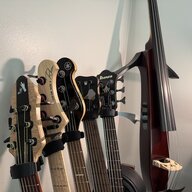
IMG_2791.jpeg
 
  • Like
Reactions: bass player 53
Scale length helps for sure but as others have said that's not the only factor. Setup, neck rigidity, strings and gauge all matter as well.

I've played 35 scale basses with mediocre B strings and 34 scale with excellent B strings.

But generally longer scale will improve clarity and tension.

I'm very happy with my Ernie Ball Music Man 5 strings. 34 is better for my hands.

The G string on 35 also doesn't sound great to me, it gets a little tinny. So I think 34 is a good balance.
 
  • Like
Reactions: bass player 53