• TalkBass has been independent since 1998. Add your voice.
    Create a free account to reply to discussions, view embedded media, and browse with fewer display ads.
    Join freeLog in
    Want zero display ads or expanded classifieds tools? Compare plans.

Double Bass Which wood goes where??

Can someone tell me what types of wood are generally used for what parts of a double bass? And what kinds of wood are useless for making a good double bass?

I am especially interested in what kind of wood is used for the fingerboard. And what kind of wood is used for the front back and sides of the bass. What characteristics does a piece of wood need to have to be a good candidate to build a bass from?

Another thing I'd like to know is how many pieces the front and back sides of a double bass are generally made from? Is it common to see basses that are cut from a single slab of wood? Or are they usually made from 2 or more pieces stuck together?

 
Your questions could be answered in a small book. To begin with, at least:
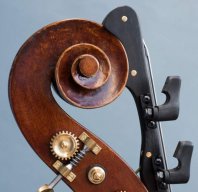
The fingerboard is most commonly ebony, but some are rosewood, or other similar tropical woods. Some cheaper ones are maple, usually painted black (ebonized, as they say). I set up my bass with a carbon reinforced hickory board, because I hate to buy tropical woods that are becoming endangered. It sounds fine. The idea is that the more rigidity there is in the neck, the less energy the neck will absorb from the string, and the more energy will be absorbed into the resonance box. Also, a dense hardwood wears down slower (string grooves and wear), and will resist warping more readily than softer wood.
The top plate is almost always spruce, though I've seen some great sounding basses made from other woods. Spruce has an extremely high mass/strength ratio.. meaning it's really light (resonant) and really strong (resists the force of the bridge pushing down upon it). The top plate is normally two pieces of book matched spruce, but some modern makers are using three, and sometimes the cheaper basses will actually be made of four, with small pieces on the extremities.
The back and ribs are typically maple. Maple offers a good balance between structural integrity and stability, with resonance and workability. Increasingly, there are basses being made from willow, as it is easier to work, and cheaper. These basses seem to sound fine, and relatively structurally sound, in my experience. I appreciate tradition, but love to see basses that are made of completely unexpected materials.. some sound surprisingly good.
The nut and saddle are normally ebony. The sound post and bracing are normally spruce. The tailpiece can vary tremendously. Some people favor heavy (ebony) and some light (boxwood..). I believe that the less weight you put down there the better.

Hope this is a good start. are you building a bass?
 
Thank you. This is very helpful.

I am seriously thinking about building a bass. I am trying to figure out how and where I can best find all the materials I need for a good price (cheapcheapcheap).

How about oak? Are there builders who use oak? Or is oak too heavy maybe?
 
Oak? I don't think it will be a good choice. At least I've never heard anything made of it. I have little experience with it. I don't think it will be available to you in affordable prices in the size pieces you'll want. Materials for a bass are very expensive, as are tools for making them properly. The only option I can think of, if you want cheap, is to make some sort of plywood bass (unconventionally shaped), or an electric upright, out of construction materials. What do you mean by cheap?
Have you ever built an instrument?
 
From a luthier's viewpoint there's another reason spruce and maple are so popular. They are both very nice to work with and carve. Other woods work but often have irritating dust, split when carved, are too hard or soft. You're in Europe where spruce and maple GROWS. Make life easy for yourself - go for a drive down into France or Germany and buy the wood from the suppliers!

I wish I could do that :-(
 
Take it from someone who is currently building his first string instrument. A double bass will require a substantial financial investment - several thousand dollars. The time involved will be substantial as well. I plan to become a builder, but figure I am about 5 years away from doing my first bass. Double bass wood is hard to come by, so it costs money. The last thing I want on my conscience is turning a set of beautiful tonewood into a crappy instrument.

That being said - everyone has to start somewhere. Good luck to you.
 
It's worth it to investigate good wood suppliers. Where in the Netherlands do you live? The cost of the wood itself doesn't have to be extreme, especialy if you are willing to try local wood types. IME the cost of all the stuf you need to turn that wood into an instrument will cost way more. You could try the "Amsterdamse Fijnhouthandel", they have been importing fine woods for centuries and have a beautiful collection. You could also ask some Dutch luthier's for advise. Ask Lucas Suringar in Almere, he builds URB's and should be able to help.

And, as Mathew pointed out: its also possible to take a drive to France, where the cost of wood sometimes can be a lot lower. Also there are supposed to be some Belgian traders that have stripped the Congo and supposedly sell at give away prices.
 
I am going to look into some suppliers around here and see what I can find. I'll look into the Belgian suppliers as well since I am pretty close to the Belgian border. I can drive to France as well. It's only a little over 2 hours away.

The reason I was asking about oak is that I can get some nice big pieces for free so I figured it might be good enough to experiment with?!
It might be too difficult to carve though because it's kinda hard. So if anyone has any experience with oak I'd love to hear it.

I appreciate the advice about trying to build some violins first but I don't want to do that because I have no interest in violins. I'm interested in double basses.
What I might do is get some poor quality wood to mess around with to get the basic technique down.
 
I've seen a few acoustic guitars with oak backs and sides but in almost 20 years of being in the musical instrument business, never seen an oak sound board on anything. I wouldn't imagine it having great acoustic properties as a sound board, but the bass could probably double as a liquor cabinet or nice armoire; you could probably stand on it too if you had to change a light bulb.
 
The last thing I want on my conscience is turning a set of beautiful tonewood into a crappy instrument.

But conversely, it would be an awful shame to spend hundreds of hours on a double bass and end up with an instrument that doesn't look or sound any good because crappy materials were used. I have never seen an oak instrument, although it wood probably work for back and sides. No, I wooden use oak :-P

To do it cheaply, buy some unfigured maple, or poplar, and some medium grade spruce. it may not look spectacular but it will sound just fine. And if you do your work well - well shaped, nice purfling, good carving etc it WILL look spectacular as well!

I appreciate the advice about trying to build some violins first but I don't want to do that because I have no interest in violins. I'm interested in double basses.

Attaboy! I'm with you. But don't buy rubbish wood. Wood cost is nothing compared with the cost of your time and tools. A flatback bass will use less wood, too.
 
  • Like
Reactions: james condino
Found some interesting stuff on oak if you really want to use it. I say go for it. From what I've found it has some very good tonewood properties. Bright trebles with somewhat thick or "thuddy" basses. sounds like it may work ok for a bass. I'd certainly check out an oak bass (use good soundboard material like spruce or a similar conifer though).

Cosmetically it's pretty nice. Who can forget the Taylor Pallet Guitar. You gotta love how he left the nails in it.
7a4cb404753710e39a18bbe08303a36e.jpg


Also,

from: The Heretic's Guide to Alternative Lutherie Woods

Oak. Oak is coarse and its large pores are hard to fill, but its availability in home improvement stores makes it widely available. Quartered oak is common at lumberyards. The only thing wrong with oak instruments is that they look so much like furniture. Quartered stock displays an irregular pattern of medullary rays that add interest to the ring lines, though filling the pores with dark material draws the eye away from the rays. Oak loves to bend and is seldom cantankerous in this regard. the hardness of the wood varies across the same board, so machine sanding alone will leave the surface wavy. The trick is to machine sand and then block sand with each grit. White oak seems to have a slightly finer texture than red oak, otherwise, I don't distinguish between the two. This wood is so far outside of musicians' expectations that oak instruments always take them by surprise, especially if they hear them before seeing them. In areas where oak is commonly burned for heat, it may be held in low regard for any other use. Be brave, though. Oak is fun to work with.

More eye-candy of oak instruments:
216777098.gif


OakNBS5.jpg


OakNBS2.jpg


This one's a Martin 000
ARTS2_body-back.jpg
 
Now I've never seen that before! That actually looks good. Are there any examples of oak as a neck, or maybe even fingerboard material?


And to the OP: I myself don't have any actual names or adresses in Belgium. As I understand there are some suppliers of exotic woods in Antwerpen. For materials like poplar, willow, ash or cherry there are probably lot's more options. The tricky bit wil probably be the material for the top. I think it will be the most difficult to find a good size and good quality piece of spruce or fichten.
 
In guitars or also in (Double) Basses? I might have seen it in a cheap acoustic guitar once. Do you know anything about it's properties?

This thread got me started again on building a EUB and it might be intersting to venture into the unorthodox woodtypes.
 
I am going to look into some suppliers around here and see what I can find. I'll look into the Belgian suppliers as well since I am pretty close to the Belgian border. I can drive to France as well. It's only a little over 2 hours away.

The reason I was asking about oak is that I can get some nice big pieces for free so I figured it might be good enough to experiment with?!
It might be too difficult to carve though because it's kinda hard. So if anyone has any experience with oak I'd love to hear it.

I appreciate the advice about trying to build some violins first but I don't want to do that because I have no interest in violins. I'm interested in double basses.
What I might do is get some poor quality wood to mess around with to get the basic technique down.

I love the look of red oak (plus you can very easily make it pitch black due to its high tanin content). But it is too heavy for me to use on a double bass. I made a few oak bows, because I like them very heavy.

I built my bass with far less than ideal materials, over the course of a few months. I already had plenty of tools, and my materials cost me a few hundred. That bass has been played on a regular basis for over a year, by me and others who borrow it for gigs.

George
 
I didn't know that. It's interesting because beech is the most common woodtype for furniture over here. A Beech EUB with a oak fingerboard seems like an interesting 'home grown' project. Would probably look a bit like my granma's furniture though.

I haven't tried it so this is pure speculation, but I would think that oak would be way too porous for a fingerboard. I don't find planing it very enjoyable either.

George